Protopopoff Natacha, Van Bortel Wim, Marcotty Tanguy, Van Herp Michel, Maes Peter, Baza Dismas, D'Alessandro Umberto, Coosemans Marc
Department of Parasitology, Prince Leopold Institute of Tropical Medicine, Nationalestraat 155, B-2000 Antwerp, Belgium.
Malar J. 2007 Dec 3;6:158. doi: 10.1186/1475-2875-6-158.
Prevention of malaria epidemics is a priority for African countries. The 2000 malaria epidemic in Burundi prompted the government to implement measures for preventing future outbreaks. Case management with artemisinin-based combination therapy and malaria surveillance were nationally improved. A vector control programme was initiated in one of the most affected highland provinces. The focal distribution of malaria vectors in the highlands was the starting point for designing a targeted vector control strategy. The objective of this study was to present the results of this strategy on malaria transmission in an African highland region.
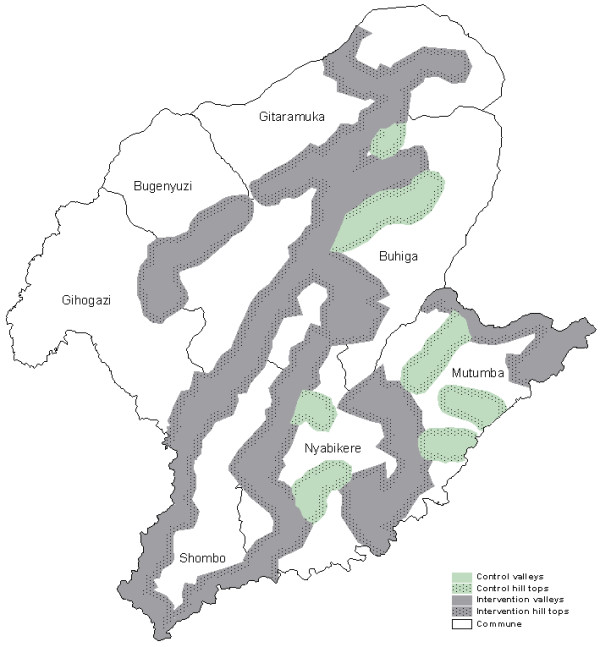
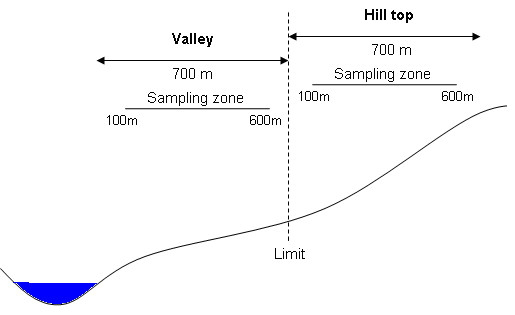
In Karuzi, in 2002-2005, vector control activities combining indoor residual spraying and long-lasting insecticidal nets were implemented. The interventions were done before the expected malaria transmission period and targeted the valleys between hills, with the expectation that this would also protect the populations living at higher altitudes. The impact on the Anopheles population and on malaria transmission was determined by nine cross-sectional surveys carried out at regular intervals throughout the study period.
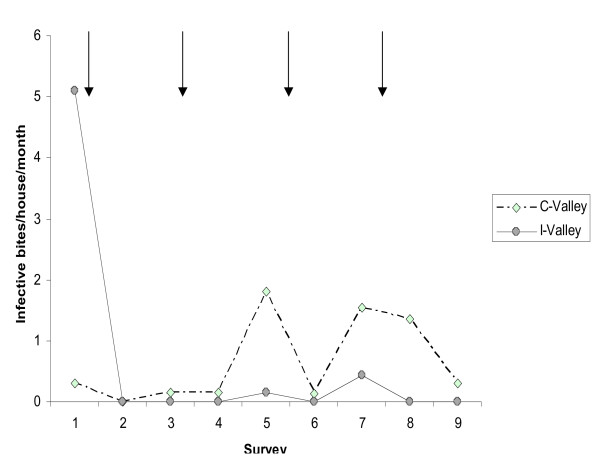
Anopheles gambiae s.l. and Anopheles funestus represented 95% of the collected anopheline species. In the valleys, where the vector control activities were implemented, Anopheles density was reduced by 82% (95% CI: 69-90). Similarly, transmission was decreased by 90% (95% CI: 63%-97%, p = 0.001). In the sprayed valleys, Anopheles density was further reduced by 79.5% (95% CI: 51.7-91.3, p < 0.001) in the houses with nets as compared to houses without them. No significant impact on vector density and malaria transmission was observed in the hill tops. However, the intervention focused on the high risk areas near the valley floor, where 93% of the vectors are found and 90% of the transmission occurs.
Spatial targeted vector control effectively reduced Anopheles density and transmission in this highland district. Bed nets have an additional effect on Anopheles density though this did not translate in an additional impact on transmission. Though no impact was observed in the hilltops, the programme successfully covered the areas most at risk. Such a targeted strategy could prevent the emergence and spread of an epidemic from these high risk foci.
预防疟疾流行是非洲国家的一项优先任务。2000年布隆迪的疟疾流行促使该国政府采取措施预防未来的疫情爆发。以青蒿素为基础的联合疗法的病例管理和疟疾监测在全国范围内得到了改善。在受灾最严重的一个高地省份启动了病媒控制项目。高地疟疾传播媒介的集中分布情况是设计有针对性的病媒控制策略的出发点。本研究的目的是介绍这一策略对非洲一个高地地区疟疾传播的影响结果。
2002年至2005年期间,在卡鲁齐实施了结合室内滞留喷洒和长效驱虫蚊帐的病媒控制活动。这些干预措施在预计的疟疾传播期之前进行,目标是针对山间谷地,期望这也能保护居住在较高海拔地区的人群。在整个研究期间定期进行的9次横断面调查确定了对按蚊种群和疟疾传播的影响。
冈比亚按蚊复合体和嗜人按蚊占所采集按蚊种类的95%。在实施病媒控制活动的谷地,按蚊密度降低了82%(95%置信区间:69%-90%)。同样,传播率下降了90%(95%置信区间:63%-97%,p = 0.001)。在喷洒过的谷地,有蚊帐的房屋中的按蚊密度比没有蚊帐的房屋进一步降低了79.5%(95%置信区间:51.7%-91.3%,p < 0.001)。在山顶未观察到对病媒密度和疟疾传播有显著影响。然而,干预措施集中在谷底附近的高风险地区,那里发现了93%的传播媒介,发生了90%的传播。
空间针对性的病媒控制有效地降低了该高地地区的按蚊密度和传播率。蚊帐对按蚊密度有额外影响,尽管这并未转化为对传播的额外影响。尽管在山顶未观察到影响,但该项目成功覆盖了风险最高的地区。这样一种有针对性的策略可以防止疫情从这些高风险疫源地出现和传播。