Winkelmayer Wolfgang C, Bucsics Anna E, Schautzer Alexandra, Wieninger Peter, Pogantsch Michaela
Division of Pharmacoepidemiology and Pharmacoeconomics, Department of Medicine, Brigham and Women's Hospital, Harvard Medical School, Boston, MA 02120, USA.
Eur J Epidemiol. 2008;23(2):153-62. doi: 10.1007/s10654-007-9212-4. Epub 2007 Dec 7.
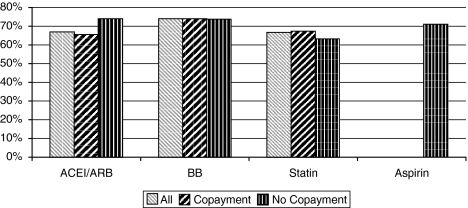
Guidelines recommend long-term use of beta-blockers (BB), statins, and angiotensin-converting-enzyme-inhibitors or angiotensin-receptor-blockers (ACEI/ARB) after myocardial infarction (MI), but data on their use after discharge are scarce. From Austrian sickness funds claims, we identified all acute MI patients who were discharged within 30 days and who survived >or=120 days after MI in 2004. We ascertained outpatient use of ACEI/ARBs, BBs, statins, and aspirin from all filled prescriptions between discharge and 120 days post MI. Comorbidities were ascertained from use of indicator drugs during the preceding year. Multivariate logistic regression was used to evaluate the independent determinants of study drug use. We evaluated 4,105 MI patients, whose mean age was 68.8 (+/-13.2) years; 59.5% were men. Within 120 days after MI, 67% filled prescriptions for ACE/ARBs, 74% for BBs, and 67% for statin. While 41% received all these classes and 34% two, 25% of patients received only one or none of these drugs. Older age and presence of severe mental illness were associated with lower use of all drug classes. Diabetics had greater ACEI/ARB use. Fewer BBs were used in patients with obstructive lung disease. Statin use was lower in patients using treatment for congestive heart failure (all P<0.001). We conclude that recommended medications were underused in Austrian MI survivors. Quality indicators should be established and interventions be implemented to ensure maximum secondary prevention after MI.
指南推荐心肌梗死(MI)后长期使用β受体阻滞剂(BB)、他汀类药物以及血管紧张素转换酶抑制剂或血管紧张素受体阻滞剂(ACEI/ARB),但关于出院后使用这些药物的数据却很匮乏。我们从奥地利疾病基金索赔数据中,识别出了2004年所有在30天内出院且心肌梗死后存活≥120天的急性心肌梗死患者。我们确定了出院至心肌梗死后120天内所有已配药处方中ACEI/ARB、BB、他汀类药物和阿司匹林的门诊使用情况。通过前一年指示性药物的使用情况确定合并症。采用多变量逻辑回归评估研究药物使用的独立决定因素。我们评估了4105例心肌梗死患者,他们的平均年龄为68.8(±13.2)岁;59.5%为男性。在心肌梗死后120天内,67%的患者配了ACE/ARB的处方,74%配了BB的处方,67%配了他汀类药物的处方。41%的患者使用了所有这些药物类别,34%的患者使用了两种,25%的患者仅使用了其中一种或未使用任何一种药物。年龄较大和患有严重精神疾病与所有药物类别的使用较少有关。糖尿病患者ACEI/ARB的使用较多。阻塞性肺病患者使用BB较少。充血性心力衰竭患者使用他汀类药物较少(所有P<0.001)。我们得出结论,在奥地利心肌梗死幸存者中,推荐药物的使用不足。应建立质量指标并实施干预措施,以确保心肌梗死后的最大程度二级预防。