Khelashvili George, Weinstein Harel, Harries Daniel
Department of Physiology and Biophysics, Weill Medical College of Cornell University, New York, New York, USA.
Biophys J. 2008 Apr 1;94(7):2580-97. doi: 10.1529/biophysj.107.120667. Epub 2007 Dec 7.
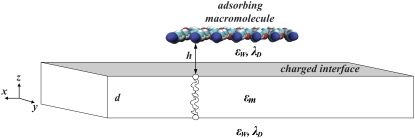
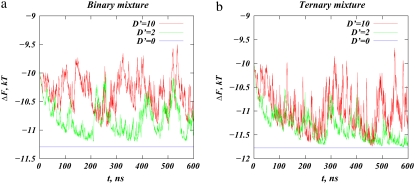
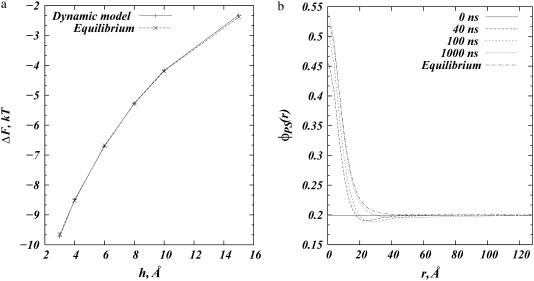
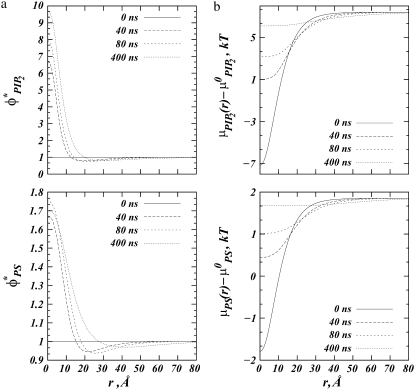
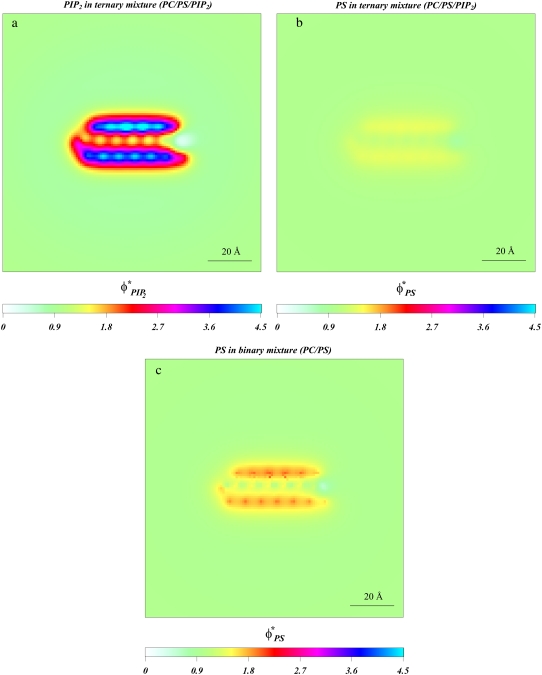
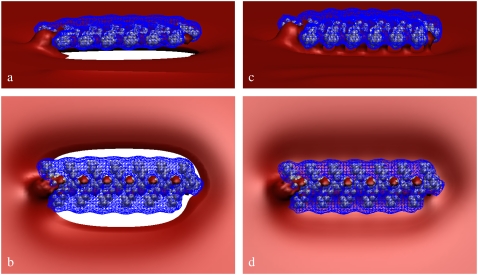
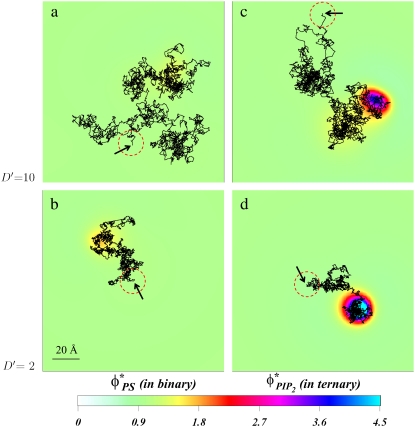
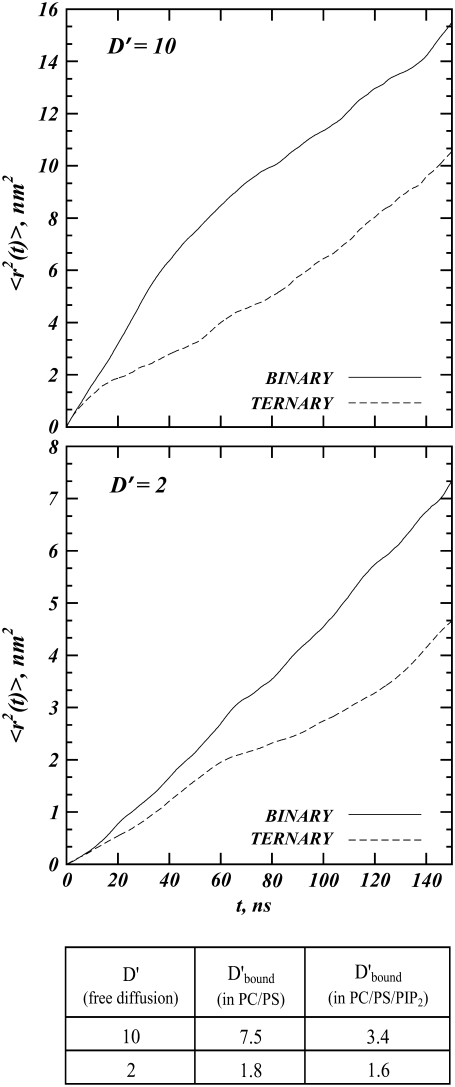
As charged macromolecules adsorb and diffuse on cell membranes in a large variety of cell signaling processes, they can attract or repel oppositely charged lipids. This results in lateral membrane rearrangement and affects the dynamics of protein function. To address such processes quantitatively we introduce a dynamic mean-field scheme that allows self-consistent calculations of the equilibrium state of membrane-protein complexes after such lateral reorganization of the membrane components, and serves to probe kinetic details of the process. Applicable to membranes with heterogeneous compositions containing several types of lipids, this comprehensive method accounts for mobile salt ions and charged macromolecules in three dimensions, as well as for lateral demixing of charged and net-neutral lipids in the membrane plane. In our model, the mobility of membrane components is governed by the diffusion-like Cahn-Hilliard equation, while the local electrochemical potential is based on nonlinear Poisson-Boltzmann theory. We illustrate the method by applying it to the adsorption of the anionic polypeptide poly-Lysine on negatively charged lipid membranes composed of binary mixtures of neutral and monovalent lipids, or onto ternary mixtures of neutral, monovalent, and multivalent lipids. Consistent with previous calculations and experiments, our results show that at steady-state multivalent lipids (such as PIP(2)), but not monovalent lipid (such as phosphatidylserine), will segregate near the adsorbing macromolecules. To address the corresponding diffusion of the adsorbing protein in the membrane plane, we couple lipid mobility with the propagation of the adsorbing protein through a dynamic Monte Carlo scheme. We find that due to their higher mobility dictated by the electrochemical potential, multivalent lipids such as PIP(2) more quickly segregate near oppositely charged proteins than do monovalent lipids, even though their diffusion constants may be similar. The segregation, in turn, slows protein diffusion, as lipids introduce an effective drag on the motion of the adsorbate. In contrast, monovalent lipids such as phosphatidylserine only weakly segregate, and the diffusions of protein and lipid remain largely uncorrelated.
在多种细胞信号传导过程中,带电大分子在细胞膜上吸附并扩散时,它们会吸引或排斥带相反电荷的脂质。这会导致细胞膜的横向重排,并影响蛋白质功能的动力学。为了定量研究此类过程,我们引入了一种动态平均场方案,该方案允许在膜成分进行这种横向重组后,对膜 - 蛋白复合物的平衡状态进行自洽计算,并用于探究该过程的动力学细节。这种综合方法适用于含有多种脂质的异质成分膜,它考虑了三维空间中的移动盐离子和带电大分子,以及膜平面中带电和净中性脂质的横向分相。在我们的模型中,膜成分的迁移率由类似扩散的Cahn - Hilliard方程控制,而局部电化学势基于非线性泊松 - 玻尔兹曼理论。我们通过将其应用于阴离子多肽聚赖氨酸在由中性和单价脂质二元混合物组成的带负电脂质膜上的吸附,或应用于中性、单价和多价脂质的三元混合物上,来说明该方法。与先前的计算和实验一致,我们的结果表明,在稳态下,多价脂质(如PIP(2))而非单价脂质(如磷脂酰丝氨酸)会在吸附的大分子附近发生分相。为了研究吸附蛋白在膜平面中的相应扩散,我们通过动态蒙特卡罗方案将脂质迁移率与吸附蛋白的扩散联系起来。我们发现由于多价脂质(如PIP(2))受电化学势影响具有更高的迁移率,即使它们的扩散常数可能相似,它们也比单价脂质更快地在带相反电荷的蛋白质附近发生分相。反过来,这种分相会减缓蛋白质的扩散,因为脂质对吸附物的运动产生了有效的阻力。相比之下,单价脂质(如磷脂酰丝氨酸)仅发生微弱的分相,蛋白质和脂质的扩散在很大程度上仍不相关。