Dhar Shilpa S, Ongwijitwat Sakkapol, Wong-Riley Margaret T T
Department of Cell Biology, Neurobiology, and Anatomy, Medical College of Wisconsin, Milwaukee, Wisconsin 53226.
Department of Cell Biology, Neurobiology, and Anatomy, Medical College of Wisconsin, Milwaukee, Wisconsin 53226.
J Biol Chem. 2008 Feb 8;283(6):3120-3129. doi: 10.1074/jbc.M707587200. Epub 2007 Dec 12.
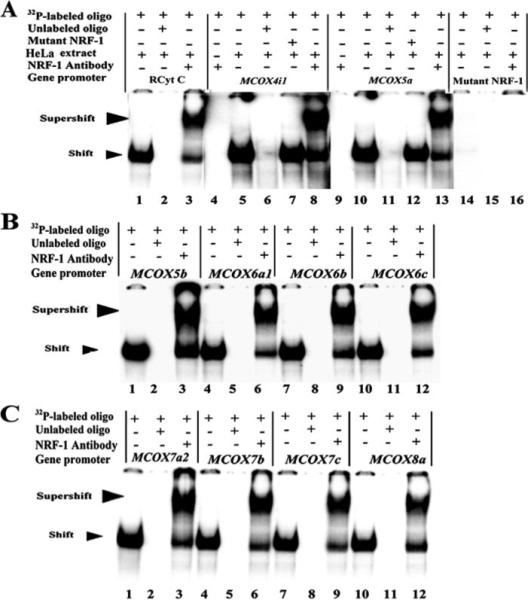
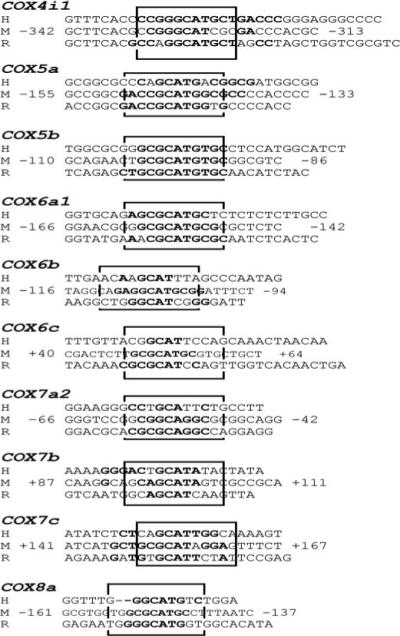
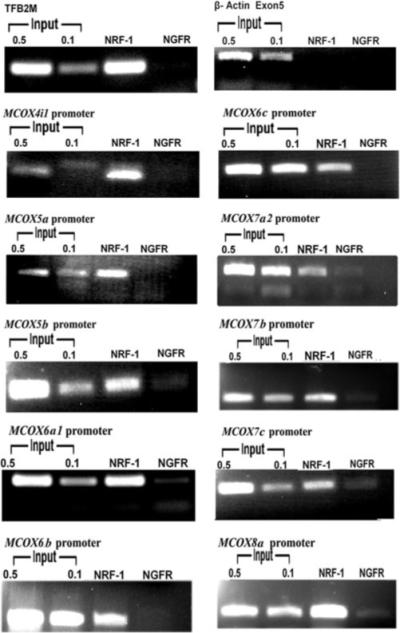
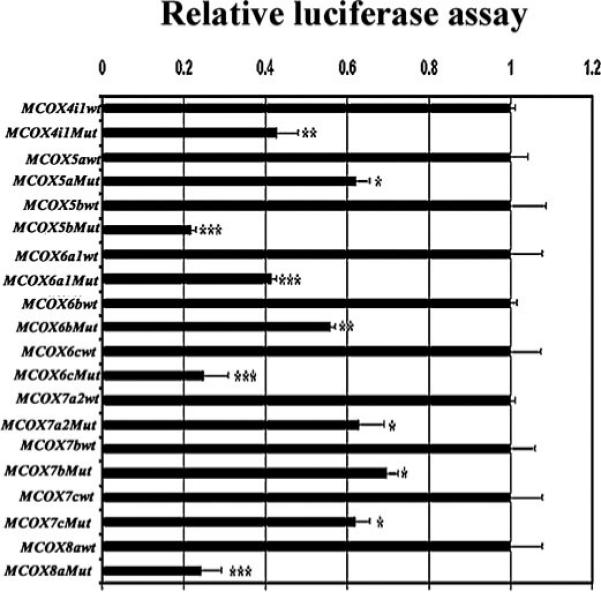
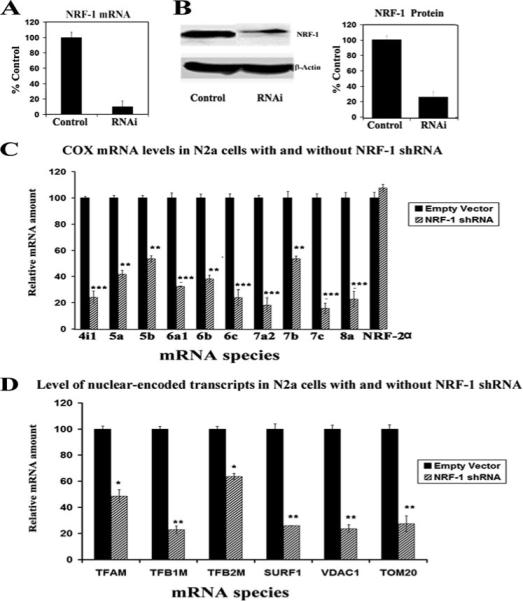
Cytochrome c oxidase (COX) is one of only four bigenomic proteins in mammalian cells, having ten subunits encoded in the nuclear genome and three in the mitochondrial DNA. The mechanism of its bigenomic control is not well understood. The ten nuclear subunits are on different chromosomes, and the possibility of their coordinate regulation by the same transcription factor(s) deserves serious consideration. The present study tested our hypothesis that nuclear respiratory factor 1 (NRF-1) serves such a role in subunit coordination. Following in silico analysis of murine nuclear-encoded COX subunit promoters, electrophoretic mobility shift and supershift assays indicated NRF-1 binding to all ten promoters. In vivo chromatin immunoprecipitation assays also showed NRF-1 binding to all ten promoters in murine neuroblastoma cells. Site-directed mutagenesis of putative NRF-1 binding sites confirmed the functionality of NRF-1 binding on all ten COX promoters. These sites are highly conserved among mice, rats, and humans. Silencing of NRF-1 with RNA interference reduced all ten COX subunit mRNAs and mRNAs of other genes involved in mitochondrial biogenesis. We conclude that NRF-1 plays a significant role in coordinating the transcriptional regulation of all ten nuclear-encoded COX subunits in neurons. Moreover, NRF-1 is known to activate mitochondrial transcription factors A and B, thereby indirectly regulating the expressions of the three mitochondrial-encoded COX subunits. Thus, NRF-1 and our previously described NRF-2 prove to be the two key bigenomic coordinators for transcriptional regulation of all cytochrome c oxidase subunits in neurons. Possible interactions between the NRFs will be investigated in the future.
细胞色素c氧化酶(COX)是哺乳动物细胞中仅有的四种双基因组蛋白之一,其十个亚基由核基因组编码,三个亚基由线粒体DNA编码。其双基因组控制机制尚不清楚。十个核亚基位于不同的染色体上,它们由相同转录因子进行协调调控的可能性值得认真考虑。本研究检验了我们的假设,即核呼吸因子1(NRF-1)在亚基协调中发挥这样的作用。在对小鼠核编码的COX亚基启动子进行电子计算机分析之后,电泳迁移率变动分析和超迁移分析表明NRF-1与所有十个启动子结合。体内染色质免疫沉淀分析也显示NRF-1与小鼠神经母细胞瘤细胞中的所有十个启动子结合。对假定的NRF-1结合位点进行定点诱变证实了NRF-1在所有十个COX启动子上结合的功能性。这些位点在小鼠、大鼠和人类中高度保守。用RNA干扰使NRF-1沉默会降低所有十个COX亚基的mRNA以及参与线粒体生物发生的其他基因的mRNA。我们得出结论,NRF-1在协调神经元中所有十个核编码的COX亚基的转录调控中发挥重要作用。此外,已知NRF-1可激活线粒体转录因子A和B,从而间接调节三个线粒体编码的COX亚基的表达。因此,NRF-1和我们之前描述的NRF-2被证明是神经元中所有细胞色素c氧化酶亚基转录调控的两个关键双基因组协调因子。未来将研究NRFs之间可能的相互作用。