Nguyen Huong Q, Ackermann Ronald T, Maciejewski Matthew, Berke Ethan, Patrick Marsha, Williams Barbara, LoGerfo James P
Department of Biobehavioral Nursing and Health Systems, School of Nursing, University of Washington, HSB T602A, Box 357266, Seattle, WA 98199, USA.
Prev Chronic Dis. 2008 Jan;5(1):A14. Epub 2007 Dec 15.
Our study was undertaken to determine the association between use of a health plan-sponsored health club benefit by older adults and total health care costs over 2 years.
This retrospective cohort study used administrative and claims data from a Medicare Advantage plan. Participants (n = 4766) were enrolled in the plan for at least 1 year before participating in the plan-sponsored health club benefit (Silver Sneakers). Controls (n = 9035) were matched to participants by age and sex according to the index date of Silver Sneakers enrollment. Multivariate regression models were used to estimate health care use and costs and to make subgroup comparisons according to frequency of health club visits.
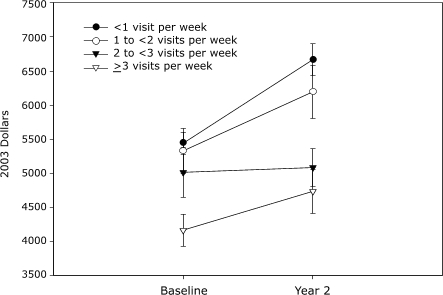
Compared with controls, Silver Sneakers participants were older and more likely to be male, used more preventive services, and had higher total health care costs at baseline. Adjusted total health care costs for Silver Sneakers participants and controls did not differ significantly in year 1. By year 2, compared with controls, Silver Sneakers participants had significantly fewer inpatient admissions (-2.3%, 95% confidence interval, -3.3% to -1.2%; P < .001) and lower total health care costs (-$500; 95% confidence interval, -$892 to -$106; P = .01]. Silver Sneakers participants who averaged at least two health club visits per week over 2 years incurred at least $1252 (95% confidence interval, -$1937 to -$567; P < .001) less in health care costs in year 2 than did those who visited on average less than once per week.
Regular use of a health club benefit was associated with slower growth in total health care costs in the long term but not in the short term. These findings warrant additional prospective investigations to determine whether policies to offer health club benefits and promote physical activity among older adults can reduce increases in health care costs.
我们开展这项研究是为了确定老年人使用健康计划赞助的健身俱乐部福利与两年内的总医疗费用之间的关联。
这项回顾性队列研究使用了来自医疗保险优势计划的行政和理赔数据。参与者(n = 4766)在参加该计划赞助的健身俱乐部福利(银色慢跑鞋计划)之前已加入该计划至少一年。对照组(n = 9035)根据银色慢跑鞋计划注册的索引日期,按年龄和性别与参与者进行匹配。使用多变量回归模型来估计医疗保健的使用情况和费用,并根据健身俱乐部访问频率进行亚组比较。
与对照组相比,银色慢跑鞋计划的参与者年龄更大,男性比例更高,使用了更多的预防服务,并且在基线时总医疗费用更高。在第1年,银色慢跑鞋计划参与者和对照组的调整后总医疗费用没有显著差异。到第2年,与对照组相比,银色慢跑鞋计划参与者的住院次数显著减少(-2.3%,95%置信区间,-3.3%至-1.2%;P <.001),总医疗费用更低(-500美元;95%置信区间,-892美元至-106美元;P =.01)。在两年内平均每周至少进行两次健身俱乐部访问的银色慢跑鞋计划参与者,与平均每周访问次数少于一次的参与者相比在第2年的医疗保健费用至少少1252美元(95%置信区间,-1937美元至-567美元;P <.001)。
长期定期使用健身俱乐部福利与总医疗费用增长放缓相关,但短期并非如此。这些发现值得进行更多前瞻性调查,以确定提供健身俱乐部福利和促进老年人身体活动的政策是否可以减少医疗保健费用的增加。