El-Saed Aiman, Sekikawa Akira, Zaky Riad Wahid, Kadowaki Takashi, Takamiya Tomoko, Okamura Tomonori, Edmundowicz Daniel, Kita Yoshikuni, Kuller Lewis H, Ueshima Hirotsugu
Department of Epidemiology, Graduate School of Public Health. University of Pittsburgh, Pittsburgh, PA 15213, USA.
J Epidemiol. 2007 Nov;17(6):179-85. doi: 10.2188/jea.17.179.
We have previously reported that the prevalence of coronary artery calcification (CAC) was substantially lower among Japanese than American men despite a less favorable profile of many traditional risk factors in Japanese men. To determine whether lipoprotein-associated phospholipase A2 (Lp-PLA2) levels are related to the difference in the prevalence of CAC between the two populations.
A total of 200 men aged 40-49 years were examined: 100 residents in Allegheny County, Pennsylvania, United States, and 100 residents in Kusatsu City, Shiga, Japan. Coronary calcium score (CCS) was evaluated by electron-beam tomography, Lp-PLA2 levels, nuclear magnetic resonance (NMR) lipoprotein subclasses, and other factors were assessed in 2001-2002.
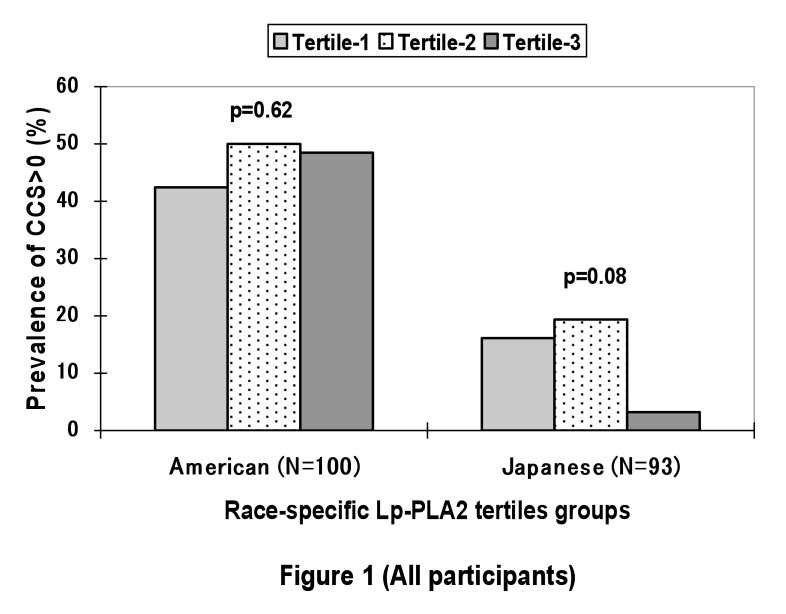
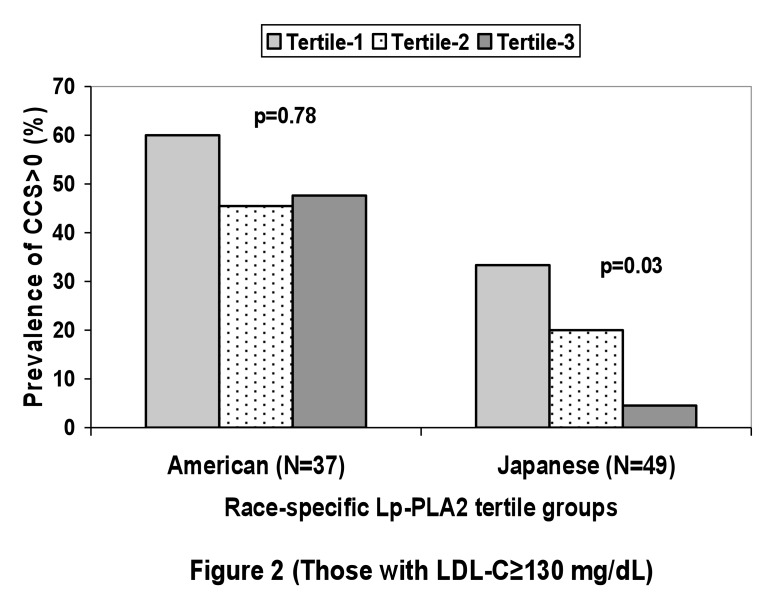
Lp-PLA2 levels were higher among American than Japanese men (Mean +/- standard deviation 301.7 +/- 82.6 versus 275.9 +/- 104.7 ng/mL, respectively, p=0.06). Among all Japanese men and those with low density lipoprotein (LDL) cholesterol > or =130 mg/dL, there was an inverse association of the prevalence of CCS>0 with the tertile groups of Lp-PLA2 levels (p=0.08 and p=0.03, respectively). American men did not have any association between CCS>0 with the tertile groups of Lp-PLA2 (p=0.62). Although Lp-PLA2 among both populations correlated positively with LDL and total cholesterol, American and Japanese men had different correlations with NMR lipoprotein subclasses. Reported high odds ratio for CCS>0 among American compared to Japanese men was not reduced after adjusting for Lp-PLA2 levels.
Lp-PLA2 may have different mechanisms of action among American and Japanese men. Lp-PLA2 levels can not explain the observed CAC differences between the two populations.
我们之前报道过,尽管日本男性的许多传统危险因素状况不如美国男性,但日本男性冠状动脉钙化(CAC)的患病率却显著低于美国男性。为了确定脂蛋白相关磷脂酶A2(Lp-PLA2)水平是否与这两个人群中CAC患病率的差异有关。
共检查了200名40 - 49岁的男性:100名是美国宾夕法尼亚州阿勒格尼县的居民,100名是日本滋贺县草津市的居民。在2001 - 2002年期间,通过电子束断层扫描评估冠状动脉钙化评分(CCS),并评估Lp-PLA2水平、核磁共振(NMR)脂蛋白亚类及其他因素。
美国男性的Lp-PLA2水平高于日本男性(分别为平均±标准差301.7±82.6与275.9±104.7 ng/mL,p = 0.06)。在所有日本男性以及低密度脂蛋白(LDL)胆固醇≥130 mg/dL的日本男性中,CCS>0的患病率与Lp-PLA2水平三分位数组呈负相关(分别为p = 0.08和p = 0.03)。美国男性中CCS>0与Lp-PLA2三分位数组之间无关联(p = 0.62)。尽管两个人群中的Lp-PLA2均与LDL和总胆固醇呈正相关,但美国和日本男性与NMR脂蛋白亚类的相关性不同。在调整Lp-PLA2水平后,美国男性与日本男性相比报道的CCS>0的高比值比并未降低。
Lp-PLA2在美国和日本男性中可能具有不同的作用机制。Lp-PLA2水平无法解释观察到的两个人群之间的CAC差异。