Worldwide Epidemiology, GlaxoSmithKline R&D, 1-3 Iron Bridge Road, Stockley Park, UB11 1BT, UK ; Memory Clinic, Department of Geriatrics, Basel University Hospital, Schanzenstrasse 55, 4031 Basel, Switzerland.
R&D China, GlaxoSmithKline, Addenbrooke's Centre for Clinical Investigation, Addenbrooke's Hospital, Hills Road, Cambridge, CB2 2GG, UK.
Alzheimers Res Ther. 2012 Dec 7;4(6):51. doi: 10.1186/alzrt154. eCollection 2012.
Lipoprotein-associated phospholipase A2 (Lp-PLA2) is a circulating enzyme with pro-inflammatory and oxidative activities associated with cardiovascular disease and ischemic stroke. While high plasma Lp-PLA2 activity was reported as a risk factor for dementia in the Rotterdam study, no association between Lp-PLA2 mass and dementia or Alzheimer's disease (AD) was detected in the Framingham study. The objectives of the current study were to explore the relationship of plasma Lp-PLA2 activity with cognitive diagnoses (AD, amnestic mild cognitive impairment (aMCI), and cognitively healthy subjects), cardiovascular markers, cerebrospinal fluid (CSF) markers of AD, and apolipoprotein E (APOE) genotype.
Subjects with mild AD (n = 78) and aMCI (n = 59) were recruited from the Memory Clinic, University Hospital, Basel, Switzerland; cognitively healthy subjects (n = 66) were recruited from the community. Subjects underwent standardised medical, neurological, neuropsychological, imaging, genetic, blood and CSF evaluation. Differences in Lp-PLA2 activity between the cognitive diagnosis groups were tested with ANOVA and in multiple linear regression models with adjustment for covariates. Associations between Lp-PLA2 and markers of cardiovascular disease and AD were explored with Spearman's correlation coefficients.
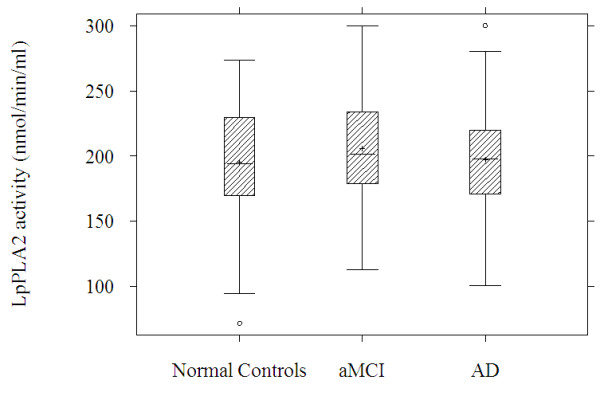
There was no significant difference in plasma Lp-PLA2 activity between AD (197.1 (standard deviation, SD 38.4) nmol/min/ml) and controls (195.4 (SD 41.9)). Gender, statin use and low-density lipoprotein cholesterol (LDL) were independently associated with Lp-PLA2 activity in multiple regression models. Lp-PLA2 activity was correlated with LDL and inversely correlated with high-density lipoprotein (HDL). AD subjects with APOE-ε4 had higher Lp-PLA2 activity (207.9 (SD 41.2)) than AD subjects lacking APOE-ε4 (181.6 (SD 26.0), P = 0.003) although this was attenuated by adjustment for LDL (P = 0.09). No strong correlations were detected for Lp-PLA2 activity and CSF markers of AD.
Plasma Lp-PLA2 was not associated with a diagnosis of AD or aMCI in this cross-sectional study. The main clinical correlates of Lp-PLA2 activity in AD, aMCI and cognitively healthy subjects were variables associated with lipid metabolism.
脂蛋白相关磷脂酶 A2(Lp-PLA2)是一种具有促炎和氧化作用的循环酶,与心血管疾病和缺血性中风有关。虽然在鹿特丹研究中,高血浆 Lp-PLA2 活性被报道为痴呆的危险因素,但在弗雷明汉研究中,未发现 Lp-PLA2 质量与痴呆或阿尔茨海默病(AD)之间存在关联。本研究的目的是探讨血浆 Lp-PLA2 活性与认知诊断(AD、遗忘型轻度认知障碍(aMCI)和认知健康受试者)、心血管标志物、AD 的脑脊液(CSF)标志物和载脂蛋白 E(APOE)基因型之间的关系。
从瑞士巴塞尔大学医院的记忆诊所招募轻度 AD(n=78)和 aMCI(n=59)患者;从社区招募认知健康受试者(n=66)。受试者接受了标准化的医学、神经学、神经心理学、影像学、遗传学、血液和 CSF 评估。使用方差分析和多元线性回归模型(调整协变量后)测试认知诊断组之间 Lp-PLA2 活性的差异。使用 Spearman 相关系数探讨 Lp-PLA2 与心血管疾病和 AD 标志物之间的关系。
AD(197.1(标准差,SD 38.4)nmol/min/ml)和对照组(195.4(SD 41.9))之间的血浆 Lp-PLA2 活性无显著差异。性别、他汀类药物使用和低密度脂蛋白胆固醇(LDL)是多元回归模型中 Lp-PLA2 活性的独立相关因素。Lp-PLA2 活性与 LDL 呈正相关,与高密度脂蛋白(HDL)呈负相关。载脂蛋白 E(APOE)-ε4 存在的 AD 患者的 Lp-PLA2 活性(207.9(SD 41.2))高于 APOE-ε4 缺乏的 AD 患者(181.6(SD 26.0),P=0.003),但调整 LDL 后则减弱(P=0.09)。Lp-PLA2 活性与 AD 的 CSF 标志物之间未检测到强相关性。
在这项横断面研究中,血浆 Lp-PLA2 与 AD 或 aMCI 的诊断无关。AD、aMCI 和认知健康受试者中 Lp-PLA2 活性的主要临床相关因素是与脂质代谢相关的变量。