Department of Health Science, International Buddhist University, 3-2-1 Gakuenmae, Habikino, Osaka, 583-8501, Japan.
Biopsychosoc Med. 2007 Dec 20;1:24. doi: 10.1186/1751-0759-1-24.
Premenstrual syndrome (PMS) encompasses a wide variety of cyclic and recurrent physical, emotional, and behavioral symptoms occurring during the late luteal phase of the menstrual cycle and abating shortly following the beginning of menses. Although PMS is widely recognized, its etiopathogenesis is not yet understood. The present study investigates whether the activity of the autonomic nervous system, which plays a vital role in orchestrating physiological homeostasis within the human body, is altered during the menstrual cycle of women with different degrees of premenstrual symptomatology.
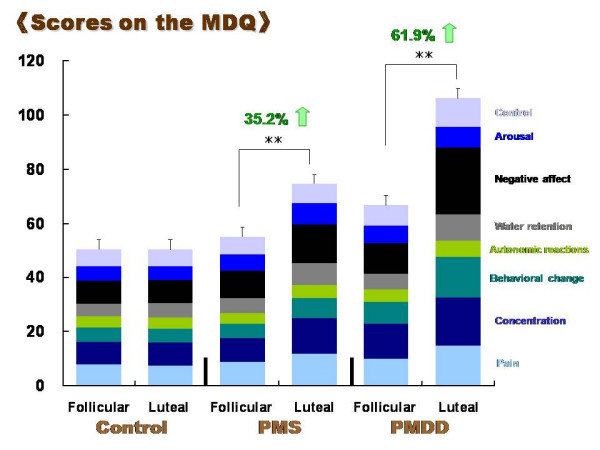
Sixty-two women in their 20s to 40s with regular menstrual cycles participated in this study. All subjects were examined during the follicular and late luteal phases. Cycle phase was determined by the onset of menstruation and oral temperature and was verified by concentrations of ovarian hormones, estrone, and pregnanediol in a urine sample taken early in the morning. Autonomic nervous system activity was assessed by means of heart-rate variability (HRV) power spectral analysis during supine rest. The Menstrual Distress Questionnaire was used to evaluate physical, emotional, and behavioral symptoms accompanying the menstrual cycle of the subjects. The subjects were categorized in three groups, Control, PMS, and premenstrual dysphoric disorder (PMDD) groups, depending on the severity of premenstrual symptomatology.
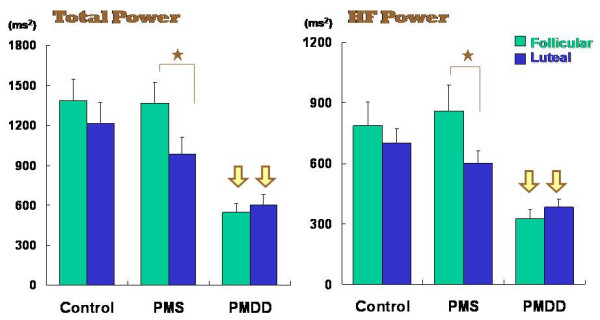
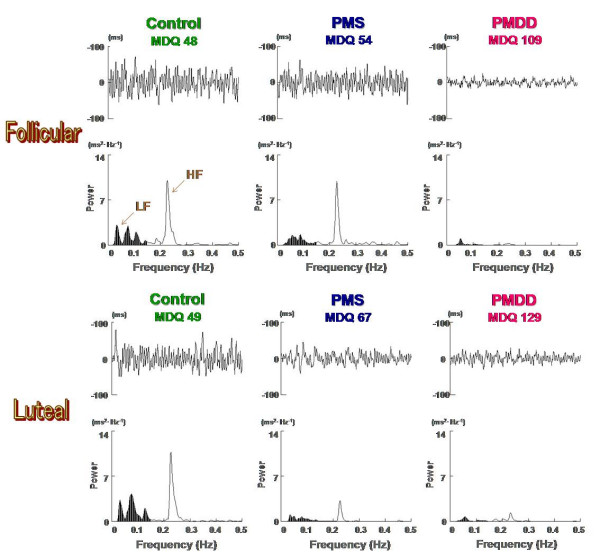
No intramenstrual cycle difference in any of the parameters of HRV was found in the Control group, which had no or a small increase in premenstrual symptoms. In contrast, Total power and high frequency power, which reflect overall autonomic and parasympathetic nerve activity, respectively, significantly decreased in the late luteal phase from the follicular phase in the PMS group. As for the PMDD group, which had more severe symptoms premenstrually, heart-rate fluctuation as well as all components of the power spectrum of HRV were markedly decreased regardless of the menstrual cycle compared to those of the other two groups.
Several theories have been proposed to explain the underlying mechanisms of PMS with its complex web of bio-psycho-social factors. Although causes and consequences continue to elude, the present study provides intriguing and novel findings that the altered functioning of the autonomic nervous system in the late luteal phase could be associated with diverse psychosomatic and behavioral symptoms appearing premenstrually. In addition, when symptoms become more severe (as seen in women with PMDD), the sympathovagal function might be more depressed regardless of the menstrual cycle.
经前期综合征(PMS)包含广泛的周期性和复发性身体、情绪和行为症状,这些症状发生在月经周期的黄体晚期,并在月经开始后不久消退。尽管 PMS 被广泛认可,但它的病因发病机制尚未被理解。本研究旨在调查在不同程度经前期症状的女性的月经周期中,自主神经系统的活动是否发生改变,自主神经系统在调节人体生理稳态方面起着至关重要的作用。
本研究纳入了 62 名 20 多岁至 40 多岁的月经周期规律的女性。所有受试者均在卵泡期和黄体晚期接受检查。周期阶段通过月经来潮和口腔温度来确定,并通过清晨采集的尿液样本中雌酮和孕烷二醇的浓度来验证。自主神经系统活动通过仰卧休息时的心率变异性(HRV)功率谱分析来评估。使用经前期困扰问卷评估受试者伴随月经周期的身体、情绪和行为症状。根据经前期症状的严重程度,将受试者分为对照组、PMS 组和经前期烦躁障碍(PMDD)组。
在对照组中,HRV 的任何参数在月经周期内均无变化,或者仅有轻度增加。相比之下,在 PMS 组中,总功率和高频功率分别反映整体自主神经和副交感神经活动,在黄体晚期与卵泡期相比显著下降。对于 PMDD 组,其经前期症状更严重,与其他两组相比,无论月经周期如何,心率波动以及 HRV 功率谱的所有成分均明显降低。
有几种理论被提出来解释 PMS 的潜在机制及其复杂的生物心理社会因素网络。尽管原因和后果仍不清楚,但本研究提供了有趣的新发现,即黄体晚期自主神经系统功能的改变可能与经前期出现的各种身心和行为症状有关。此外,当症状变得更严重时(如 PMDD 女性所见),无论月经周期如何,交感神经和副交感神经功能可能更为抑制。