Bonefeld-Jørgensen Eva C, Long Manhai, Hofmeister Marlene V, Vinggaard Anne Marie
Unit of Cellular and Molecular Toxicology, Institute of Public Health, Department of Environmental and Occupational Medicine, University of Aarhus, Aarhus, Denmark.
Environ Health Perspect. 2007 Dec;115 Suppl 1(Suppl 1):69-76. doi: 10.1289/ehp.9368.
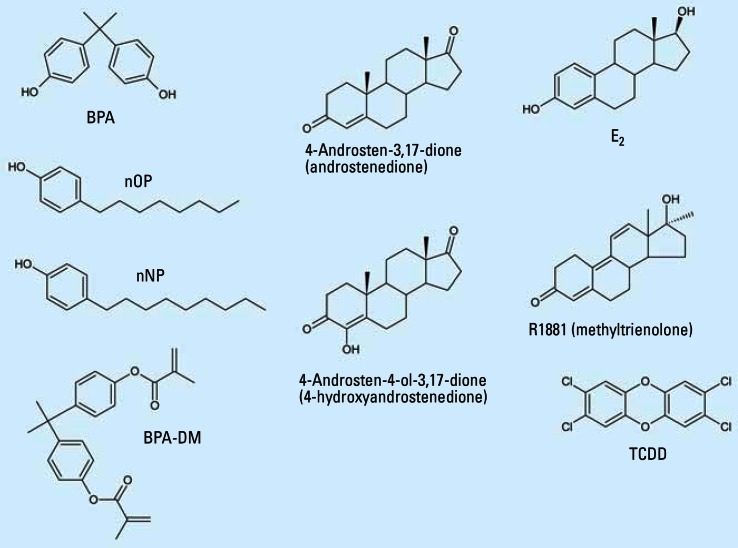
An array of environmental compounds is known to possess endocrine disruption (ED) potentials. Bisphenol A (BPA) and bisphenol A dimethacrylate (BPA-DM) are monomers used to a high extent in the plastic industry and as dental sealants. Alkylphenols such as 4-n-nonylphenol (nNP) and 4-n-octylphenol (nOP) are widely used as surfactants.
We investigated the effect in vitro of these four compounds on four key cell mechanisms including transactivation of a) the human estrogen receptor (ER), b) the human androgen receptor (AR), c) the aryl hydrocarbon receptor (AhR), and d) aromatase activity.
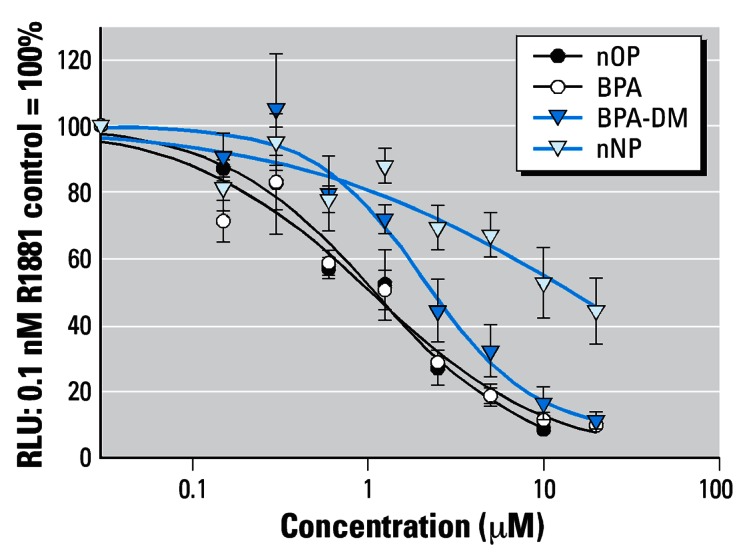
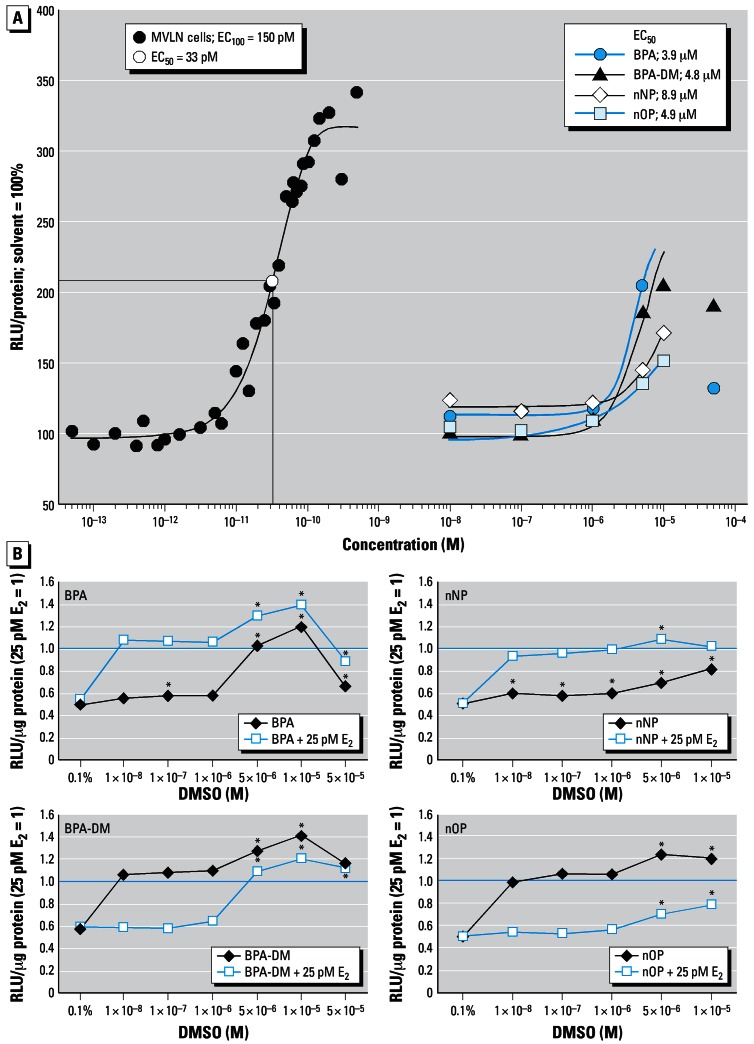
All four compounds inhibited aromatase activity and were agonists and antagonists of ER and AR, respectively. nNP increased AhR activity concentration-dependently and further increased the 2,3,7,8-tetrachlorodibenzo-p-dioxin AhR action. nOP caused dual responses with a weak increased and a decreased AhR activity at lower (10(-8) M) and higher concentrations (10(-5)-10(-4) M), respectively. AhR activity was inhibited with BPA (10(-5)-10(-4) M) and weakly increased with BPA-DM (10(-5) M), respectively. nNP showed the highest relative potency (REP) compared with the respective controls in the ER, AhR, and aromatase assays, whereas similar REP was observed for the four chemicals in the AR assay.
Our in vitro data clearly indicate that the four industrial compounds have ED potentials and that the effects can be mediated via several cellular pathways, including the two sex steroid hormone receptors (ER and AR), aromatase activity converting testosterone to estrogen, and AhR; AhR is involved in syntheses of steroids and metabolism of steroids and xenobiotic compounds.
已知一系列环境化合物具有内分泌干扰(ED)潜力。双酚A(BPA)和双酚A二甲基丙烯酸酯(BPA-DM)是在塑料工业中大量使用的单体,也用作牙科密封剂。烷基酚,如4-正壬基酚(nNP)和4-正辛基酚(nOP),被广泛用作表面活性剂。
我们研究了这四种化合物在体外对四种关键细胞机制的影响,包括a)人雌激素受体(ER)、b)人雄激素受体(AR)、c)芳烃受体(AhR)的反式激活,以及d)芳香化酶活性。
所有四种化合物均抑制芳香化酶活性,分别是ER和AR的激动剂和拮抗剂。nNP浓度依赖性地增加AhR活性,并进一步增强2,3,7,8-四氯二苯并对二恶英的AhR作用。nOP引起双重反应,在较低浓度(10⁻⁸ M)时AhR活性略有增加,在较高浓度(10⁻⁵ - 10⁻⁴ M)时则降低。BPA(10⁻⁵ - 10⁻⁴ M)抑制AhR活性,BPA-DM(10⁻⁵ M)则使其略有增加。在ER、AhR和芳香化酶测定中,与各自对照相比,nNP显示出最高的相对效力(REP),而在AR测定中,四种化学物质的REP相似。
我们的体外数据清楚地表明,这四种工业化合物具有ED潜力,其影响可通过多种细胞途径介导,包括两种性类固醇激素受体(ER和AR)、将睾酮转化为雌激素的芳香化酶活性以及AhR;AhR参与类固醇的合成以及类固醇和外源性化合物的代谢。