Taniguchi Akito, Hamasaki Koji
Graduate School of Biosphere Science, Hiroshima University, 1-4-4 Kagamiyama, Higashi-Hiroshima, Hiroshima, Japan.
Environ Microbiol. 2008 Apr;10(4):1007-17. doi: 10.1111/j.1462-2920.2007.01521.x. Epub 2007 Dec 19.
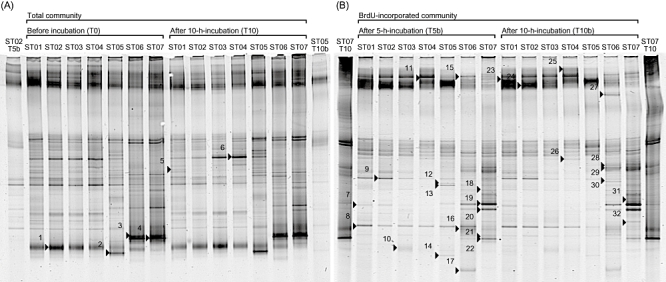
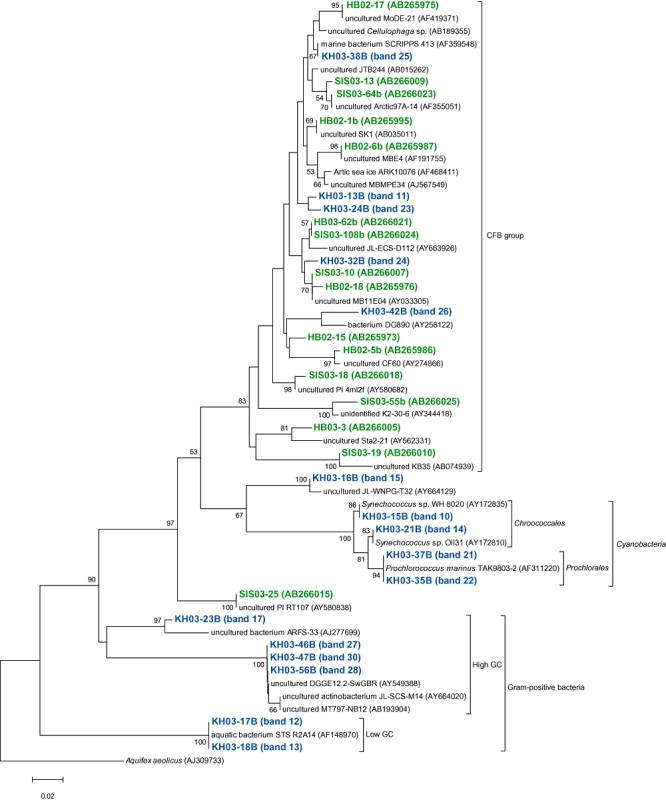
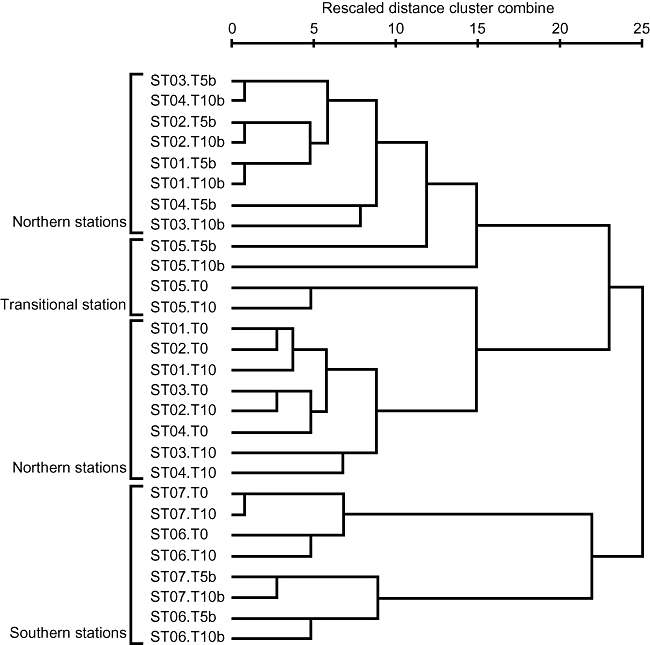
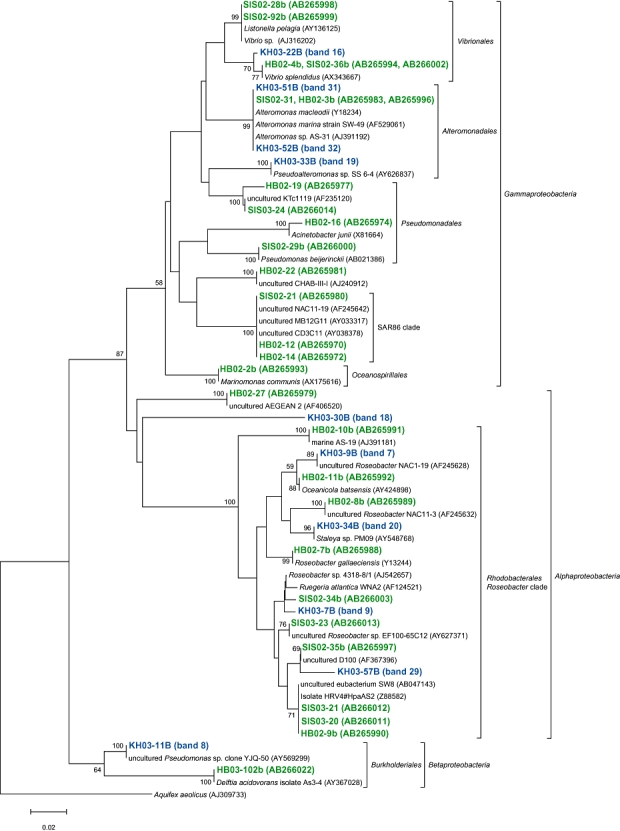
Bacterial community structures and their activities in the ocean are tightly coupled with organic matter fluxes and thus control ocean biogeochemical cycles. Bromodeoxyuridine (BrdU), halogenated nucleoside and thymidine analogue, has been recently used to monitor actively growing bacteria (AGB) in natural environments. We labelled DNA of proliferating cells in seawater bacterial assemblages with BrdU and determined community structures of the bacteria that were possible key species in mediating biochemical reactions in the ocean. Surface seawater samples were collected along a north-south transect in the North Pacific in October 2003 and subjected to BrdU magnetic beads immunocapture and PCR-DGGE (BUMP-DGGE) analysis. Change of BrdU-incorporated community structures reflected the change of water masses along a north-south transect from subarctic to subtropical gyres in the North Pacific. We identified 25 bands referred to AGB as BrdU-incorporated phylotypes, belonging to Alphaproteobacteria (5 bands), Betaproteobacteria (1 band), Gammaproteobacteria (4 bands), Cytophaga-Flavobacterium-Bacteroides (CFB) group bacteria (5 bands), Gram-positive bacteria (6 bands), and Cyanobacteria (4 bands). BrdU-incorporated phylotypes belonging to Vibrionales, Alteromonadales and Gram-positive bacteria appeared only at sampling stations in a subtropical gyre, while those belonging to Roseobacter-related bacteria and CFB group bacteria appeared at the stations in both subarctic and subtropical gyres. Our result revealed phylogenetic affiliation of AGB and their dynamic change along with north-south environmental gradients in open oceans. Different species of AGB utilize different amount and kinds of substrates, which can affect the change of organic matter fluxes along transect.
海洋中的细菌群落结构及其活动与有机物质通量紧密相关,从而控制着海洋生物地球化学循环。溴脱氧尿苷(BrdU),一种卤代核苷和胸腺嘧啶类似物,最近已被用于监测自然环境中活跃生长的细菌(AGB)。我们用BrdU标记了海水细菌群落中增殖细胞的DNA,并确定了可能是介导海洋生化反应的关键物种的细菌群落结构。2003年10月,沿着北太平洋的南北断面采集了表层海水样本,并进行了BrdU磁珠免疫捕获和PCR-DGGE(BUMP-DGGE)分析。掺入BrdU的群落结构变化反映了北太平洋从亚北极到亚热带环流的南北断面水团的变化。我们鉴定出25个被称为AGB的条带,作为掺入BrdU的系统发育型,属于α变形菌纲(5个条带)、β变形菌纲(1个条带)、γ变形菌纲(4个条带)、噬纤维菌-黄杆菌-拟杆菌(CFB)群细菌(5个条带)、革兰氏阳性菌(6个条带)和蓝细菌(4个条带)。属于弧菌目、交替单胞菌目和革兰氏阳性菌的掺入BrdU的系统发育型仅出现在亚热带环流的采样站,而属于玫瑰杆菌相关细菌和CFB群细菌的系统发育型则出现在亚北极和亚热带环流的采样站。我们的结果揭示了公海中AGB的系统发育归属及其随南北环境梯度的动态变化。不同种类的AGB利用不同数量和种类的底物,这可能会影响断面沿线有机物质通量的变化。