Kroth Peter G, Chiovitti Anthony, Gruber Ansgar, Martin-Jezequel Veronique, Mock Thomas, Parker Micaela Schnitzler, Stanley Michele S, Kaplan Aaron, Caron Lise, Weber Till, Maheswari Uma, Armbrust E Virginia, Bowler Chris
Fachbereich Biologie, University of Konstanz, Konstanz, Germany.
PLoS One. 2008 Jan 9;3(1):e1426. doi: 10.1371/journal.pone.0001426.
Diatoms are unicellular algae responsible for approximately 20% of global carbon fixation. Their evolution by secondary endocytobiosis resulted in a complex cellular structure and metabolism compared to algae with primary plastids.
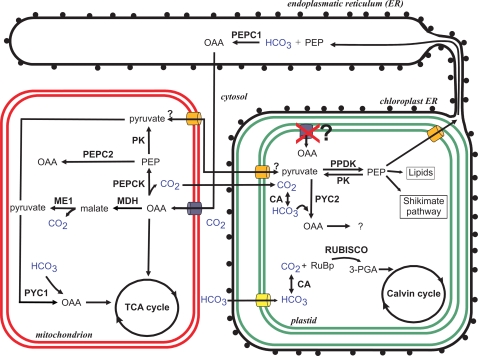
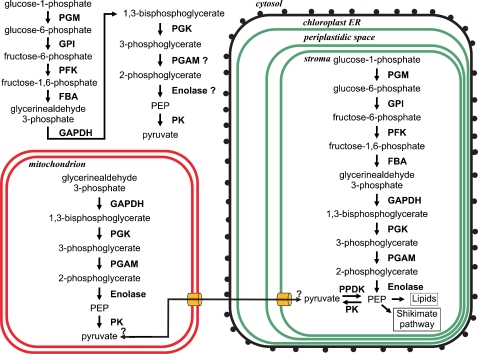
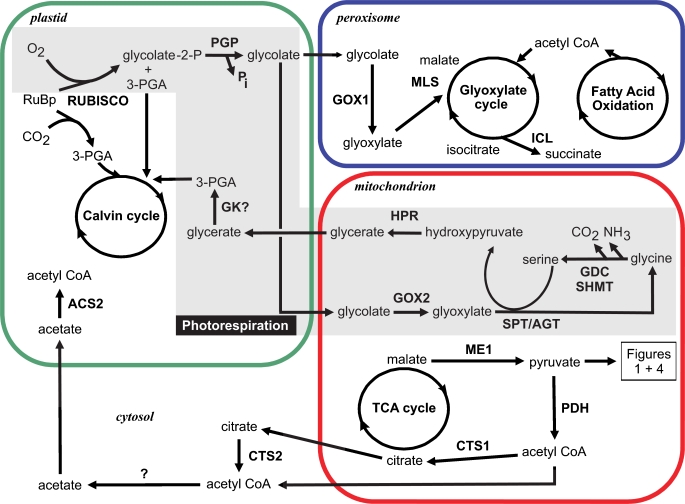
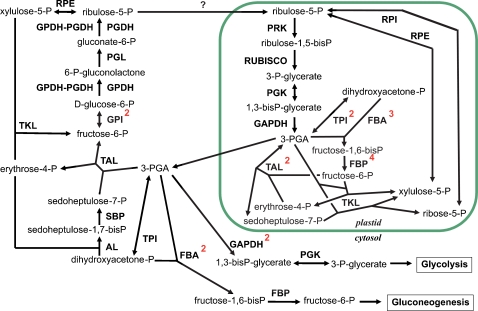
METHODOLOGY/PRINCIPAL FINDINGS: The whole genome sequence of the diatom Phaeodactylum tricornutum has recently been completed. We identified and annotated genes for enzymes involved in carbohydrate pathways based on extensive EST support and comparison to the whole genome sequence of a second diatom, Thalassiosira pseudonana. Protein localization to mitochondria was predicted based on identified similarities to mitochondrial localization motifs in other eukaryotes, whereas protein localization to plastids was based on the presence of signal peptide motifs in combination with plastid localization motifs previously shown to be required in diatoms. We identified genes potentially involved in a C4-like photosynthesis in P. tricornutum and, on the basis of sequence-based putative localization of relevant proteins, discuss possible differences in carbon concentrating mechanisms and CO(2) fixation between the two diatoms. We also identified genes encoding enzymes involved in photorespiration with one interesting exception: glycerate kinase was not found in either P. tricornutum or T. pseudonana. Various Calvin cycle enzymes were found in up to five different isoforms, distributed between plastids, mitochondria and the cytosol. Diatoms store energy either as lipids or as chrysolaminaran (a beta-1,3-glucan) outside of the plastids. We identified various beta-glucanases and large membrane-bound glucan synthases. Interestingly most of the glucanases appear to contain C-terminal anchor domains that may attach the enzymes to membranes.
CONCLUSIONS/SIGNIFICANCE: Here we present a detailed synthesis of carbohydrate metabolism in diatoms based on the genome sequences of Thalassiosira pseudonana and Phaeodactylum tricornutum. This model provides novel insights into acquisition of dissolved inorganic carbon and primary metabolic pathways of carbon in two different diatoms, which is of significance for an improved understanding of global carbon cycles.
硅藻是单细胞藻类,约占全球碳固定量的20%。与具有原始质体的藻类相比,它们通过二次内共生进化而来,具有复杂的细胞结构和代谢。
方法/主要发现:硅藻三角褐指藻的全基因组序列最近已完成。我们基于大量的EST支持,并与另一种硅藻——拟南芥的全基因组序列进行比较,鉴定并注释了参与碳水化合物途径的酶的基因。基于与其他真核生物中线粒体定位基序的已鉴定相似性,预测蛋白质定位于线粒体,而蛋白质定位于质体则基于信号肽基序的存在以及先前已证明硅藻中所需的质体定位基序。我们在三角褐指藻中鉴定了可能参与类C4光合作用的基因,并根据相关蛋白质基于序列的推定定位,讨论了两种硅藻在碳浓缩机制和CO₂固定方面可能存在的差异。我们还鉴定了编码参与光呼吸的酶的基因,但有一个有趣的例外:在三角褐指藻和拟南芥中均未发现甘油酸激酶。发现各种卡尔文循环酶多达五种不同的同工型,分布于质体、线粒体和细胞质中。硅藻在质体外以脂质或金藻昆布多糖(一种β-1,3-葡聚糖)的形式储存能量。我们鉴定了各种β-葡聚糖酶和大型膜结合葡聚糖合酶。有趣的是,大多数葡聚糖酶似乎都含有C末端锚定结构域,可能将酶附着于膜上。
结论/意义:在此,我们基于拟南芥和三角褐指藻的基因组序列,对硅藻中的碳水化合物代谢进行了详细的综合分析。该模型为两种不同硅藻中溶解无机碳的获取和碳的初级代谢途径提供了新的见解,这对于更好地理解全球碳循环具有重要意义。