Morin Nicole A, Oakes Patrick W, Hyun Young-Min, Lee Dooyoung, Chin Y Eugene, King Michael R, Springer Timothy A, Shimaoka Motomu, Tang Jay X, Reichner Jonathan S, Kim Minsoo
Department of Surgery, Rhode Island Hospital and Brown Medical School, Providence, RI 02903, USA.
J Exp Med. 2008 Jan 21;205(1):195-205. doi: 10.1084/jem.20071543. Epub 2008 Jan 14.
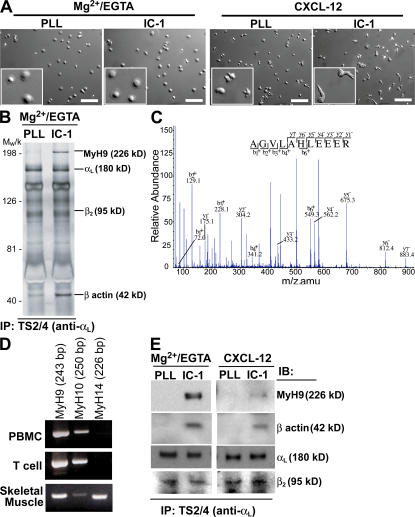
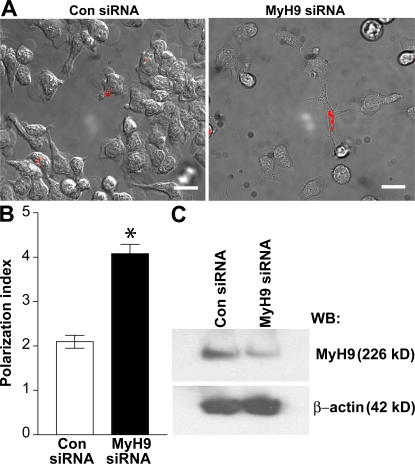
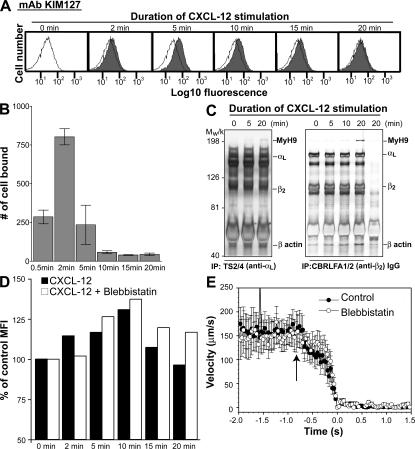
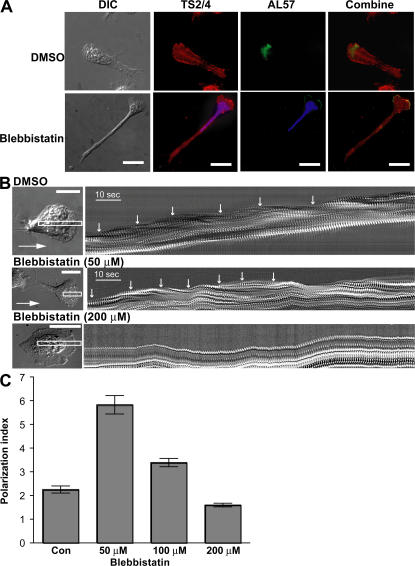
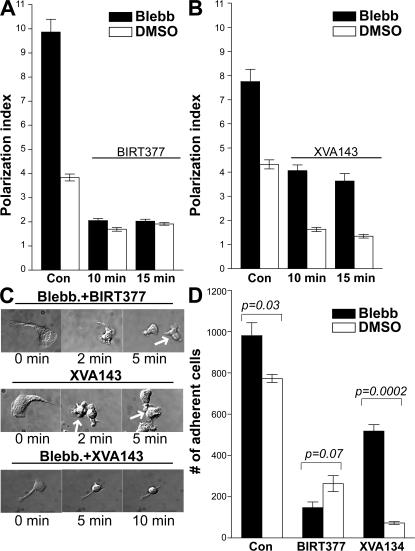
Precise spatial and temporal regulation of cell adhesion and de-adhesion is critical for dynamic lymphocyte migration. Although a great deal of information has been learned about integrin lymphocyte function-associated antigen (LFA)-1 adhesion, the mechanism that regulates efficient LFA-1 de-adhesion from intercellular adhesion molecule (ICAM)-1 during T lymphocyte migration is unknown. Here, we show that nonmuscle myosin heavy chain IIA (MyH9) is recruited to LFA-1 at the uropod of migrating T lymphocytes, and inhibition of the association of MyH9 with LFA-1 results in extreme uropod elongation, defective tail detachment, and decreased lymphocyte migration on ICAM-1, without affecting LFA-1 activation by chemokine CXCL-12. This defect was reversed by a small molecule antagonist that inhibits both LFA-1 affinity and avidity regulation, but not by an antagonist that inhibits only affinity regulation. Total internal reflection fluorescence microscopy of the contact zone between migrating T lymphocytes and ICAM-1 substrate revealed that inactive LFA-1 is selectively localized to the posterior of polarized T lymphocytes, whereas active LFA-1 is localized to their anterior. Thus, during T lymphocyte migration, uropodal adhesion depends on LFA-1 avidity, where MyH9 serves as a key mechanical link between LFA-1 and the cytoskeleton that is critical for LFA-1 de-adhesion.
细胞黏附与去黏附的精确时空调节对于淋巴细胞的动态迁移至关重要。尽管已经了解到许多关于整合素淋巴细胞功能相关抗原(LFA)-1黏附的信息,但在T淋巴细胞迁移过程中调节LFA-1从细胞间黏附分子(ICAM)-1高效去黏附的机制尚不清楚。在此,我们表明非肌肉肌球蛋白重链IIA(MyH9)在迁移的T淋巴细胞的尾足处被招募到LFA-1上,抑制MyH9与LFA-1的结合会导致尾足极度伸长、尾部脱离缺陷以及淋巴细胞在ICAM-1上的迁移减少,而不影响趋化因子CXCL-12对LFA-1的激活。这种缺陷可被一种抑制LFA-1亲和力和亲和力调节的小分子拮抗剂逆转,但不能被仅抑制亲和力调节的拮抗剂逆转。对迁移的T淋巴细胞与ICAM-1底物之间接触区的全内反射荧光显微镜观察显示,无活性的LFA-1选择性地定位于极化T淋巴细胞的后部,而活性LFA-1定位于其前部。因此,在T淋巴细胞迁移过程中,尾足黏附取决于LFA-1的亲和力,其中MyH9作为LFA-1与细胞骨架之间的关键机械连接,对LFA-1的去黏附至关重要。