Barrera David, Avila Euclides, Hernández Guillermo, Méndez Isabel, González Leticia, Halhali Ali, Larrea Fernando, Morales Angélica, Díaz Lorenza
Departamento de Biología de la Reproducción, Instituto Nacional de Ciencias Médicas y Nutrición Salvador Zubirán, Vasco de Quiroga No, 15, Tlalpan 14000, México, DF, México.
Reprod Biol Endocrinol. 2008 Jan 22;6:3. doi: 10.1186/1477-7827-6-3.
In pregnancy, maternal serum concentrations of calcitriol significantly rise as a result of increased renal and placental contribution in order to assure calcium supply for the developing fetus. Considering that placenta is a site for vitamin D activation, and the versatility and potency of calcitriol, it is feasible that this hormone participates in fetal/placental development and physiology. In the present work we studied calcitriol actions upon human chorionic gonadotropin (hCG) secretion and expression in cultured trophoblasts, as well as vitamin D receptor (VDR) and CYP27B1 immunolocalization in placental villi.
Quantification of hCG in culture media was performed by immunoassay. Expression studies were carried out by real time PCR. Analysis of CYP27B1 and VDR localization in placental slides were performed by immunohistochemistry. Statistical significance was established by one way ANOVA using Tukey test for comparisons.
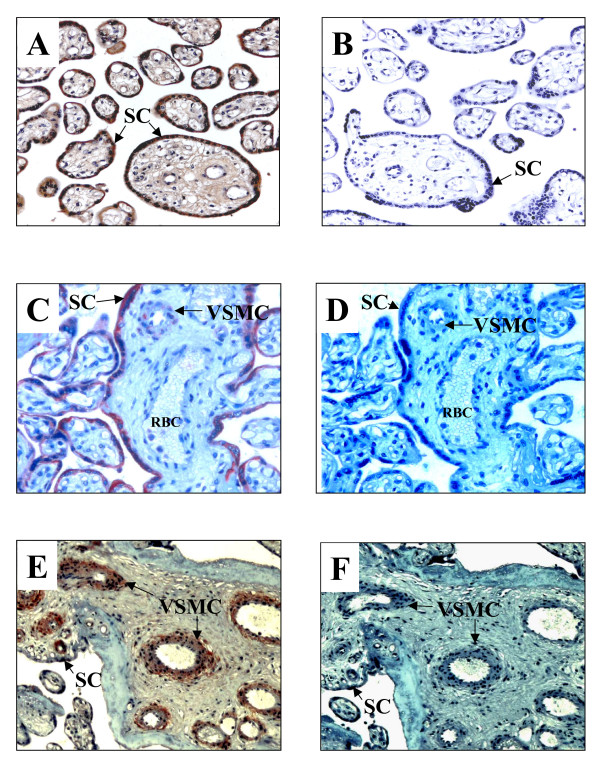
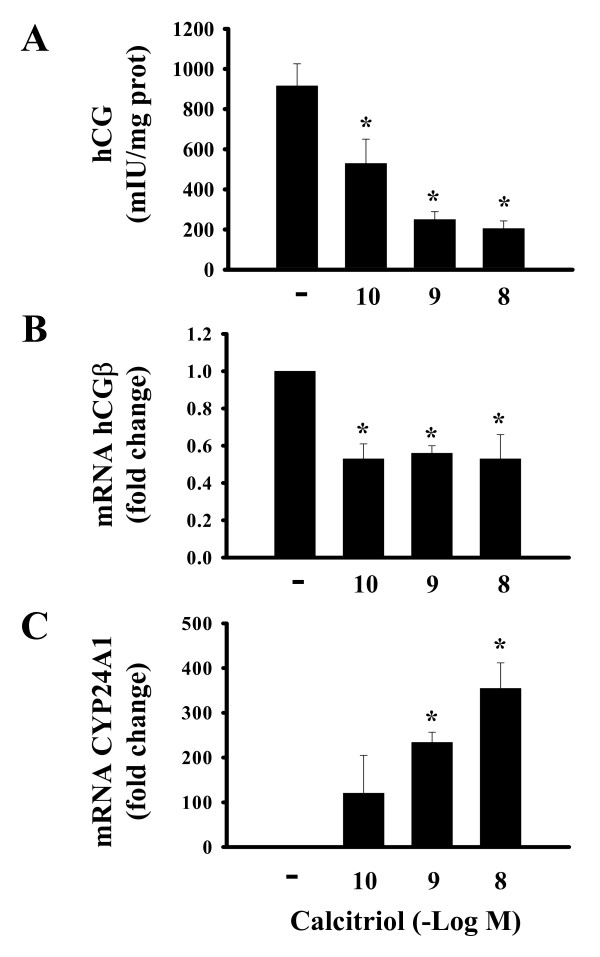
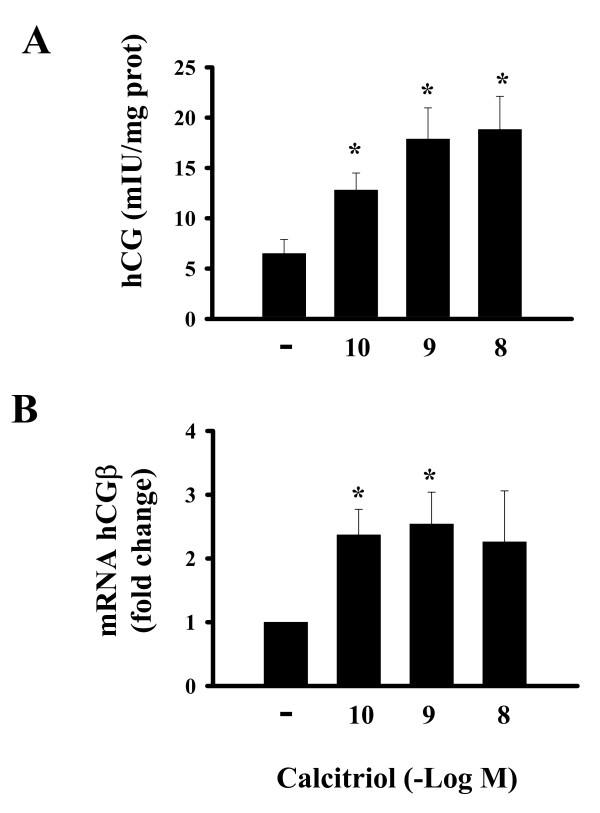
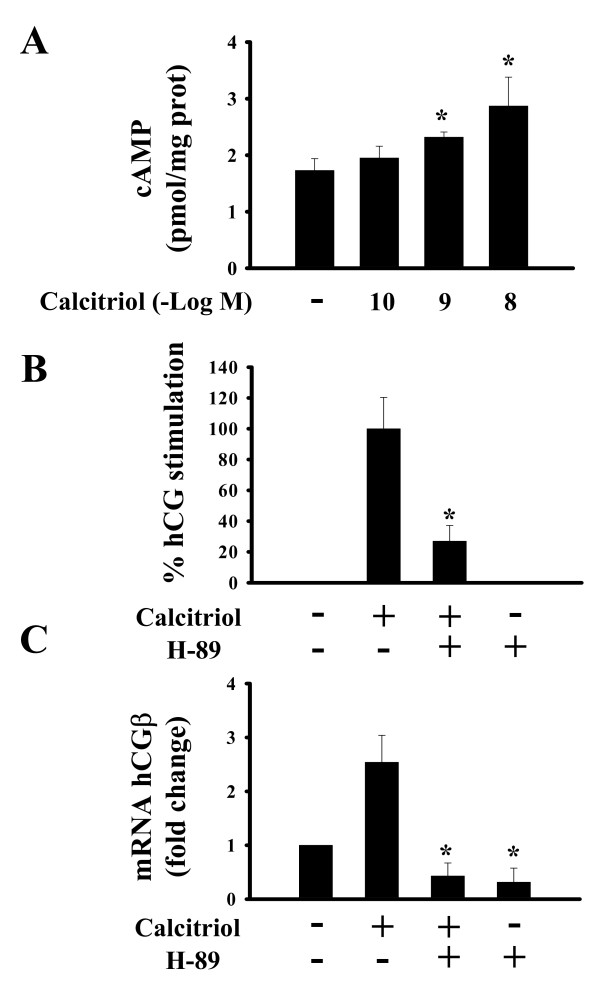
Calcitriol regulated hCG in a time-dependent manner: at 6 h the secosteroid stimulated hCG, whereas longer incubations (24 h) showed opposite effects. Interestingly, calcitriol stimulatory effects on hCG were accompanied by an increase in intracellular cAMP content and were abolished by pre-incubation of the cells with a selective protein kinase A inhibitor. Immunohistochemical techniques showed differential VDR localization in the syncytiotrophoblast layer or in the vascular smooth muscle cells depending on the epitope to which the antibodies were raised (specific for the carboxy- or amino-terminal regions, respectively). CYP27B1 was immunolocalized in the syncytiotrophoblast layer of placental villi.
The presence and location of the vitamin D activating enzyme CYP27B1 as well as the specific receptor for vitamin D were shown in placental sections. The latter, together with findings demonstrating specific effects of calcitriol acting through the VDR and the cAMP/PKA signaling pathway upon hCG expression and secretion, indicate that there is a functional vitamin D endocrine system in the placenta, and recognize calcitriol as an autocrine regulator of hCG.
在孕期,由于肾脏和胎盘的贡献增加,孕妇血清中骨化三醇的浓度显著升高,以确保为发育中的胎儿提供钙供应。鉴于胎盘是维生素D活化的场所,且骨化三醇具有多功能性和强效性,这种激素参与胎儿/胎盘发育及生理过程是可行的。在本研究中,我们研究了骨化三醇对培养的滋养层细胞中人绒毛膜促性腺激素(hCG)分泌和表达的作用,以及胎盘绒毛中维生素D受体(VDR)和CYP27B1的免疫定位。
通过免疫测定法对培养基中的hCG进行定量。通过实时PCR进行表达研究。通过免疫组织化学对胎盘切片中CYP27B1和VDR的定位进行分析。使用Tukey检验进行单因素方差分析以确定统计学意义。
骨化三醇以时间依赖性方式调节hCG:在6小时时,这种甾醇刺激hCG,而较长时间孵育(24小时)则显示出相反的效果。有趣的是,骨化三醇对hCG的刺激作用伴随着细胞内cAMP含量的增加,并且在用选择性蛋白激酶A抑制剂预孵育细胞后被消除。免疫组织化学技术显示,根据所产生抗体针对的表位(分别针对羧基末端或氨基末端区域),VDR在合体滋养层或血管平滑肌细胞中的定位存在差异。CYP27B1免疫定位在胎盘绒毛的合体滋养层。
在胎盘切片中显示了维生素D活化酶CYP27B1以及维生素D特异性受体的存在和定位。后者与证明骨化三醇通过VDR和cAMP/PKA信号通路对hCG表达和分泌具有特异性作用的研究结果一起,表明胎盘中存在功能性维生素D内分泌系统,并将骨化三醇识别为hCG的自分泌调节因子。