Lee Intaek, Doray Balraj, Govero Jennifer, Kornfeld Stuart
Department of Internal Medicine, Washington University School of Medicine, St. Louis, MO 63110, USA.
J Cell Biol. 2008 Feb 11;180(3):467-72. doi: 10.1083/jcb.200709037. Epub 2008 Feb 4.
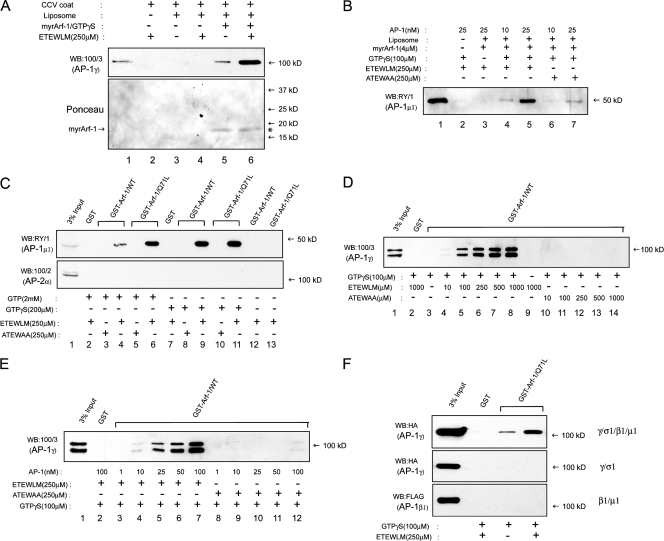
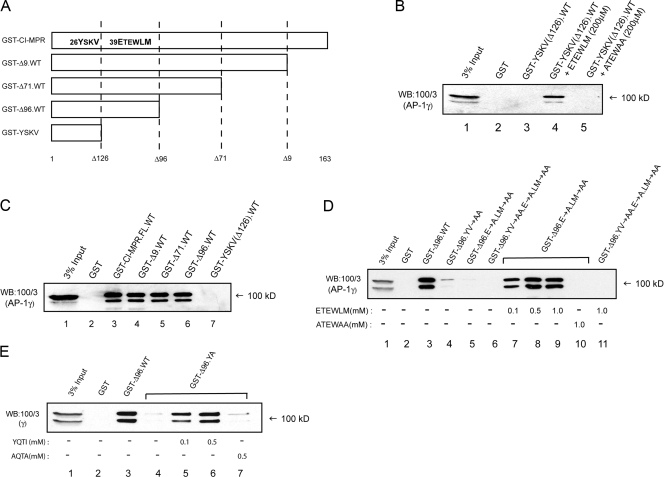
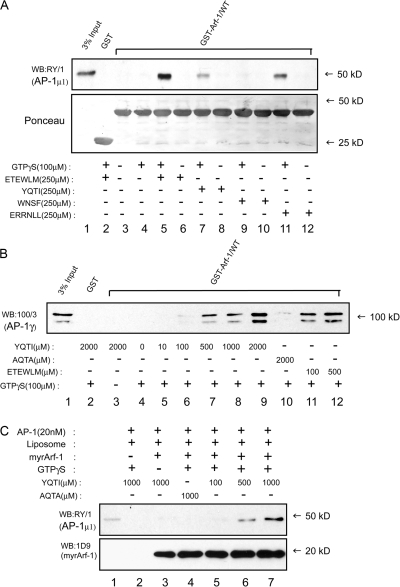
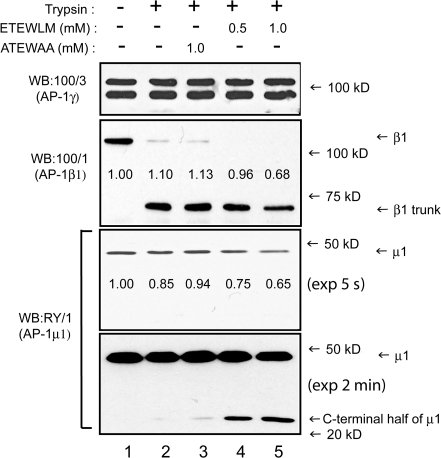
The adaptor protein AP-1 is the major coat protein involved in the formation of clathrin-coated vesicles at the trans-Golgi network. The prevailing view is that AP-1 recruitment involves coincident binding to multiple low-affinity sites comprising adenosine diphosphate ribosylation factor 1 (Arf-1)-guanosine triphosphate (GTP), cargo sorting signals, and phosphoinositides. We now show that binding of cargo signal peptides to AP-1 induces a conformational change in its core domain that greatly enhances its interaction with Arf-1-GTP. In addition, we provide evidence for cross talk between the dileucine and tyrosine binding sites within the AP-1 core domain such that binding of a cargo signal to one site facilitates binding to the other site. The stable association of AP-1 with Arf-1-GTP, which is induced by cargo signals, would serve to provide sufficient time for adaptor polymerization and clathrin recruitment while ensuring the packaging of cargo molecules into the forming transport vesicles.
衔接蛋白AP-1是参与反式高尔基体网络中网格蛋白包被囊泡形成的主要包被蛋白。目前流行的观点是,AP-1的募集涉及与多个低亲和力位点的同时结合,这些位点包括二磷酸腺苷核糖基化因子1(Arf-1)-三磷酸鸟苷(GTP)、货物分选信号和磷酸肌醇。我们现在表明,货物信号肽与AP-1的结合会诱导其核心结构域发生构象变化,从而大大增强其与Arf-1-GTP的相互作用。此外,我们提供了AP-1核心结构域内双亮氨酸和酪氨酸结合位点之间存在串扰的证据,使得货物信号与一个位点的结合促进了与另一个位点的结合。由货物信号诱导的AP-1与Arf-1-GTP的稳定结合,将为衔接蛋白聚合和网格蛋白募集提供足够的时间,同时确保货物分子被包装到形成中的运输囊泡中。