
我们对风险沟通了解多少?对严重但罕见风险的背景化进行简要回顾与建议,并以环氧化酶-2选择性和非选择性非甾体抗炎药为例
What do we know about communicating risk? A brief review and suggestion for contextualising serious, but rare, risk, and the example of cox-2 selective and non-selective NSAIDs.
作者信息
Moore R Andrew, Derry Sheena, McQuay Henry J, Paling John
机构信息
Pain Research and Nuffield Department of Anaesthetics, University of Oxford, Oxford Radcliffe NHS Trust, The Churchill, Headington, Oxford OX3 7LJ, UK.
出版信息
Arthritis Res Ther. 2008;10(1):R20. doi: 10.1186/ar2373. Epub 2008 Feb 7.
BACKGROUND
Communicating risk is difficult. Although different methods have been proposed - using numbers, words, pictures or combinations - none has been extensively tested. We used electronic and bibliographic searches to review evidence concerning risk perception and presentation. People tend to underestimate common risk and overestimate rare risk; they respond to risks primarily on the basis of emotion rather than facts, seem to be risk averse when faced with medical interventions, and want information on even the rarest of adverse events.
METHODS
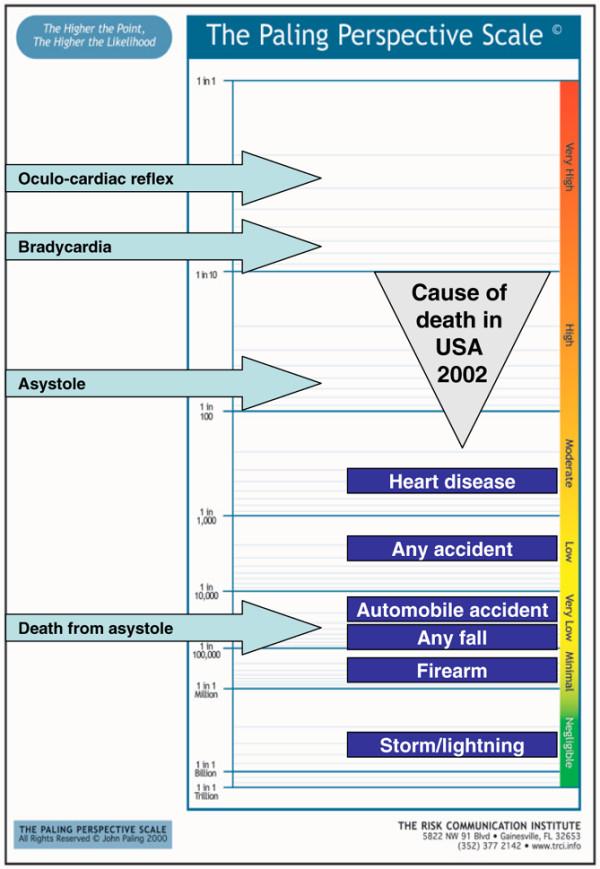
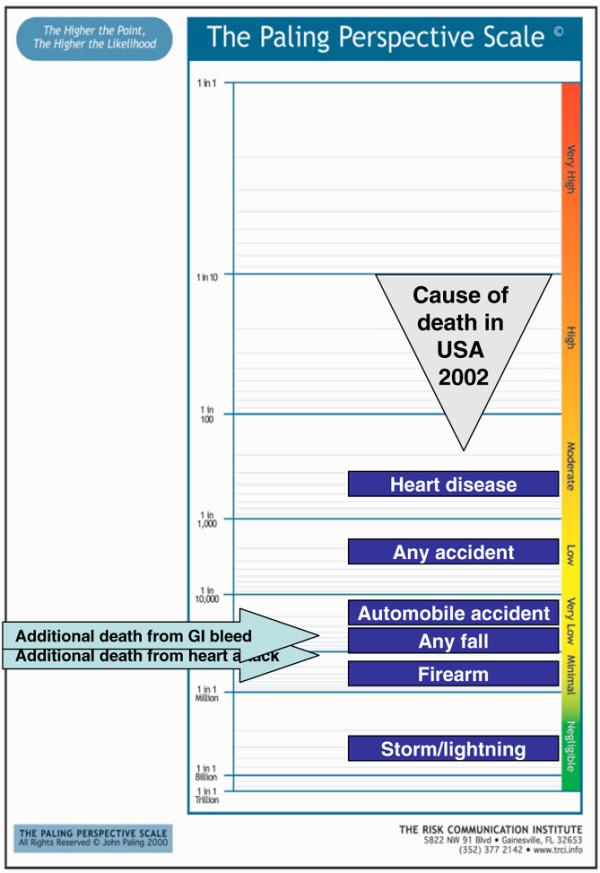
We identified observational studies (primarily in the form of meta-analyses) with information on individual non-steroidal anti-inflammatory drug (NSAID) or selective cyclooxygenase-2 inhibitor (coxib) use and relative risk of gastrointestinal bleed or cardiovascular event, the background rate of events in the absence of NSAID or coxib, and the likelihood of death from an event. Using this information we present the outcome of additional risk of death from gastrointestinal bleed and cardiovascular event for individual NSAIDs and coxibs alongside information about death from other causes in a series of perspective scales.
RESULTS
The literature on communicating risk to patients is limited. There are problems with literacy, numeracy and the human tendency to overestimate rare risk and underestimate common risk. There is inconsistency in how people translate between numbers and words. We present a method of communicating information about serious risks using the common outcome of death, using pictures, numbers and words, and contextualising the information. The use of this method for gastrointestinal and cardiovascular harm with NSAIDs and coxibs shows differences between individual NSAIDs and coxibs.
CONCLUSION
Although contextualised risk information can be provided on two possible adverse events, many other possible adverse events with potential serious consequences were omitted. Patients and professionals want much information about risks of medical interventions but we do not know how best to meet expectations. The impact of contextualised information remains to be tested.
背景
传达风险很困难。尽管已提出了不同的方法——使用数字、文字、图片或其组合——但没有一种方法经过广泛测试。我们通过电子检索和文献检索来回顾有关风险认知和呈现的证据。人们往往低估常见风险而高估罕见风险;他们主要基于情感而非事实来应对风险,在面对医疗干预时似乎规避风险,并且即使是最罕见的不良事件也想了解相关信息。
方法
我们确定了观察性研究(主要为荟萃分析形式),这些研究包含有关个体使用非甾体抗炎药(NSAID)或选择性环氧化酶 -2 抑制剂(coxib)以及胃肠道出血或心血管事件的相对风险、在未使用 NSAID 或 coxib 时事件的背景发生率以及事件导致死亡的可能性的信息。利用这些信息,我们在一系列透视量表中展示了个体 NSAID 和 coxib 导致胃肠道出血和心血管事件额外死亡风险的结果,以及其他原因导致死亡的信息。
结果
向患者传达风险的文献有限。存在读写能力、算术能力方面的问题,以及人类高估罕见风险和低估常见风险的倾向。人们在数字和文字之间转换时存在不一致性。我们提出了一种使用常见的死亡结果、图片、数字和文字来传达严重风险信息并将信息情境化的方法。将这种方法用于 NSAID 和 coxib 导致的胃肠道和心血管损害时,显示出个体 NSAID 和 coxib 之间存在差异。
结论
尽管可以针对两种可能的不良事件提供情境化风险信息,但许多其他可能产生严重后果的不良事件被遗漏了。患者和专业人员希望了解大量有关医疗干预风险的信息,但我们不知道如何最好地满足这些期望。情境化信息的影响仍有待测试。





 Zotero 插件