Hämäläinen Mari, Nieminen Riina, Vuorela Pia, Heinonen Marina, Moilanen Eeva
The Immunopharmacology Research Group, University of Tampere, Medical School and Tampere University Hospital, Research Unit, Tampere 33014, Finland.
Mediators Inflamm. 2007;2007:45673. doi: 10.1155/2007/45673.
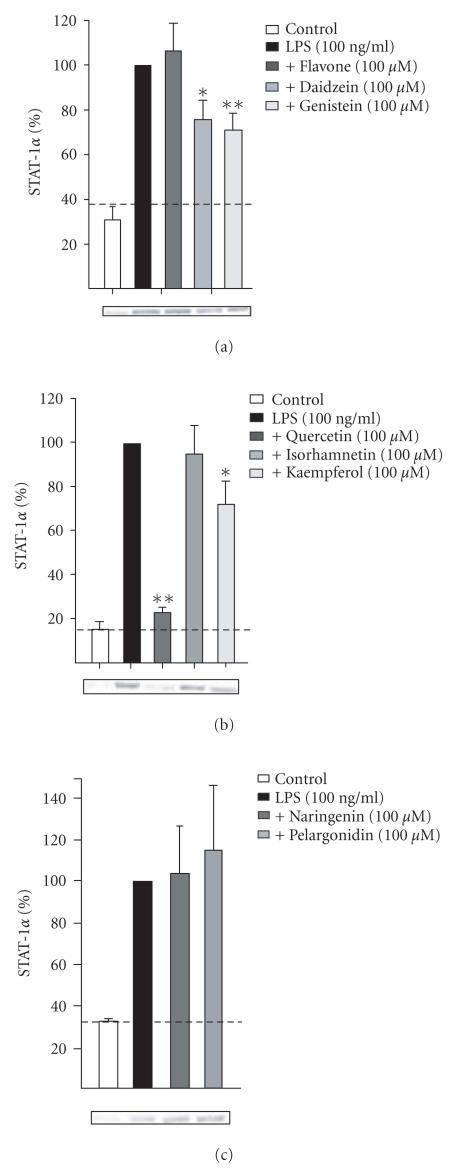
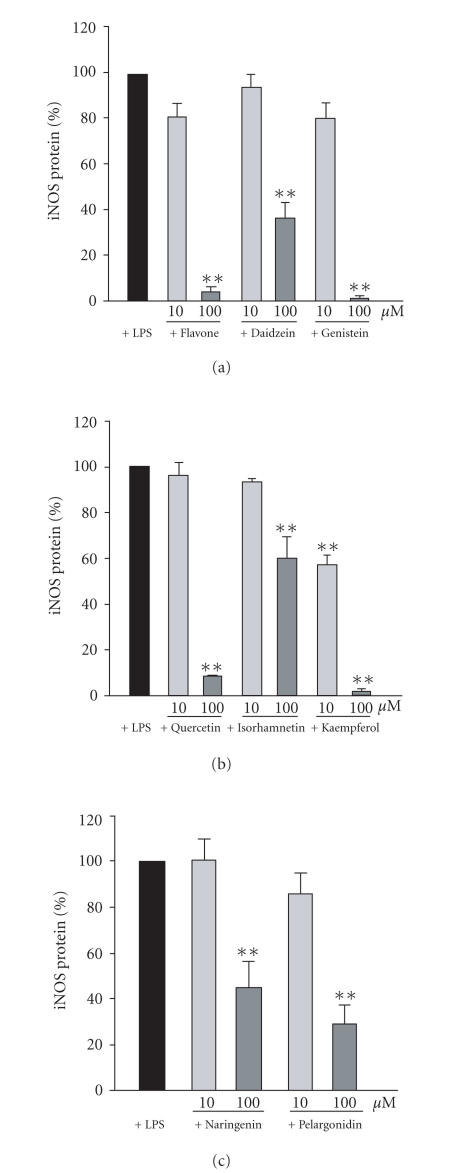
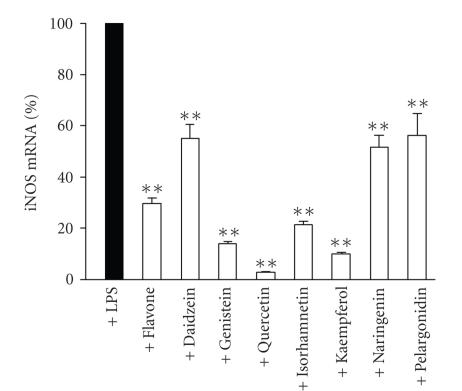
In inflammation, bacterial products and proinflammatory cytokines induce the formation of large amounts of nitric oxide (NO) by inducible nitric oxide synthase (iNOS), and compounds that inhibit NO production have anti-inflammatory effects. In the present study, we systematically investigated the effects of 36 naturally occurring flavonoids and related compounds on NO production in macrophages exposed to an inflammatory stimulus (lipopolysaccharide, LPS), and evaluated the mechanisms of action of the effective compounds. Flavone, the isoflavones daidzein and genistein, the flavonols isorhamnetin, kaempferol and quercetin, the flavanone naringenin, and the anthocyanin pelargonidin inhibited iNOS protein and mRNA expression and also NO production in a dose-dependent manner. All eight active compounds inhibited the activation of nuclear factor-kappaB (NF-kappaB), which is a significant transcription factor for iNOS. Genistein, kaempferol, quercetin, and daidzein also inhibited the activation of the signal transducer and activator of transcription 1 (STAT-1), another important transcription factor for iNOS. The present study characterises the effects and mechanisms of naturally occurring phenolic compounds on iNOS expression and NO production in activated macrophages. The results partially explain the pharmacological efficacy of flavonoids as anti-inflammatory compounds.
在炎症反应中,细菌产物和促炎细胞因子可通过诱导型一氧化氮合酶(iNOS)诱导大量一氧化氮(NO)的形成,而抑制NO生成的化合物具有抗炎作用。在本研究中,我们系统地研究了36种天然存在的黄酮类化合物及相关化合物对暴露于炎症刺激物(脂多糖,LPS)的巨噬细胞中NO生成的影响,并评估了有效化合物的作用机制。黄酮、异黄酮大豆苷元和染料木黄酮、黄酮醇异鼠李素、山奈酚和槲皮素、黄烷酮柚皮素以及花青素天竺葵素均以剂量依赖性方式抑制iNOS蛋白和mRNA表达以及NO生成。所有这八种活性化合物均抑制核因子-κB(NF-κB)的激活,NF-κB是iNOS的重要转录因子。大豆苷元、山奈酚、槲皮素和染料木黄酮还抑制信号转导子和转录激活子1(STAT-1)的激活,STAT-1是iNOS的另一个重要转录因子。本研究描述了天然存在的酚类化合物对活化巨噬细胞中iNOS表达和NO生成的影响及机制。这些结果部分解释了黄酮类化合物作为抗炎化合物的药理功效。