Chundru Usha, Liebeskind Amy, Seidelmann Frank, Fogel Joshua, Franklin Peter, Beltran Javier
Department of Radiology, Maimonides Medical Center, Brooklyn, NY 11219, USA.
Skeletal Radiol. 2008 Jun;37(6):505-10. doi: 10.1007/s00256-008-0455-2.
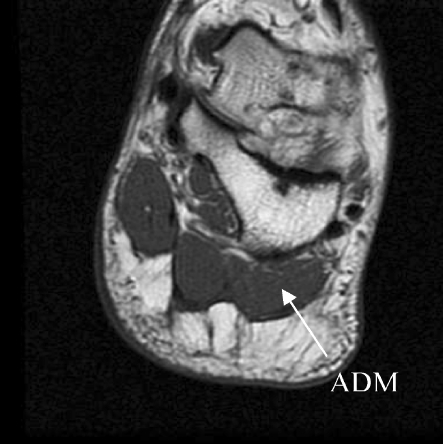
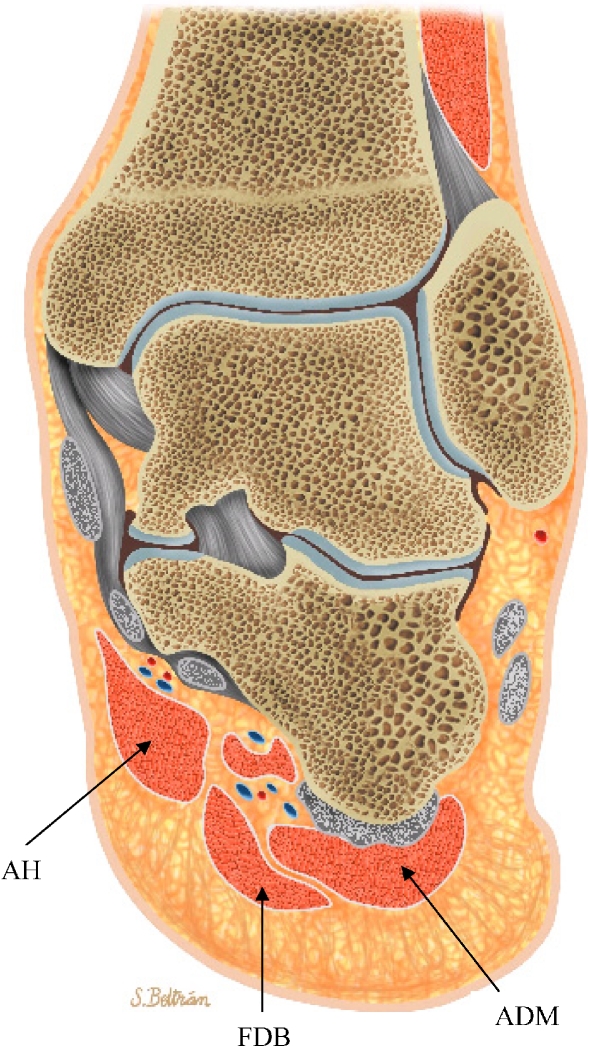
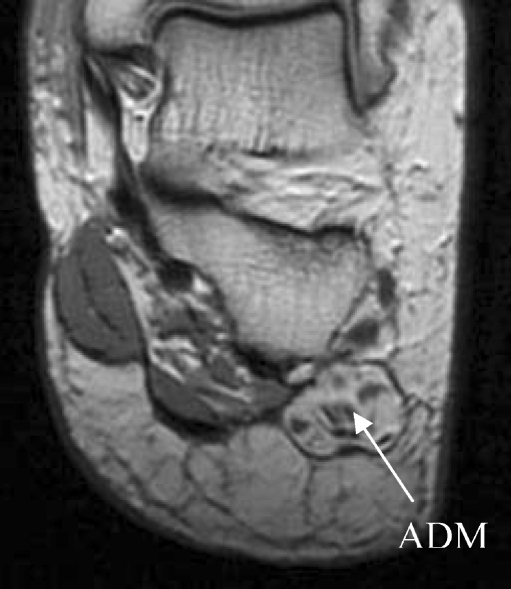
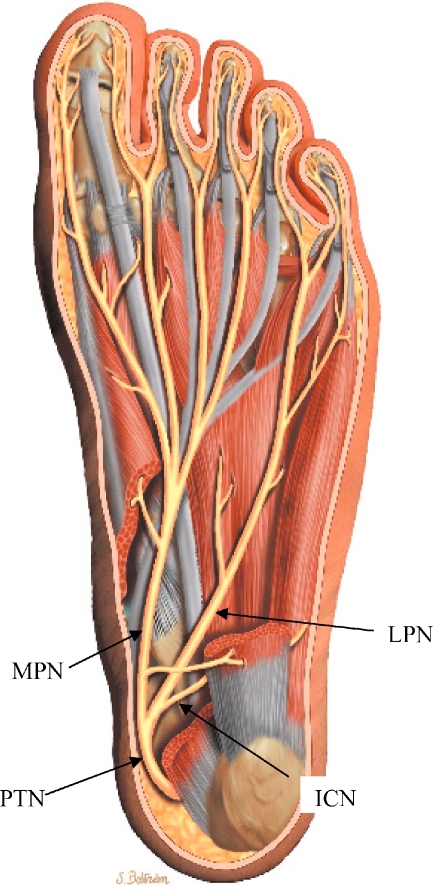
To determine the association of atrophy of the abductor digiti minimi muscle (ADMA), an MRI manifestation of chronic compression of the inferior calcaneal nerve suggesting the clinical diagnosis of Baxter's neuropathy, with MRI markers of potential etiologies, including calcaneal spur formation, plantar fasciitis, calcaneal edema, Achilles tendinosis and posterior tibial tendon dysfunction (PTTD).
Prevalence of calcaneal spur formation, plantar fasciitis, calcaneal edema, Achilles tendinosis and PTTD was assessed retrospectively on 100 MRI studies with ADMA and 100 MRI studies without ADMA. Patients ranged in age from 10-92 years. Pearson chi-square analyses and Fisher's exact test were used to compare prevalence of the above findings in patients with and without ADMA. Logistic regression was used to determine which variables were significantly associated with ADMA.
Among patients with ADMA, there was significantly greater age (57.2 years vs 40.8 years, p<0.001), presence of Achilles tendinosis (22.0% vs 3.0%, P<0.001), calcaneal edema (15.0% vs 3.0%, P=0.005), calcaneal spur (48.0% vs 7.0%, P<0.001), plantar fasciitis (52.5% vs 11.0%, P<0.001), and PTTD (32.0% vs 11.0%, P<0.001). After multivariate logistic regression analysis, only age [odds ratio (OR) 1.06, 95% confidence interval (CI) 1.03, 1.09], calcaneal spur (OR 3.60, 95% CI 1.28, 10.17), and plantar fasciitis (OR 3.35, 95% CI 1.31, 8.56) remained significant.
Advancing age, calcaneal spur, and plantar fasciitis are significantly associated with ADMA. Their high odds ratios support the notion of a possible etiologic role for calcaneal spur and plantar fasciitis in the progression to Baxter's neuropathy.
确定小趾展肌萎缩(ADMA)与潜在病因的MRI标志物之间的关联,ADMA是跟骨下神经慢性受压的MRI表现,提示临床诊断为巴克斯特神经病变,潜在病因的MRI标志物包括跟骨骨刺形成、足底筋膜炎、跟骨水肿、跟腱病和胫后肌腱功能障碍(PTTD)。
回顾性评估100例有ADMA的MRI研究和100例无ADMA的MRI研究中跟骨骨刺形成、足底筋膜炎、跟骨水肿、跟腱病和PTTD的患病率。患者年龄在10 - 92岁之间。采用Pearson卡方分析和Fisher精确检验比较有和无ADMA患者上述表现的患病率。采用逻辑回归确定哪些变量与ADMA显著相关。
在有ADMA的患者中,年龄显著更大(57.2岁对40.8岁,p<0.001),跟腱病的存在(22.0%对3.0%,P<0.001),跟骨水肿(15.0%对3.0%,P = 0.005),跟骨骨刺(48.0%对7.0%,P<0.001),足底筋膜炎(52.5%对11.0%,P<0.001),以及PTTD(32.0%对11.0%,P<0.001)。多因素逻辑回归分析后,只有年龄[比值比(OR)1.06,95%置信区间(CI)1.03,1.09]、跟骨骨刺(OR 3.60,95% CI 1.28,10.17)和足底筋膜炎(OR 3.35,95% CI
1.31,8.56)仍然显著。
年龄增长、跟骨骨刺和足底筋膜炎与ADMA显著相关。它们较高的比值比支持跟骨骨刺和足底筋膜炎在发展为巴克斯特神经病变过程中可能起病因学作用的观点。