Havemann Johanna, Müller Ursula, Berger Jürgen, Schwarz Heinz, Gerberding Matthias, Moussian Bernard
Max-Planck-Institut für Entwicklungsbiologie, Spemannstrasse 35, 72076 Tübingen, Germany.
Cell Tissue Res. 2008 May;332(2):359-70. doi: 10.1007/s00441-007-0571-7. Epub 2008 Feb 22.
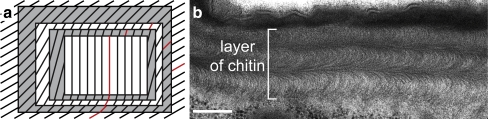
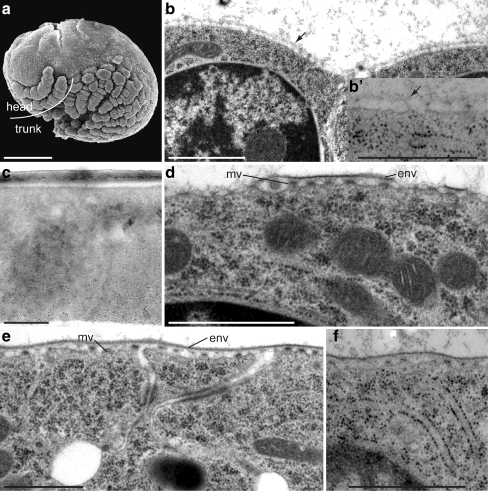
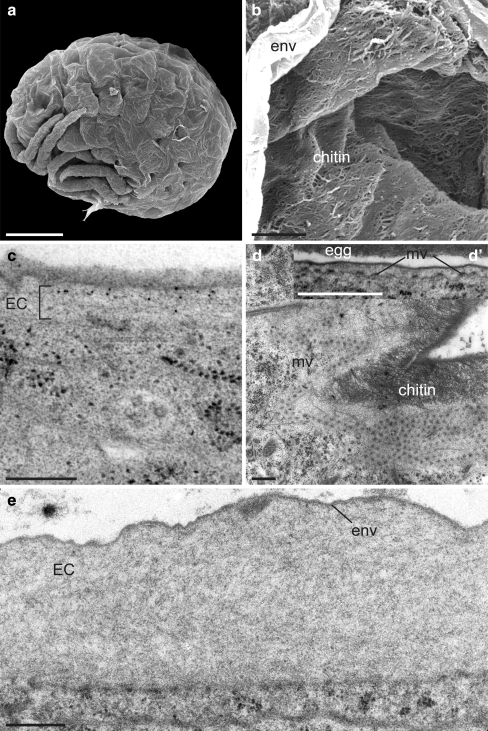
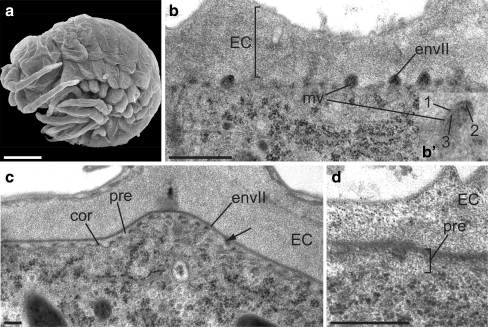
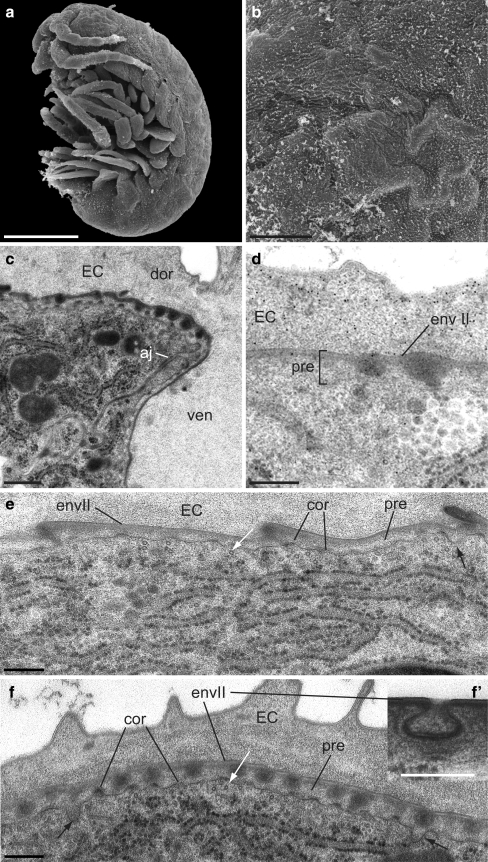
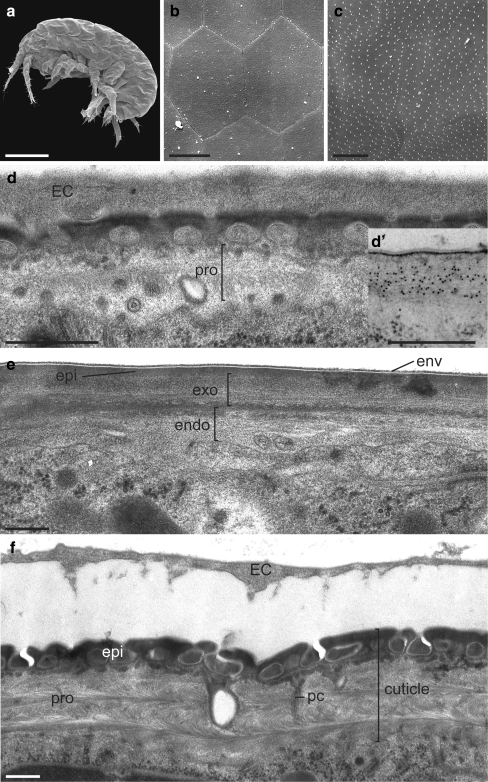
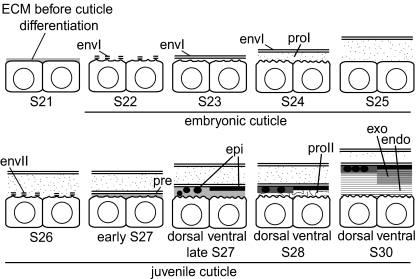
The arthropod cuticle is a multilayered extracellular matrix produced by the epidermis during embryogenesis and moulting. Molecularly and histologically, cuticle differentiation has been extensively investigated in the embryo of the insect Drosophila melanogaster. To learn about the evolution of cuticle differentiation, we have studied the histology of cuticle differentiation during embryogenesis of the amphipod crustacean Parhyale hawaiensis, which had a common ancestor with Drosophila about 510 million years ago. The establishment of the layers of the Parhyale juvenile cuticle is largely governed by mechanisms observed in Drosophila, e.g. as in Drosophila, the synthesis and arrangement of chitin in the inner procuticle are separate processes. A major difference between the cuticle of Parhyale and Drosophila concerns the restructuring of the Parhyale dorsal epicuticle after deposition. In contrast to the uniform cuticle of the Drosophila larva, the Parhyale cuticle is subdivided into two regions, the ventral and the dorsal cuticles. Remarkably, the boundary between the ventral and dorsal cuticles is sharp suggesting active extracellular regionalisation. The present analysis of Parhyale cuticle differentiation should allow the characterisation of the cuticle-producing and -organising factors of Parhyale (by comparison with the branchiopod crustacean Daphnia pulex) in order to contribute to the elucidation of fundamental questions relevant to extracellular matrix organisation and differentiation.
节肢动物的角质层是表皮在胚胎发育和蜕皮过程中产生的多层细胞外基质。在分子和组织学层面,昆虫黑腹果蝇胚胎中的角质层分化已得到广泛研究。为了解角质层分化的进化过程,我们研究了夏威夷片脚类甲壳动物Parhyale hawaiensis胚胎发育过程中角质层分化的组织学,该物种与果蝇在约5.1亿年前拥有共同祖先。Parhyale幼体角质层各层的形成在很大程度上受果蝇中观察到的机制支配,例如,与果蝇一样,内表皮中几丁质的合成和排列是分开的过程。Parhyale和果蝇角质层的一个主要区别在于Parhyale背表皮在沉积后的重组。与果蝇幼虫均匀的角质层不同,Parhyale的角质层分为两个区域,即腹侧角质层和背侧角质层。值得注意的是,腹侧和背侧角质层之间的边界很清晰,这表明存在活跃的细胞外区域化。目前对Parhyale角质层分化的分析应有助于确定Parhyale产生和组织角质层的因子(通过与鳃足类甲壳动物蚤状溞进行比较),从而有助于阐明与细胞外基质组织和分化相关的基本问题。