Couillard-Despres Sebastien, Quehl Eike, Altendorfer Katrin, Karl Claudia, Ploetz Sonja, Bogdahn Ulrich, Winkler Juergen, Aigner Ludwig
Department of Neurology, University of Regensburg, Universitätsstr, 84, 93053 Regensburg, Germany.
BMC Neurosci. 2008 Feb 29;9:31. doi: 10.1186/1471-2202-9-31.
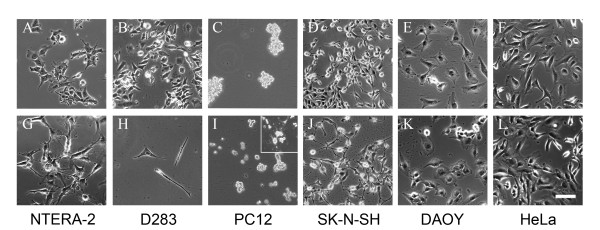
During developmental and adult neurogenesis, doublecortin is an early neuronal marker expressed when neural stem cells assume a neuronal cell fate. To understand mechanisms involved in early processes of neuronal fate decision, we investigated cell lines for their capacity to induce expression of doublecortin upon neuronal differentiation and develop in vitro reporter models using doublecortin promoter sequences.
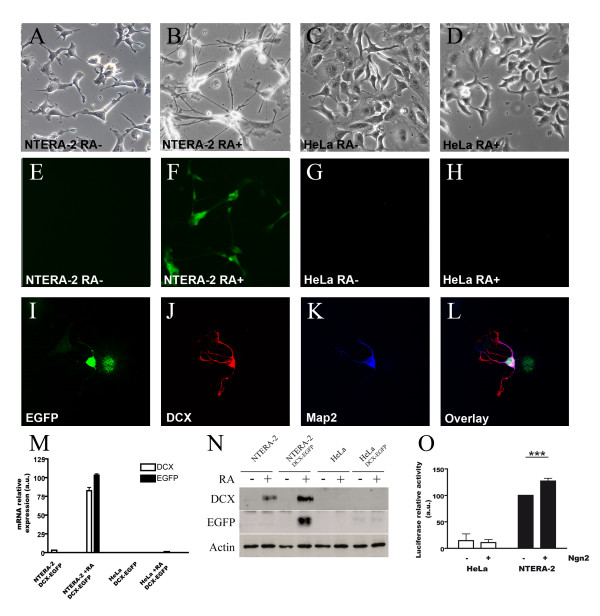
Among various cell lines investigated, the human teratocarcinoma cell line NTERA-2 was found to fulfill our criteria. Following induction of differentiation using retinoic acid treatment, we observed a 16-fold increase in doublecortin mRNA expression, as well as strong induction of doublecortin polypeptide expression. The acquisition of a neuronal precursor phenotype was also substantiated by the establishment of a multipolar neuronal morphology and expression of additional neuronal markers, such as Map2, betaIII-tubulin and neuron-specific enolase. Moreover, stable transfection in NTERA-2 cells of reporter constructs encoding fluorescent or luminescent genes under the control of the doublecortin promoter allowed us to directly detect induction of neuronal differentiation in cell culture, such as following retinoic acid treatment or mouse Ngn2 transient overexpression.
Induction of doublecortin expression in differentiating NTERA-2 cells suggests that these cells accurately recapitulate some of the very early events of neuronal determination. Hence, the use of reporter genes under the control of the doublecortin promoter in NTERA-2 cells will help us to investigate factors involved early in the course of neuronal differentiation processes. Moreover the ease to detect the induction of a neuronal program in this model will permit to perform high throughput screening for compounds acting on the early neuronal differentiation mechanisms.
在发育和成年神经发生过程中,双皮质素是一种早期神经元标志物,当神经干细胞转变为神经元细胞命运时表达。为了了解神经元命运决定早期过程中涉及的机制,我们研究了细胞系在神经元分化时诱导双皮质素表达的能力,并使用双皮质素启动子序列建立了体外报告模型。
在研究的各种细胞系中,发现人畸胎瘤细胞系NTERA-2符合我们的标准。在用视黄酸处理诱导分化后,我们观察到双皮质素mRNA表达增加了16倍,以及双皮质素多肽表达的强烈诱导。多极神经元形态的建立以及其他神经元标志物(如Map2、βIII-微管蛋白和神经元特异性烯醇化酶)的表达也证实了神经元前体表型的获得。此外,在双皮质素启动子控制下,将编码荧光或发光基因的报告构建体稳定转染到NTERA-2细胞中,使我们能够直接检测细胞培养中神经元分化的诱导,如视黄酸处理或小鼠Ngn2瞬时过表达后。
分化的NTERA-2细胞中双皮质素表达的诱导表明这些细胞准确地重现了神经元决定的一些非常早期的事件。因此,在NTERA-2细胞中使用双皮质素启动子控制下的报告基因将有助于我们研究神经元分化过程早期涉及的因素。此外,在该模型中易于检测神经元程序的诱导将允许对作用于早期神经元分化机制的化合物进行高通量筛选。