Dale Rick, Roche Jennifer, Snyder Kristy, McCall Ryan
Department of Psychology, University of Memphis, Memphis, Tennessee, USA.
PLoS One. 2008 Mar 5;3(3):e1728. doi: 10.1371/journal.pone.0001728.
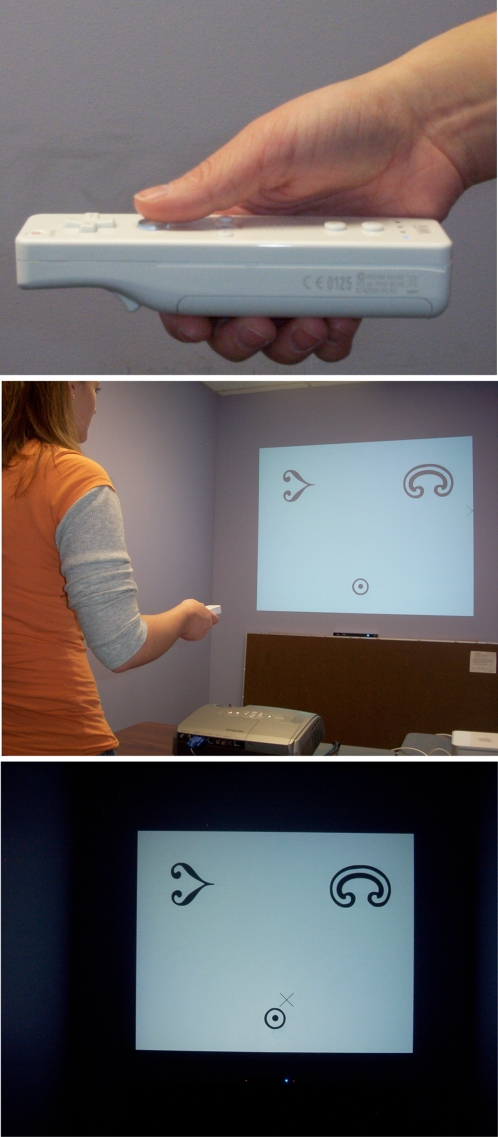
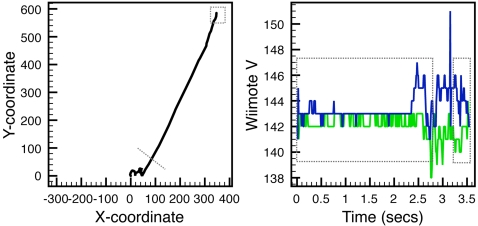
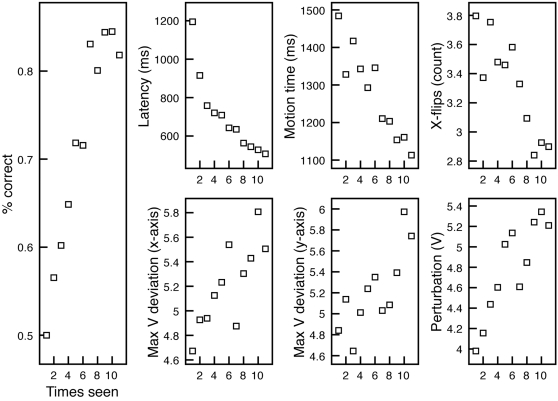
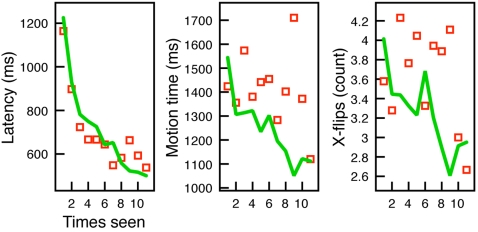
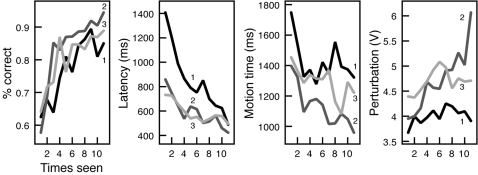
Much evidence exists supporting a richer interaction between cognition and action than commonly assumed. Such findings demonstrate that short-timescale processes, such as motor execution, may relate in systematic ways to longer-timescale cognitive processes, such as learning. We further substantiate one direction of this interaction: the flow of cognition into action systems. Two experiments explored match-to-sample paired-associate learning, in which participants learned randomized pairs of unfamiliar symbols. During the experiments, their hand movements were continuously tracked using the Nintendo Wiimote. Across learning, participant arm movements are initiated and completed more quickly, exhibit lower fluctuation, and exert more perturbation on the Wiimote during the button press. A second experiment demonstrated that action dynamics index novel learning scenarios, and not simply acclimatization to the Wiimote interface. Results support a graded and systematic covariation between cognition and action, and recommend ways in which this theoretical perspective may contribute to applied learning contexts.
有大量证据支持认知与行动之间存在比通常所认为的更为丰富的相互作用。这些研究结果表明,诸如运动执行等短时间尺度的过程可能以系统的方式与诸如学习等长时间尺度的认知过程相关联。我们进一步证实了这种相互作用的一个方向:认知流入行动系统。两项实验探究了匹配样本配对联想学习,即参与者学习随机配对的不熟悉符号。在实验过程中,使用任天堂Wiimote持续跟踪他们的手部动作。在学习过程中,参与者的手臂动作启动和完成得更快,波动更小,并且在按下按钮时对Wiimote施加的干扰更大。第二项实验表明,行动动态能够指示新的学习场景,而不仅仅是对Wiimote界面的适应。结果支持了认知与行动之间分级且系统的共变关系,并推荐了这一理论视角可能有助于应用学习情境的方式。