Close S M, Kado C I
Department of Plant Pathology, University of California, Davis 95616.
J Bacteriol. 1991 Sep;173(17):5449-56. doi: 10.1128/jb.173.17.5449-5456.1991.
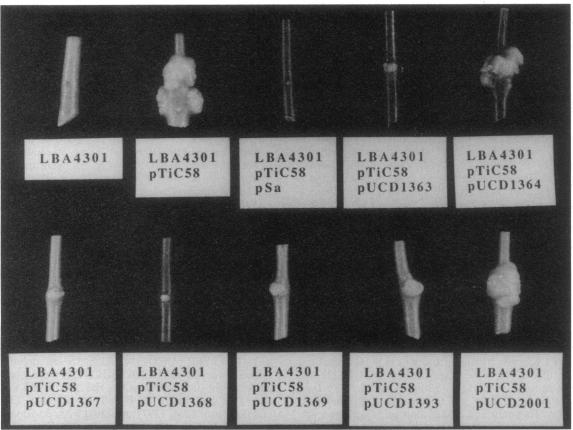
The incompatibility group W plasmid pSa suppresses Agrobacterium tumefaciens oncogenicity (J. Loper and C. Kado, J. Bacteriol. 139:591-596, 1979). The oncogenic suppressive activity was localized to a 3.1-kb region of pSa by Tn5 mutagenesis and deletion analysis. Within this fragment, a 1.1-kb subclone bearing oncogenic suppressive activity was subjected to further characterization. Nucleotide sequencing of the 1.1-kb fragment revealed a 570-bp open reading frame (ORF1) that has a coding capacity for a protein of 21.1 kDa. Sequencing of flanking regions revealed a second ORF (ORF2) located 3 bp upstream of ORF1, with a coding capacity for a protein of 22.8 kDa. Gene fusions of these ORFs to a T7 phi 10 expression system in Escherichia coli resulted in the synthesis of polypeptides of the predicted sizes. An E. coli promoter consensus sequence was not found in the expected positions in the region preceding ORF1. However, several sequences with similarity to the consensus -10 sequence of the A. tumefaciens vir gene promoters were found upstream of ORF1. Potential translational start signals are upstream of ORF1 and ORF2. These sequences showed no significant similarity at the nucleotide or amino acid levels with those in available data bases. However, the C-terminal portion of the ORF1 protein is rich in hydrophobic residues. Perhaps oncogenicity suppression is effected by an association of this protein with the Agrobacterium membrane such that T-DNA transfer is blocked.
不相容性W组质粒pSa可抑制根癌土壤杆菌的致癌性(J. 洛珀和C. 卡多,《细菌学杂志》139:591 - 596,1979年)。通过Tn5诱变和缺失分析,致癌抑制活性定位于pSa的一个3.1 kb区域。在这个片段内,对具有致癌抑制活性的一个1.1 kb亚克隆进行了进一步表征。1.1 kb片段的核苷酸测序揭示了一个570 bp的开放阅读框(ORF1),其编码能力为一个21.1 kDa的蛋白质。侧翼区域的测序揭示了位于ORF1上游3 bp处的第二个开放阅读框(ORF2),其编码能力为一个22.8 kDa的蛋白质。将这些开放阅读框与大肠杆菌中的T7 phi 10表达系统进行基因融合,导致了预测大小的多肽的合成。在ORF1之前的区域中,未在预期位置发现大肠杆菌启动子共有序列。然而,在ORF1上游发现了几个与根癌土壤杆菌vir基因启动子的共有 -10序列相似的序列。潜在的翻译起始信号在ORF1和ORF2上游。这些序列在核苷酸或氨基酸水平上与现有数据库中的序列没有显著相似性。然而,ORF1蛋白的C末端部分富含疏水残基。也许致癌性抑制是通过该蛋白与土壤杆菌膜的结合来实现的,从而阻断了T - DNA的转移。