Keller Geoffray, Cassar Emmanuel, Desebbe Olivier, Lehot Jean-Jacques, Cannesson Maxime
Hospices Civils de Lyon, Groupement Hospitalier Est, Department of Anesthesiology and Intensive Care, Louis Pradel Hospital and Claude Bernard Lyon 1 University, INSERM ERI 22, 28 avenue du doyen Lépine, 69500 Bron-Lyon, France.
Crit Care. 2008;12(2):R37. doi: 10.1186/cc6822. Epub 2008 Mar 6.
Pleth Variability Index (PVI) is a new algorithm that allows continuous and automatic estimation of respiratory variations in the pulse oximeter waveform amplitude. Our aim was to test its ability to detect changes in preload induced by passive leg raising (PLR) in spontaneously breathing volunteers.
We conducted a prospective observational study. Twenty-five spontaneously breathing volunteers were enrolled. PVI, heart rate and noninvasive arterial pressure were recorded. Cardiac output was assessed using transthoracic echocardiography. Volunteers were studied in three successive positions: baseline (semirecumbent position); after PLR of 45 degrees with the trunk lowered in the supine position; and back in the semirecubent position.
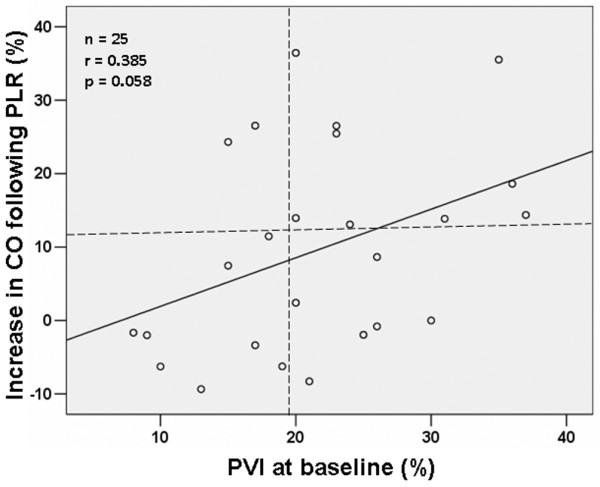
We observed significant changes in cardiac output and PVI during changes in body position. In particular, PVI decreased significantly from baseline to PLR (from 21.5 +/- 8.0% to 18.3 +/- 9.4%; P < 0.05) and increased significantly from PLR to the semirecumbent position (from 18.3 +/- 9.4% to 25.4 +/- 10.6 %; P < 0.05). A threshold PVI value above 19% was a weak but significant predictor of response to PLR (sensitivity 82%, specificity 57%, area under the receiver operating characteristic curve 0.734 +/- 0.101).
PVI can detect haemodynamic changes induced by PLR in spontaneously breathing volunteers. However, we found that PVI was a weak predictor of fluid responsiveness in this setting.
容积变异指数(PVI)是一种新算法,可连续自动估计脉搏血氧饱和度波形幅度中的呼吸变化。我们的目的是测试其在自主呼吸志愿者中检测被动抬腿(PLR)引起的前负荷变化的能力。
我们进行了一项前瞻性观察研究。招募了25名自主呼吸志愿者。记录PVI、心率和无创动脉压。使用经胸超声心动图评估心输出量。对志愿者在三个连续体位下进行研究:基线(半卧位);仰卧位将躯干降低45度进行PLR后;再回到半卧位。
我们观察到体位改变期间心输出量和PVI有显著变化。特别是,PVI从基线到PLR显著降低(从21.5±8.0%降至18.3±9.4%;P<0.05),从PLR到半卧位显著增加(从18.3±9.4%增至25.4±10.6%;P<0.05)。PVI阈值高于19%是对PLR反应的一个较弱但显著的预测指标(敏感性82%,特异性57%,受试者工作特征曲线下面积0.734±0.101)。
PVI可检测自主呼吸志愿者中PLR引起的血流动力学变化。然而,我们发现在这种情况下PVI是液体反应性的一个较弱预测指标。