Drevinek Pavel, Baldwin Adam, Dowson Christopher G, Mahenthiralingam Eshwar
Cardiff School of Biosciences, Cardiff University, Cardiff, CF10 3TL, UK.
BMC Microbiol. 2008 Mar 7;8:44. doi: 10.1186/1471-2180-8-44.
Burkholderia cenocepacia is the most prominent species of the B. cepacia complex (Bcc), a group of nine closely related and difficult to identify bacteria that cause serious infections in patients with cystic fibrosis. Despite its clinical relevance, identification of B. cenocepacia as a single species is unavailable, as it splits by a widely used recA gene-based PCR identification method into discrete phylogenetic subgroups IIIA, IIIB, IIIC and IIID. With the aim of identifying gene targets suitable for unified detection of B. cenocepacia strains, we examined sequence polymorphisms in the repA and parB genes. These essential genes are involved in the replication and partitioning of bacterial replicons, hence we also had the opportunity for the first time to investigate the evolution of the multireplicon (three chromosome) structure of Bcc genomes.
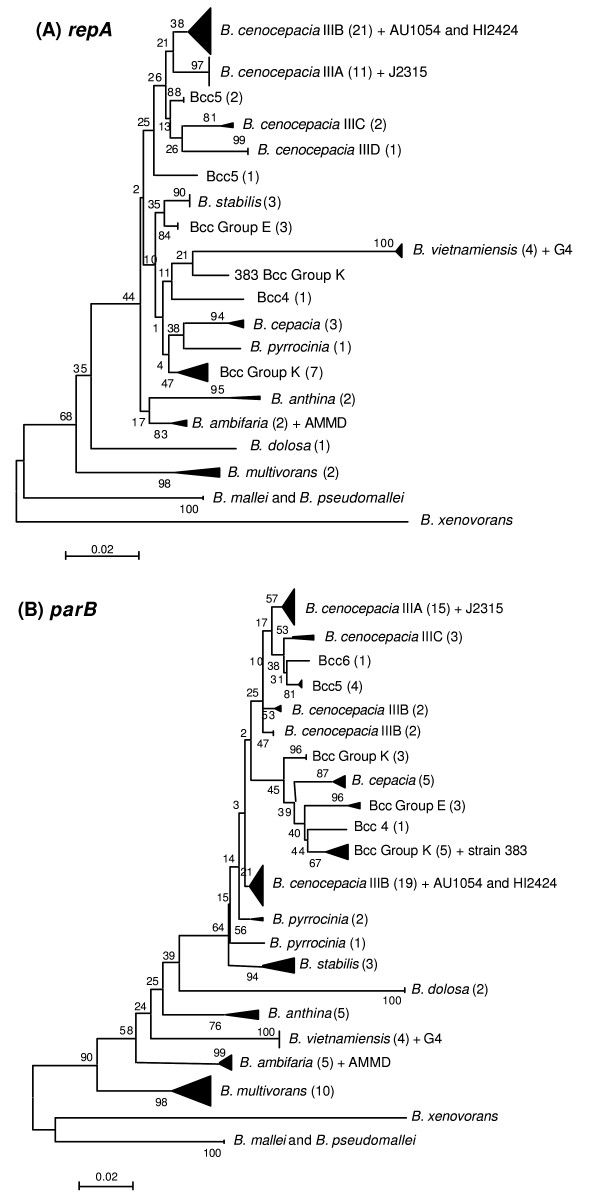
Alignment of the repA and parB genes from publicly available Bcc genome sequences enabled the design of primers for their amplification and sequence analysis. Multilocus sequencing typing, a highly discriminatory method for Bcc species and strain discrimination, was used to select strains of unique sequence types (STs) that spanned the known Bcc genetic diversity. Sequence datasets of repA (83 isolates, 67 STs) and parB (120 isolates, 95 STs) genes from the second chromosome were aligned and examined phylogenetically to identify polymorphisms suitable for identification of B. cenocepacia. In contrast to parB, the Bcc repA sequences demonstrated distinct clustering of B. cenocepacia from other species, which enabled the design a species-specific multiplex PCR. The novel single-reaction B. cenocepacia detection method was tested on a panel of 142 different Bcc strains (142 STs) and distinguished recA groups IIIA, IIIB and IIID, from all other Bcc members with 100% sensitivity and 93% specificity.
The repA-based multiplex PCR is a useful aid to the rapid identification of the most clinically relevant B. cenocepacia recA subgroups IIIA, IIIB and IIID. Phylogenetic analysis of repA and parB genes demonstrated that acquisition of the second and third replicons of Bcc genomes occurred prior to their differentiation into discrete species and that the sharing of replicons across species had not occurred.
洋葱伯克霍尔德菌是洋葱伯克霍尔德菌复合体(Bcc)中最主要的菌种,该复合体由九种密切相关且难以鉴定的细菌组成,可在囊性纤维化患者中引起严重感染。尽管其具有临床相关性,但由于通过广泛使用的基于recA基因的PCR鉴定方法可将洋葱伯克霍尔德菌分为离散的系统发育亚组IIIA、IIIB、IIIC和IIID,因此无法将其鉴定为单一菌种。为了鉴定适合统一检测洋葱伯克霍尔德菌菌株的基因靶点,我们研究了repA和parB基因中的序列多态性。这些必需基因参与细菌复制子的复制和分配,因此我们也首次有机会研究Bcc基因组多复制子(三条染色体)结构的进化。
对公开可用的Bcc基因组序列中的repA和parB基因进行比对,从而设计用于扩增和序列分析的引物。多位点测序分型是一种用于区分Bcc菌种和菌株的高分辨率方法,用于选择涵盖已知Bcc遗传多样性的独特序列类型(STs)的菌株。对来自第二条染色体的repA(83株分离株,67个STs)和parB(120株分离株,95个STs)基因的序列数据集进行比对,并进行系统发育分析,以鉴定适合鉴定洋葱伯克霍尔德菌的多态性。与parB不同,Bcc的repA序列显示洋葱伯克霍尔德菌与其他菌种明显聚类,这使得能够设计一种物种特异性多重PCR。在一组142种不同的Bcc菌株(142个STs)上测试了这种新型单反应洋葱伯克霍尔德菌检测方法,该方法以100%的灵敏度和93%的特异性区分recA亚组IIIA、IIIB和IIID与所有其他Bcc成员。
基于repA的多重PCR有助于快速鉴定临床上最相关的洋葱伯克霍尔德菌recA亚组IIIA、IIIB和IIID。repA和parB基因的系统发育分析表明,Bcc基因组的第二条和第三条复制子的获得发生在它们分化为离散菌种之前,并且尚未发生跨菌种的复制子共享。