Ronkainen Paula H A, Pöllänen Eija, Törmäkangas Timo, Tiainen Kristina, Koskenvuo Markku, Kaprio Jaakko, Rantanen Taina, Sipilä Sarianna, Kovanen Vuokko
Department of Health Sciences, University of Jyväskylä, Jyväskylä, Finland.
PLoS One. 2008 Mar 19;3(3):e1819. doi: 10.1371/journal.pone.0001819.
Muscle strength declines on average by one percent annually from midlife on. In postmenopausal women this decrement coincides with a rapid decline in estrogen production. The genetics underlying the effects of estrogen on skeletal muscle remains unclear. In the present study, we examined whether polymorphisms within COMT and ESR1 are associated with muscle properties and assessed their interaction and their combined effects with physical activity.
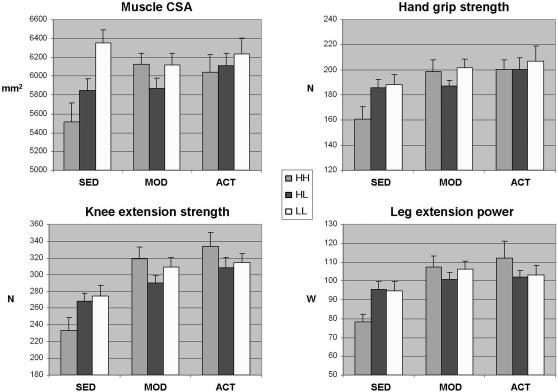
METHODOLOGY/PRINCIPAL FINDINGS: A cross-sectional data analysis was conducted with 434 63-76-year-old women from the population-based Finnish Twin Study on Aging. Body anthropometry, muscle cross-sectional area (mCSA), isometric hand grip and knee extension strengths, and leg extension power were measured. COMT Val158Met and ESR1 PvuII genotypes were determined by the RFLP method. mCSA differed by COMT genotypes (p = 0.014) being significantly larger in LL than HL individuals in unadjusted (p = 0.001) and age- and height-adjusted model (p = 0.004). When physical activity and age were entered into GEE model, COMT genotype had a significant main effect (p = 0.038) on mCSA. Furthermore, sedentary individuals with the HH genotype had lower muscle mass, strength and power, but they also appeared to benefit the most from physical activity. No association of ESR1 PvuII polymorphism with any of the muscle outcomes was observed.
CONCLUSIONS/SIGNIFICANCE: The present study suggests that the COMT polymorphism, affecting the activity of the enzyme, is associated with muscle mass. Furthermore, sedentary individuals with potential high enzyme activity were the weakest group, but they may potentially benefit the most from physical activity. This observation elucidates the importance of both environmental and genetic factors in muscle properties.
从中年开始,肌肉力量平均每年下降1%。在绝经后女性中,这种下降与雌激素分泌的快速减少同时发生。雌激素对骨骼肌影响的遗传学机制尚不清楚。在本研究中,我们检测了儿茶酚-O-甲基转移酶(COMT)和雌激素受体1(ESR1)基因多态性是否与肌肉特性相关,并评估了它们之间的相互作用以及与体育活动的联合效应。
方法/主要发现:对基于人群的芬兰老年双胞胎研究中的434名63 - 76岁女性进行了横断面数据分析。测量了身体人体测量学指标、肌肉横截面积(mCSA)、等长握力和膝关节伸展力量以及腿部伸展功率。通过限制性片段长度多态性(RFLP)方法确定COMT Val158Met和ESR1 PvuII基因型。在未调整模型(p = 0.001)和年龄及身高调整模型(p = 0.004)中,mCSA因COMT基因型不同而存在差异(p = 0.014),LL基因型个体的mCSA显著大于HL基因型个体。当将体育活动和年龄纳入广义估计方程(GEE)模型时,COMT基因型对mCSA有显著的主效应(p = 0.038)。此外,HH基因型的久坐个体肌肉质量、力量和功率较低,但他们似乎也从体育活动中获益最多。未观察到ESR1 PvuII多态性与任何肌肉指标之间存在关联。
结论/意义:本研究表明,影响该酶活性的COMT基因多态性与肌肉质量相关。此外,具有潜在高酶活性的久坐个体是最虚弱的群体,但他们可能从体育活动中获益最多。这一观察结果阐明了环境和遗传因素在肌肉特性中的重要性。