Institute of Biodiversity, Animal Health and Comparative Medicine, University of Glasgow, Glasgow, United Kingdom.
Vavilov Institute of General Genetics, Russian Academy of Sciences, Moscow, Russia.
PLoS Genet. 2020 Apr 17;16(4):e1008658. doi: 10.1371/journal.pgen.1008658. eCollection 2020 Apr.
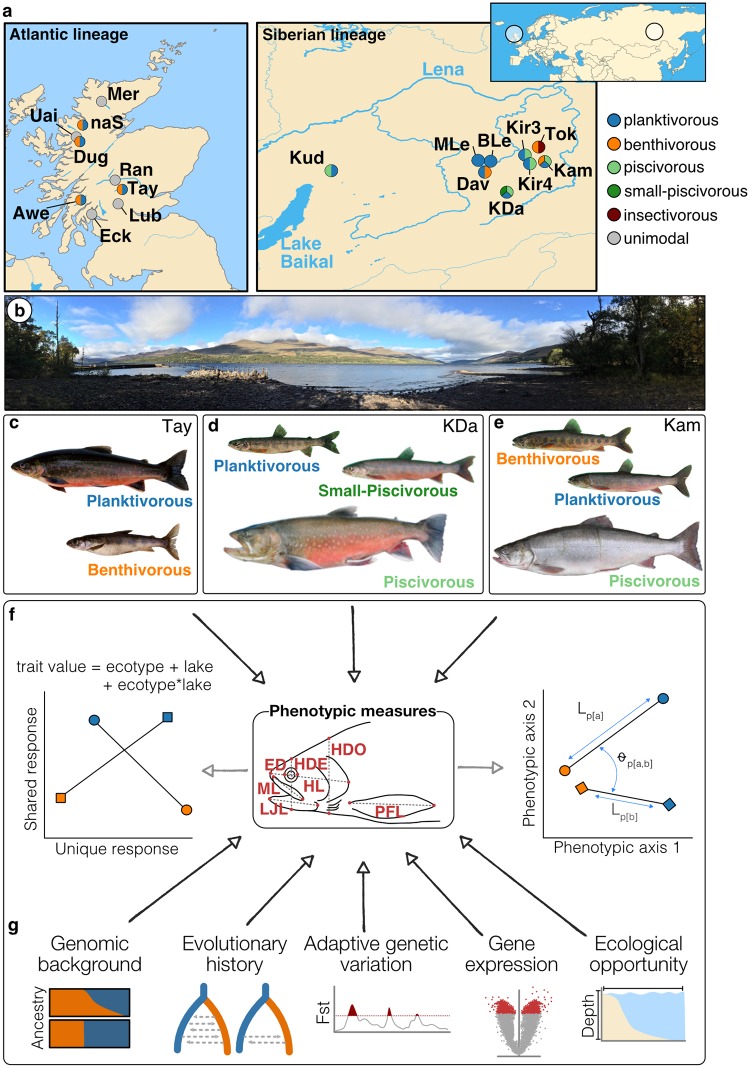
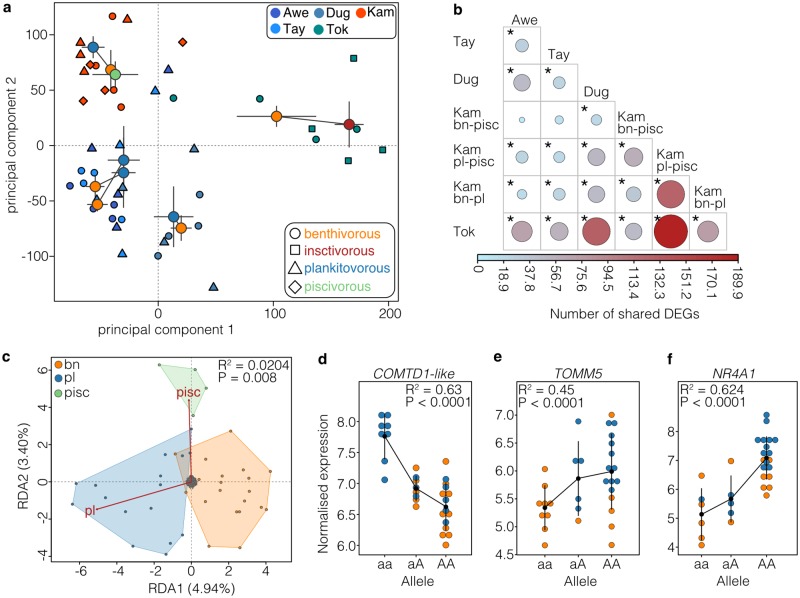
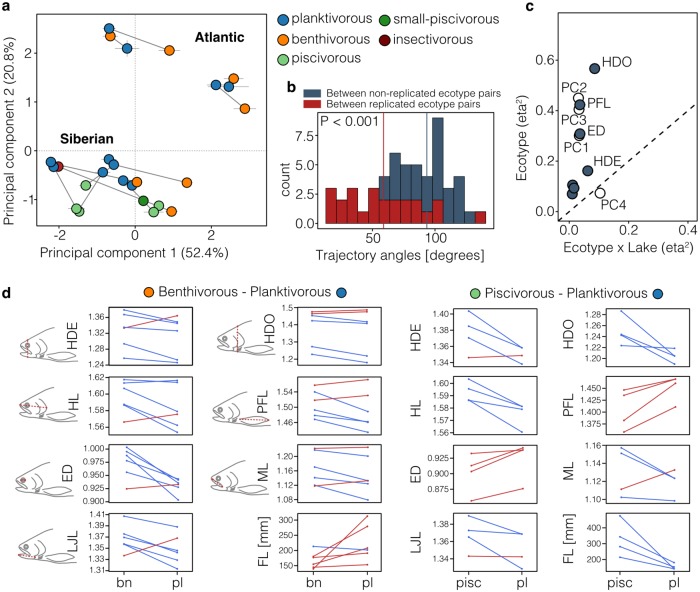
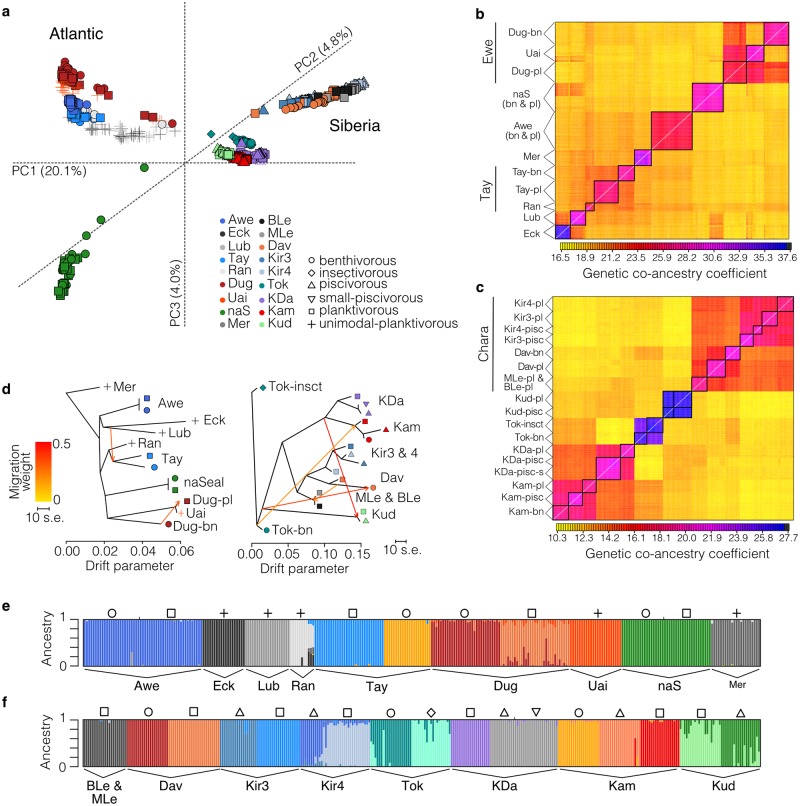
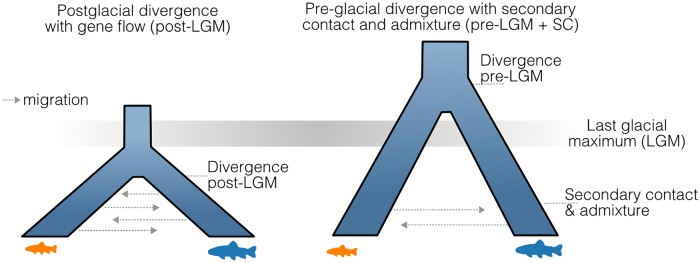
Understanding the extent to which ecological divergence is repeatable is essential for predicting responses of biodiversity to environmental change. Here we test the predictability of evolution, from genotype to phenotype, by studying parallel evolution in a salmonid fish, Arctic charr (Salvelinus alpinus), across eleven replicate sympatric ecotype pairs (benthivorous-planktivorous and planktivorous-piscivorous) and two evolutionary lineages. We found considerable variability in eco-morphological divergence, with several traits related to foraging (eye diameter, pectoral fin length) being highly parallel even across lineages. This suggests repeated and predictable adaptation to environment. Consistent with ancestral genetic variation, hundreds of loci were associated with ecotype divergence within lineages of which eight were shared across lineages. This shared genetic variation was maintained despite variation in evolutionary histories, ranging from postglacial divergence in sympatry (ca. 10-15kya) to pre-glacial divergence (ca. 20-40kya) with postglacial secondary contact. Transcriptome-wide gene expression (44,102 genes) was highly parallel across replicates, involved biological processes characteristic of ecotype morphology and physiology, and revealed parallelism at the level of regulatory networks. This expression divergence was not only plastic but in part genetically controlled by parallel cis-eQTL. Lastly, we found that the magnitude of phenotypic divergence was largely correlated with the genetic differentiation and gene expression divergence. In contrast, the direction of phenotypic change was mostly determined by the interplay of adaptive genetic variation, gene expression, and ecosystem size. Ecosystem size further explained variation in putatively adaptive, ecotype-associated genomic patterns within and across lineages, highlighting the role of environmental variation and stochasticity in parallel evolution. Together, our findings demonstrate the parallel evolution of eco-morphology and gene expression within and across evolutionary lineages, which is controlled by the interplay of environmental stochasticity and evolutionary contingencies, largely overcoming variable evolutionary histories and genomic backgrounds.
了解生态分歧的可重复性对于预测生物多样性对环境变化的响应至关重要。在这里,我们通过研究鲑鱼(北极红点鲑)的平行进化,在 11 个重复的同域生态型对(底栖食性-浮游食性和浮游食性-捕食性)和两个进化支系中,测试从基因型到表型的进化可预测性。我们发现生态形态分歧存在相当大的可变性,几个与觅食相关的特征(眼睛直径、胸鳍长度)在很大程度上是平行的,甚至在进化支系之间也是如此。这表明对环境的反复和可预测的适应。与祖先遗传变异一致,数百个基因座与生态型分歧有关,其中 8 个基因座在进化支系之间共享。尽管进化历史存在差异,从同域的冰川后分歧(约 10-15kya)到冰川前分歧(约 20-40kya),以及冰川后二次接触,但这种共享的遗传变异仍然得以维持。全转录组范围的基因表达(44102 个基因)在复制中高度平行,涉及生态型形态和生理学的特征生物过程,并揭示了调控网络的平行性。这种表达分歧不仅是可塑性的,而且部分受到平行顺式 eQTL 的遗传控制。最后,我们发现表型分歧的程度与遗传分化和基因表达分歧高度相关。相比之下,表型变化的方向主要取决于适应性遗传变异、基因表达和生态系统大小的相互作用。生态系统大小进一步解释了在和跨进化支系内,与生态型相关的假定适应性基因组模式的变异性,突出了环境变异和随机性在平行进化中的作用。总之,我们的研究结果表明,生态形态和基因表达在进化支系内和跨进化支系的平行进化,受到环境随机性和进化偶然性的相互作用的控制,在很大程度上克服了可变的进化历史和基因组背景。