Department of Medical Oncology Hôpital Beaujon, Clichy, France.
Ther Clin Risk Manag. 2007 Jun;3(2):341-8. doi: 10.2147/tcrm.2007.3.2.341.
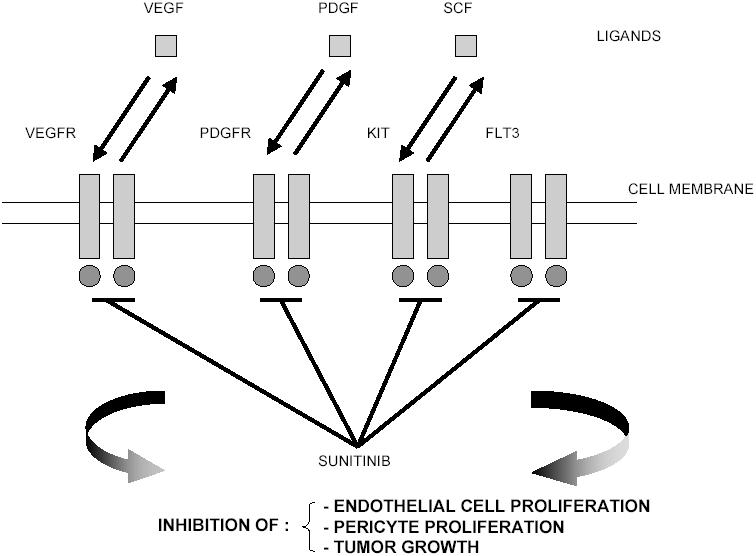
Sunitinib malate is a novel oral multitargeted tyrosine kinase inhibitor with antitumor and antiangiogenic activities. Sunitinib was recently approved in first-line treatment for patients with advanced renal cell carcinoma (RCC) and for the treatment of patients with gastrointestinal stromal tumors (GIST) after disease progression or intolerance to imatinib mesylate therapy. We report the very interesting results of the phase II trials after cytokin failure and of the randomized recent trial of sunitinib versus cytokin-based therapy in first-line treatment for patients with metastatic RCC, as well as the promising results of the recent trials on patients with GIST after disease progression or intolerance to imatinib mesylate therapy. Oral sunitinib demonstrates a high level of efficacy with acceptable tolerability with the 50 mg daily for 4 weeks followed by 2 weeks off schedule; a continuous schedule could be of interest. Hypertension and asthenia are the most common side effects with sunitinib. Regardless of these encouraging results, studies investigating sunitinib in first-line treatment (for patients with GIST), adjuvant and neoadjuvant settings are awaited, as well as trials using sunitinb in combination with chemotherapy or other targeted therapies. Clinical trials investigating sunitinib in other tumor types are ongoing.
苹果酸舒尼替尼是一种新型的口服多靶点酪氨酸激酶抑制剂,具有抗肿瘤和抗血管生成活性。舒尼替尼最近被批准用于晚期肾细胞癌(RCC)患者的一线治疗,以及伊马替尼治疗后疾病进展或不耐受的胃肠道间质瘤(GIST)患者的治疗。我们报告了细胞因子失败后的 II 期试验以及最近关于舒尼替尼与细胞因子为基础的一线治疗转移性 RCC 患者的随机试验的非常有趣的结果,以及伊马替尼治疗后疾病进展或不耐受的 GIST 患者最近试验的有希望的结果。每天口服舒尼替尼 50mg,连用 4 周,然后停药 2 周,这种方案具有很高的疗效,且耐受性良好;连续用药可能更有意义。高血压和乏力是舒尼替尼最常见的副作用。尽管有这些令人鼓舞的结果,但仍需要研究舒尼替尼在一线治疗(GIST 患者)、辅助和新辅助治疗中的应用,以及研究舒尼替尼与化疗或其他靶向治疗联合应用的情况。正在进行其他肿瘤类型中舒尼替尼的临床试验。