Cavigiolio Giorgio, Shao Baohai, Geier Ethan G, Ren Gang, Heinecke Jay W, Oda Michael N
Children's Hospital Oakland Research Institute, Oakland, CA 94609, USA.
Biochemistry. 2008 Apr 22;47(16):4770-9. doi: 10.1021/bi7023354. Epub 2008 Mar 27.
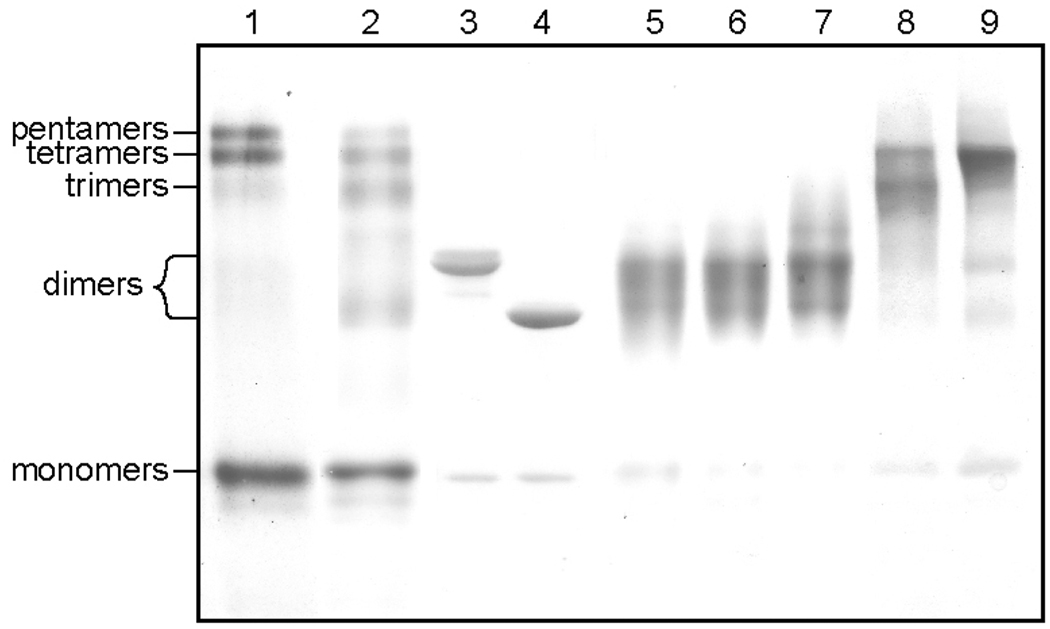
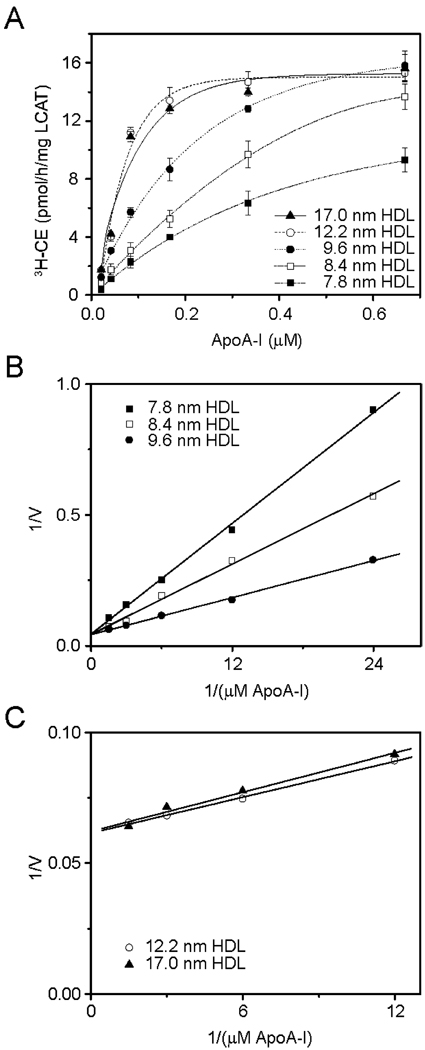
High-density lipoprotein (HDL) mediates reverse cholesterol transport (RCT), wherein excess cholesterol is conveyed from peripheral tissues to the liver and steroidogenic organs. During this process HDL continually transitions between subclass sizes, each with unique biological activities. For instance, RCT is initiated by the interaction of lipid-free/lipid-poor apolipoprotein A-I (apoA-I) with ABCA1, a membrane-associated lipid transporter, to form nascent HDL. Because nearly all circulating apoA-I is lipid-bound, the source of lipid-free/lipid-poor apoA-I is unclear. Lecithin:cholesterol acyltransferase (LCAT) then drives the conversion of nascent HDL to spherical HDL by catalyzing cholesterol esterification, an essential step in RCT. To investigate the relationship between HDL particle size and events critical to RCT such as LCAT activation and lipid-free apoA-I production for ABCA1 interaction, we reconstituted five subclasses of HDL particles (rHDL of 7.8, 8.4, 9.6, 12.2, and 17.0 nm in diameter, respectively) using various molar ratios of 1-palmitoyl-2-oleoyl-sn-glycero-3-phosphocholine, free cholesterol, and apoA-I. Kinetic analyses of this comprehensive array of rHDL particles suggest that apoA-I stoichiometry in rHDL is a critical factor governing LCAT activation. Electron microscopy revealed specific morphological differences in the HDL subclasses that may affect functionality. Furthermore, stability measurements demonstrated that the previously uncharacterized 8.4 nm rHDL particles rapidly convert to 7.8 nm particles, concomitant with the dissociation of lipid-free/lipid-poor apoA-I. Thus, lipid-free/lipid-poor apoA-I generated by the remodeling of HDL may be an essential intermediate in RCT and HDL's in vivo maturation.
高密度脂蛋白(HDL)介导逆向胆固醇转运(RCT),即过量胆固醇从外周组织转运至肝脏和类固醇生成器官。在此过程中,HDL会在不同亚类大小之间持续转变,每个亚类都具有独特的生物学活性。例如,RCT由无脂/低脂载脂蛋白A-I(apoA-I)与膜相关脂质转运蛋白ABCA1相互作用引发,形成新生HDL。由于几乎所有循环中的apoA-I都与脂质结合,无脂/低脂apoA-I的来源尚不清楚。卵磷脂胆固醇酰基转移酶(LCAT)随后通过催化胆固醇酯化驱动新生HDL转化为球形HDL,这是RCT中的关键步骤。为了研究HDL颗粒大小与RCT关键事件(如LCAT激活以及ABCA1相互作用所需的无脂apoA-I生成)之间的关系,我们使用1-棕榈酰-2-油酰-sn-甘油-3-磷酸胆碱、游离胆固醇和apoA-I的不同摩尔比,重构了HDL颗粒的五个亚类(直径分别为7.8、8.4、9.6、12.2和17.0 nm的重组HDL)。对这一系列全面的重组HDL颗粒进行动力学分析表明,重组HDL中apoA-I的化学计量是控制LCAT激活的关键因素。电子显微镜揭示了HDL亚类中可能影响功能的特定形态差异。此外,稳定性测量表明,之前未表征的8.4 nm重组HDL颗粒会迅速转化为7.8 nm颗粒,同时无脂/低脂apoA-I会解离。因此,HDL重塑产生的无脂/低脂apoA-I可能是RCT和HDL体内成熟过程中的重要中间体。