Department of Physiology and Pathophysiology, Peking (Beijing) University Diabetes Center, Peking (Beijing) University Health Science Center, Beijing 100083, China.
PPAR Res. 2008;2008:723243. doi: 10.1155/2008/723243.
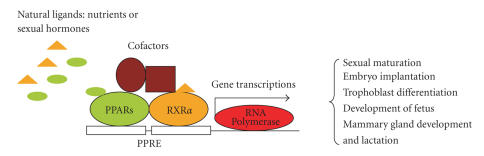
Peroxisome proliferator-activated receptors (PPARs) are ligand-activated nuclear receptors controlling many important physiological processes, including lipid and glucose metabolism, energy homeostasis, inflammation, as well as cell proliferation and differentiation. In the past decade, intensive study of PPARs has shed novel insight into prevention and treatment of dyslipidemia, insulin resistance, and type 2 diabetes. Recently, a large body of research revealed that PPARs are also functionally expressed in reproductive organs and various parts of placenta during pregnancy, which strongly suggests that PPARs might play a critical role in reproduction and development, in addition to their central actions in energy homeostasis. In this review, we summarize recent findings elucidating the role of PPARs in female reproduction, with particular focus on evidence from gene knockout and transgenic animal model study.
过氧化物酶体增殖物激活受体(PPARs)是配体激活的核受体,可控制许多重要的生理过程,包括脂质和葡萄糖代谢、能量平衡、炎症以及细胞增殖和分化。在过去的十年中,对 PPARs 的深入研究为预防和治疗血脂异常、胰岛素抵抗和 2 型糖尿病提供了新的认识。最近,大量研究表明,PPARs 在怀孕期间也在生殖器官和胎盘的各个部位有功能性表达,这强烈表明 PPARs 除了在能量平衡中发挥核心作用外,还可能在生殖和发育中发挥关键作用。在这篇综述中,我们总结了最近阐明 PPARs 在女性生殖中的作用的发现,特别关注基因敲除和转基因动物模型研究的证据。