Moeller Niels C, Korsholm Lars, Kristensen Peter L, Andersen Lars B, Wedderkopp Niels, Froberg Karsten
Institute of Sport Science and Clinical Biomechanics, University of Southern Denmark, Odense, Denmark.
BMC Med Res Methodol. 2008 Apr 11;8:19. doi: 10.1186/1471-2288-8-19.
Potentially, unit-specific in-vitro calibration of accelerometers could increase field data quality and study power. However, reduced inter-unit variability would only be important if random instrument variability contributes considerably to the total variation in field data. Therefore, the primary aim of this study was to calculate and apply unit-specific calibration factors in multiple accelerometers in order to examine the impact on random output variation caused by inter-instrument variability.
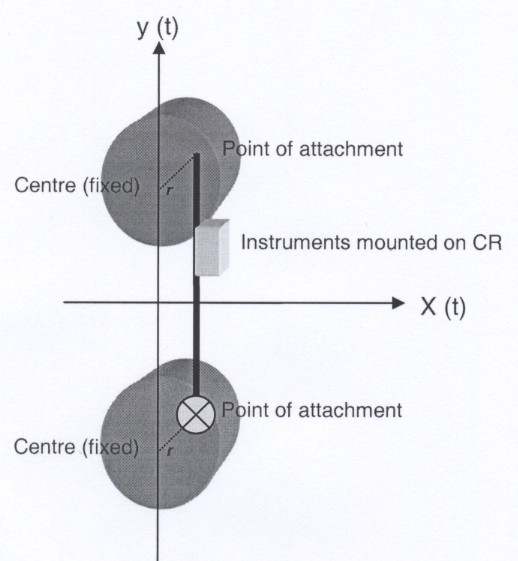
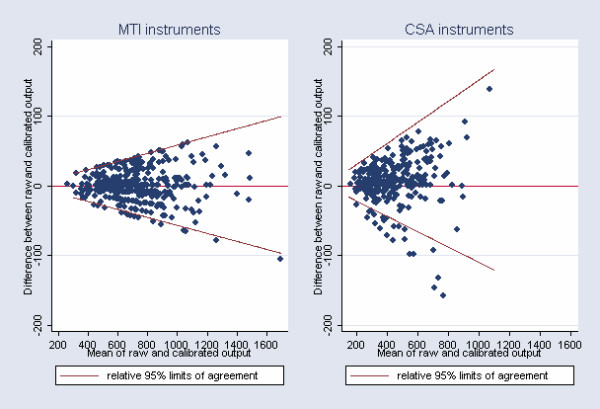
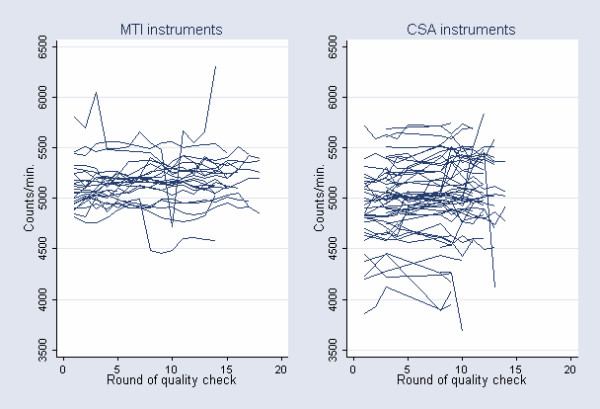
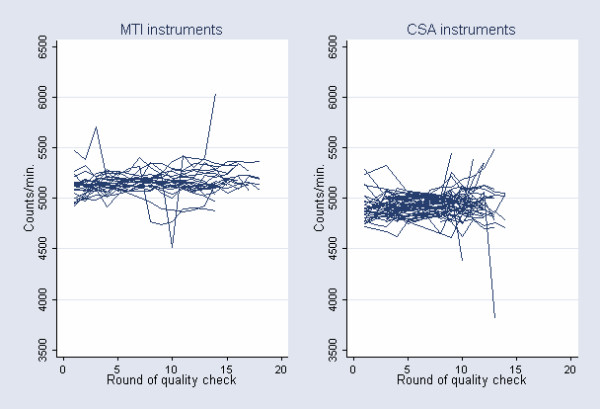
Instrument-specific calibration factors were estimated in 25 MTI- and 53 CSA accelerometers in a mechanical setup using four different settings varying in frequencies and/or amplitudes. Calibration effect was analysed by comparing raw and calibrated data after applying unit-specific calibration factors to data obtained during quality checks in a mechanical setup and to data collected during free living conditions.
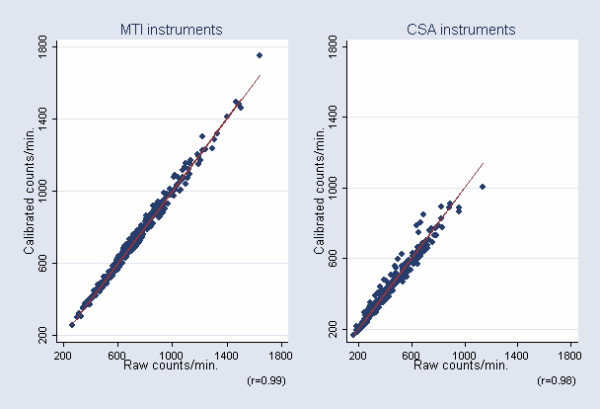
Calibration reduced inter-instrument variability considerably in the mechanical setup, both in the MTI instruments (raw SDbetween units = 195 countsmin-1 vs. calibrated SDbetween units = 65 countsmin-1) and in the CSA instruments (raw SDbetween units = 343 countsmin-1 vs. calibrated SDbetween units = 67 countsmin-1). However, the effect of applying the derived calibration to children's and adolescents' free living physical activity data did not alter the coefficient of variation (CV) (children: CVraw = 30.2% vs. CVcalibrated = 30.4%, adolescents: CVraw = 36.3% vs. CVcalibrated = 35.7%). High correlations (r = 0.99 & r = 0.98, respectively) were observed between raw and calibrated field data, and the proportion of the total variation caused by the MTI- and CSA monitor was estimated to be only 1.1% and 4.2%, respectively. Compared to the CSA instruments, a significantly increased (9.95%) mean acceleration response was observed post hoc in the batch of MTI instruments, in which a significantly reduced inter-instrumental reliability was observed over time.
The application of unit-specific calibration factors to data collected during free living conditions had no apparent effect on inter-instrument variability. In all probability, the effect of technical calibration was primarily attenuated in the field by other more dominant sources of variation. However, routine technical assessments are still very important for determining the acceleration responses in the batch of instruments being used and, if performed after every field use, for preventing decidedly broken instruments from being returned into the field repeatedly.
加速度计的特定单元体外校准可能会提高现场数据质量和研究效能。然而,只有当随机仪器变异性在现场数据的总变异中占相当大比例时,降低单元间变异性才会很重要。因此,本研究的主要目的是计算并应用多个加速度计的特定单元校准因子,以检验仪器间变异性对随机输出变异的影响。
在机械装置中,使用四种频率和/或振幅不同的设置,对25个MTI加速度计和53个CSA加速度计进行仪器特定校准因子的估计。通过将特定单元校准因子应用于在机械装置质量检查期间获得的数据以及在自由生活条件下收集的数据后,比较原始数据和校准后的数据,分析校准效果。
在校准机械装置中,校准显著降低了仪器间变异性,在MTI仪器中(单元间原始标准差 = 195计数·分钟⁻¹,单元间校准后标准差 = 65计数·分钟⁻¹)和CSA仪器中(单元间原始标准差 = 343计数·分钟⁻¹,单元间校准后标准差 = 67计数·分钟⁻¹)均如此。然而,将推导的校准应用于儿童和青少年的自由生活身体活动数据,并未改变变异系数(CV)(儿童:CV原始 = 30.2%,CV校准 = 30.4%;青少年:CV原始 = 36.3%,CV校准 = 35.7%)。在校准前后的现场数据之间观察到高度相关性(分别为r = 0.99和r = 0.98),并且估计MTI和CSA监测器引起的总变异比例分别仅为1.1%和4.2%。与CSA仪器相比,事后观察到MTI仪器批次的平均加速度响应显著增加(9.95%),其中随着时间推移,仪器间可靠性显著降低。
将特定单元校准因子应用于自由生活条件下收集的数据,对仪器间变异性没有明显影响。很可能,技术校准的效果在现场主要被其他更主要的变异来源所减弱。然而,常规技术评估对于确定正在使用的仪器批次中的加速度响应仍然非常重要,如果在每次现场使用后进行评估,则有助于防止明显损坏的仪器反复返回现场。