Grunt Michal, Zárský Viktor, Cvrcková Fatima
Department of Plant Physiology, Faculty of Sciences, Charles University, Vinièná 5, CZ 128 43 Praha 2, Czech Republic.
BMC Evol Biol. 2008 Apr 22;8:115. doi: 10.1186/1471-2148-8-115.
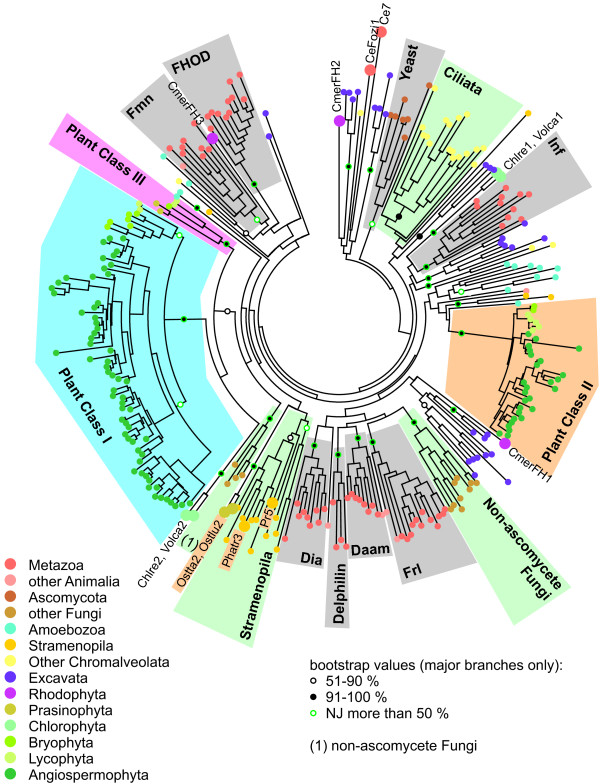
Shuffling of modular protein domains is an important source of evolutionary innovation. Formins are a family of actin-organizing proteins that share a conserved FH2 domain but their overall domain architecture differs dramatically between opisthokonts (metazoans and fungi) and plants. We performed a phylogenomic analysis of formins in most eukaryotic kingdoms, aiming to reconstruct an evolutionary scenario that may have produced the current diversity of domain combinations with focus on the origin of the angiosperm formin architectures.
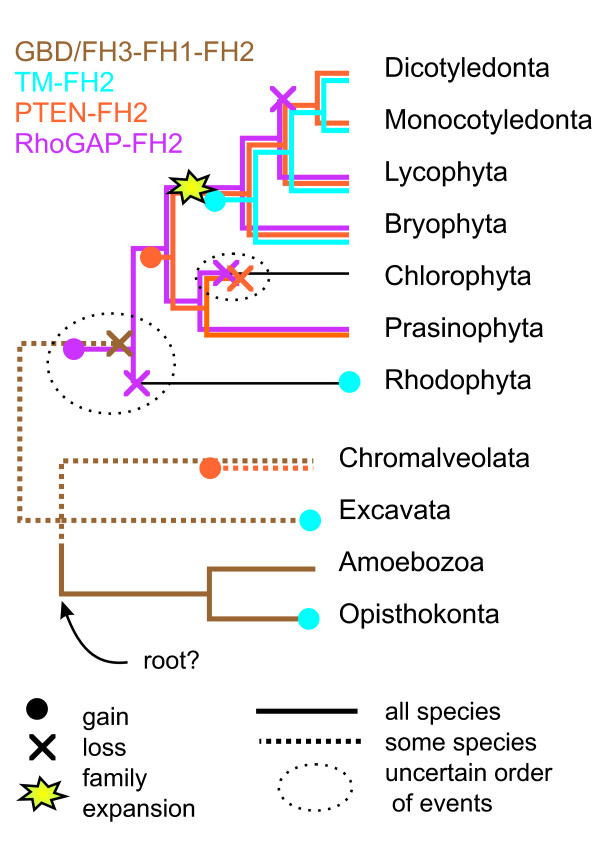
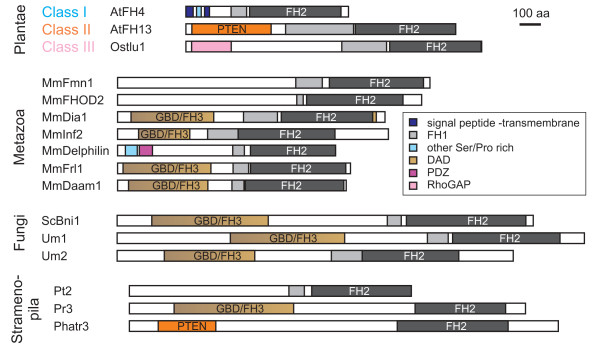
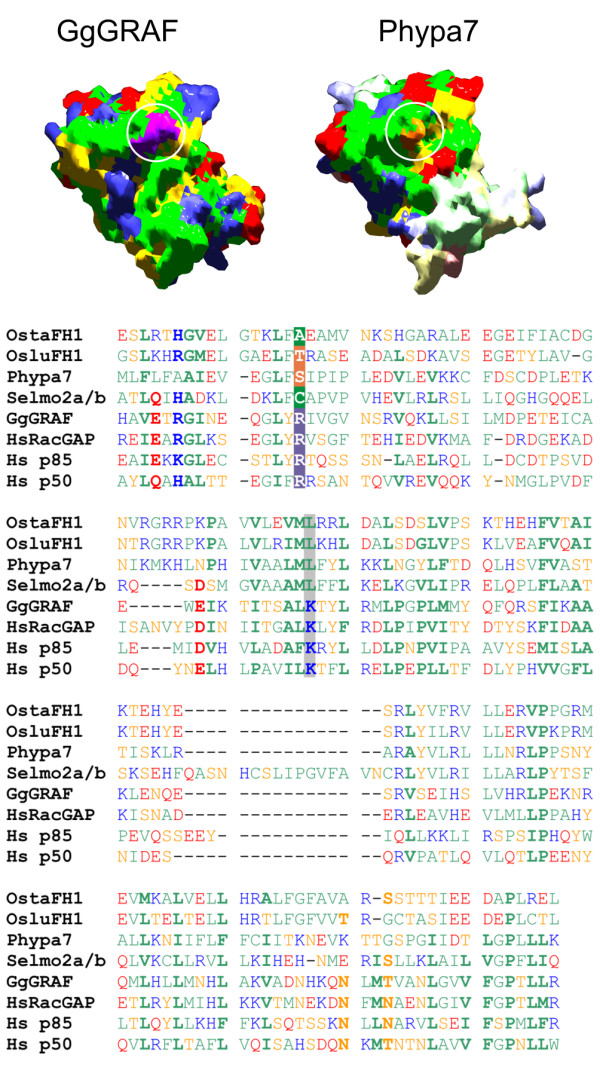
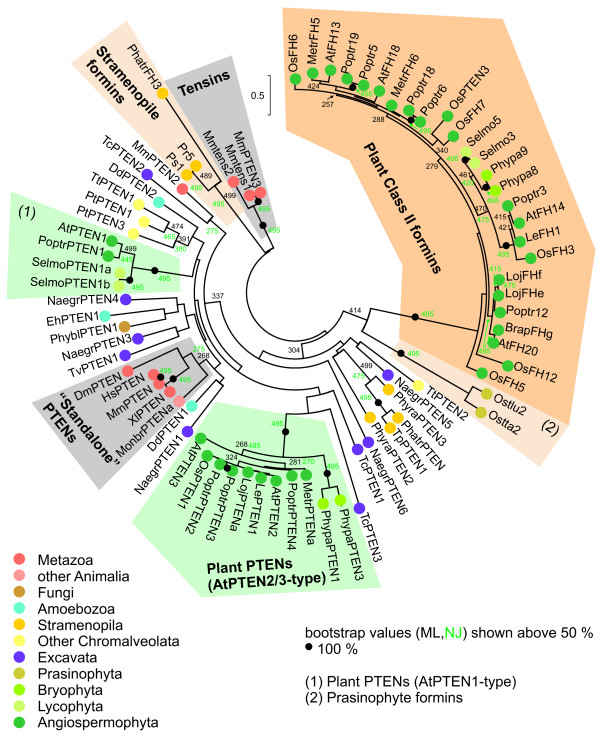
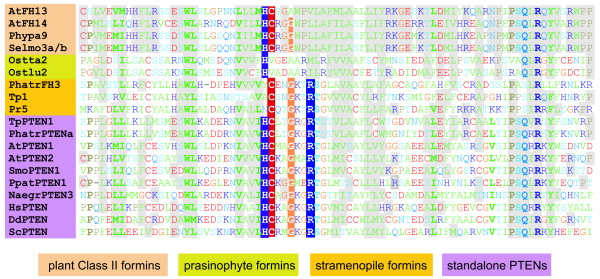
The Rho GTPase-binding domain (GBD/FH3) reported from opisthokont and Dictyostelium formins was found in all lineages except plants, suggesting its ancestral character. Instead, mosses and vascular plants possess the two formin classes known from angiosperms: membrane-anchored Class I formins and Class II formins carrying a PTEN-like domain. PTEN-related domains were found also in stramenopile formins, where they have been probably acquired independently rather than by horizontal transfer, following a burst of domain rearrangements in the chromalveolate lineage. A novel RhoGAP-related domain was identified in some algal, moss and lycophyte (but not angiosperm) formins that define a specific branch (Class III) of the formin family.
We propose a scenario where formins underwent multiple domain rearrangements in several eukaryotic lineages, especially plants and chromalveolates. In plants this replaced GBD/FH3 by a probably inactive RhoGAP-like domain, preserving a formin-mediated association between (membrane-anchored) Rho GTPases and the actin cytoskeleton. Subsequent amplification of formin genes, possibly coincident with the expansion of plants to dry land, was followed by acquisition of alternative membrane attachment mechanisms present in extant Class I and Class II formins, allowing later loss of the RhoGAP-like domain-containing formins in angiosperms.
模块化蛋白质结构域的重排是进化创新的重要来源。formin是一类肌动蛋白组织蛋白,它们共享一个保守的FH2结构域,但后生动物(后生动物和真菌)与植物之间其整体结构域架构差异巨大。我们对大多数真核生物界的formin进行了系统基因组分析,旨在重建一个可能产生当前结构域组合多样性的进化场景,重点关注被子植物formin架构的起源。
除植物外,在所有谱系中均发现了后生动物和盘基网柄菌formin中报道的Rho GTPase结合结构域(GBD/FH3),表明其具有祖先特征。相反,苔藓和维管植物拥有被子植物中已知的两类formin:膜锚定的I类formin和携带PTEN样结构域的II类formin。在不等鞭毛藻formin中也发现了与PTEN相关的结构域,在色素体藻类谱系中经历了一系列结构域重排后,它们可能是独立获得而非通过水平转移。在一些藻类、苔藓和石松(但不是被子植物)formin中鉴定出一个新的与RhoGAP相关的结构域,该结构域定义了formin家族的一个特定分支(III类)。
我们提出了一种设想,即formin在几个真核生物谱系中经历了多次结构域重排,尤其是在植物和色素体藻类中。在植物中,这一过程用一个可能无活性的RhoGAP样结构域取代了GBD/FH3,保留了formin介导的(膜锚定的)Rho GTPases与肌动蛋白细胞骨架之间的关联。随后formin基因的扩增,可能与植物向陆地的扩张同时发生,接着获得了现存I类和II类formin中存在的替代膜附着机制,从而使被子植物中含RhoGAP样结构域的formin后来丢失。