Pande Saket, Keyzer Michiel A, Arouna Aminou, Sonneveld Ben G J S
Centre for World Food Studies (SOW-VU), VU University, Amsterdam, Netherlands.
Int J Health Geogr. 2008 Apr 23;7:17. doi: 10.1186/1476-072X-7-17.
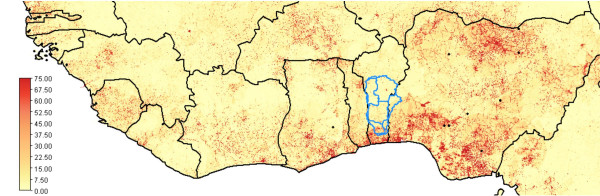
In West Africa, the Northern Sahelian zone and the coastal areas are densely populated but the Middle Belt in between is in general sparsely settled. Predictions of climate change foresee more frequent drought in the north and more frequent flooding in the coastal areas, while conditions in the Middle Belt will remain moderate. Consequently, the Middle Belt might become a major area for immigration but there may be constraining factors as well, particularly with respect to water availability. As a case study, the paper looks into the capacity of the Middle Belt zone of Benin, known as the Oueme River Basin (ORB), to reduce diarrhea prevalence. In Benin it links to the Millennium Development Goals on child mortality and environmental sustainability that are currently farthest from realization. However, diarrhea prevalence is only in part due to lack of availability of drinking water from a safe source. Social factors such as hygienic practices and poor sanitation are also at play. Furthermore, we consider these factors to possess the properties of a local public good that suffers from under provision and requires collective action, as individual actions to prevent illness are bound to fail as long as others free ride.
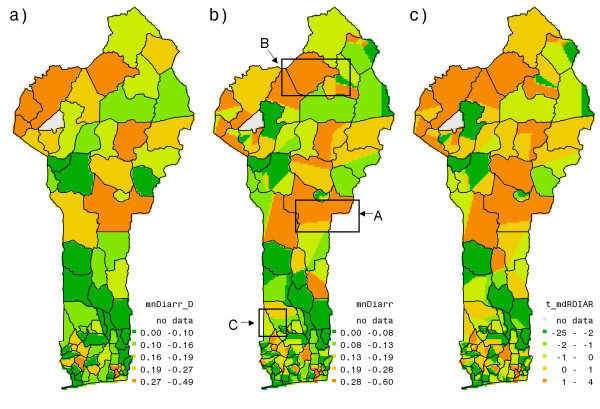
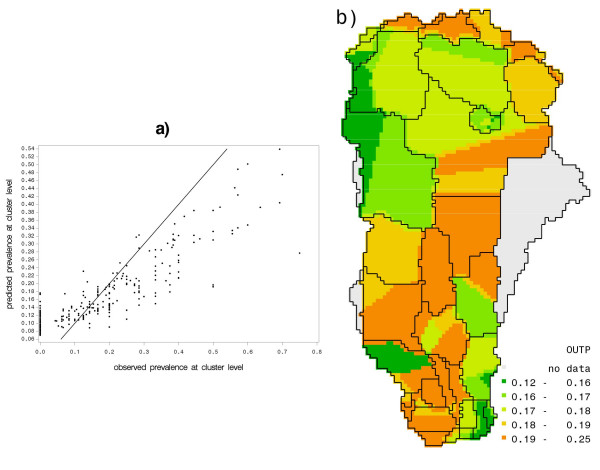
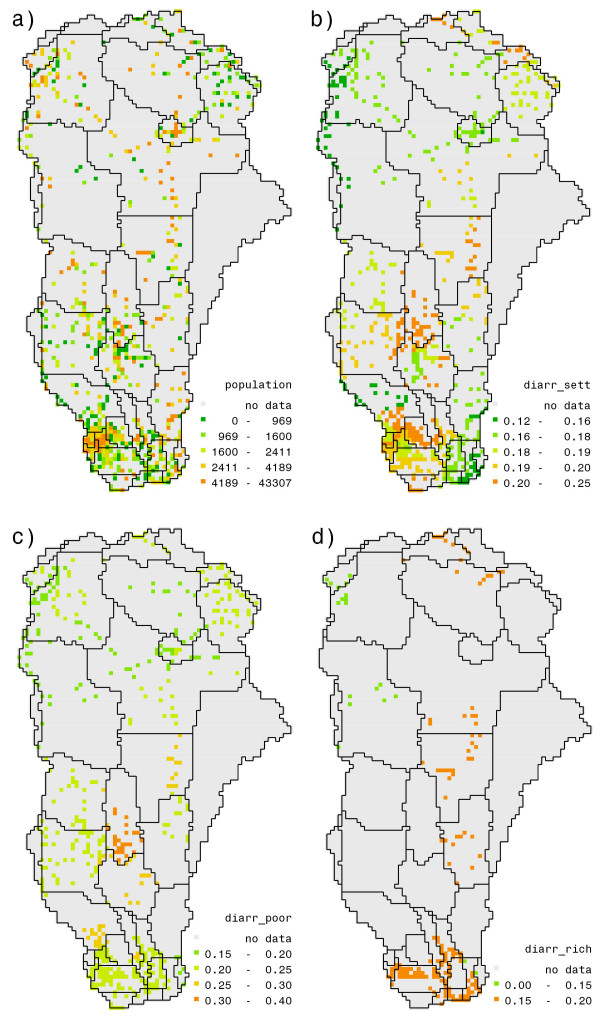
Combining data from the Demographic Health Survey with various spatial data sets for Benin, we apply mixed effect logit regression to arrive at a spatially explicit assessment of geographical and social determinants of diarrhea prevalence. Starting from an analysis of these factors separately at national level, we identify relevant proxies at household level, estimate a function with geo-referenced independent variables and apply it to evaluate the costs and impacts of improving access to good water in the basin.
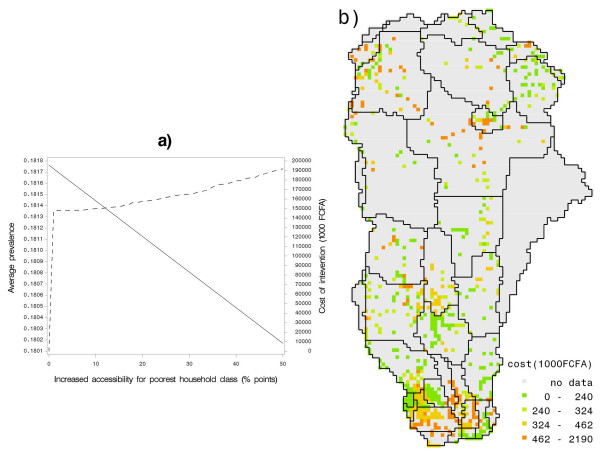
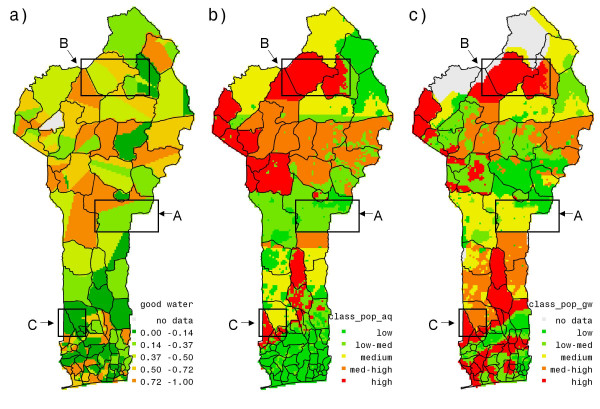
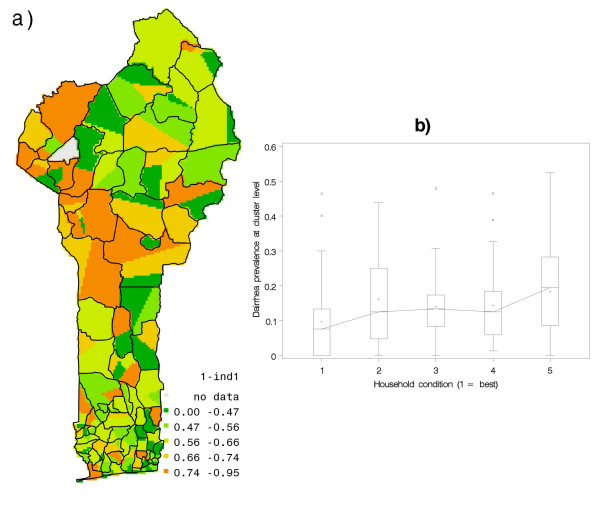
First, the study confirms the well established stylized fact on the causes of diarrhea that a household with access to clean water and with good hygienic practices will, irrespective of other conditions, not suffer diarrhea very often. Second, our endogeneity tests show that joint estimation performs better than an instrumental variable regression. Third, our model is stable with respect to its functional form, as competing specifications could not achieve better performance in overall likelihood or significance of parameters. Fourth, it finds that the richer and better educated segments of the population suffer much less from the disease and apparently can secure safe water for their households, irrespective of where they live. Fifth, regarding geographical causes, it indicates that diarrhea prevalence varies with groundwater availability and quality across Benin. Finally, our assessment of costs and benefits reveals that improving physical access to safe water is not expensive but can only marginally improve the overall health situation of the basin, unless the necessary complementary measures are taken in the social sphere.
The ORB provides adequate water resources to accommodate future settlers but it lacks appropriate infrastructure to deliver safe water to households. Moreover, hygienic practices are often deficient. Therefore, a multifaceted approach is needed that acknowledges the public good aspects of health situation and consequently combines collective action with investments into water sources with improved management of public wells and further educational efforts to change hygienic practices.
在西非,萨赫勒北部地区和沿海地区人口密集,但两者之间的中部地带人口总体稀少。气候变化预测显示,北部干旱将更加频繁,沿海地区洪水将更加频繁,而中部地带的情况将保持温和。因此,中部地带可能会成为主要的移民地区,但也可能存在制约因素,特别是在水资源供应方面。作为一个案例研究,本文探讨了贝宁中部地带(即韦梅河流域,ORB)降低腹泻患病率的能力。在贝宁,这与目前距离实现最远的儿童死亡率和环境可持续性千年发展目标相关。然而,腹泻患病率只是部分归因于缺乏安全饮用水源。卫生习惯和卫生条件差等社会因素也在起作用。此外,我们认为这些因素具有地方公共物品的属性,存在供应不足的问题,需要集体行动,因为只要其他人搭便车,个人预防疾病的行动必然会失败。
我们将人口与健康调查数据与贝宁的各种空间数据集相结合,应用混合效应逻辑回归,对腹泻患病率的地理和社会决定因素进行空间明确的评估。从在国家层面分别分析这些因素开始,我们确定家庭层面的相关代理变量,估计一个包含地理参考自变量的函数,并应用它来评估改善流域优质水供应的成本和影响。
首先,该研究证实了关于腹泻病因的一个既定的典型事实,即无论其他条件如何,能够获得清洁水且卫生习惯良好的家庭不太容易经常患腹泻。其次,我们的内生性检验表明,联合估计比工具变量回归表现更好。第三,我们的模型在函数形式方面是稳定的,因为竞争的设定在总体似然性或参数显著性方面无法取得更好的表现。第四,研究发现,无论居住在哪里,较富裕和受教育程度较高的人群患这种疾病的几率要低得多,而且显然能够为其家庭确保安全用水。第五,关于地理原因,研究表明贝宁各地的腹泻患病率随地下水的可获得性和质量而变化。最后,我们对成本和效益的评估表明,改善安全水的实际供应成本不高,但只能略微改善流域的整体健康状况,除非在社会领域采取必要的补充措施。
韦梅河流域提供了充足的水资源来容纳未来的定居者,但缺乏将安全水输送到家庭的适当基础设施。此外,卫生习惯往往不足。因此,需要采取多方面的方法,承认健康状况的公共物品属性,从而将集体行动与对水源的投资相结合,同时改善公共水井的管理,并进一步开展教育工作以改变卫生习惯。