Dutra Walderez O, Gollob Kenneth J
Department of Morphology, Federal University of Minas Gerais, Belo Horizonte, Minas Gerais, Brazil.
Curr Opin Infect Dis. 2008 Jun;21(3):287-92. doi: 10.1097/QCO.0b013e3282f88b80.
Chagas disease is a complex ailment caused by infection with Trypanosoma cruzi. It afflicts millions in Latin America. Years of studies have focused on the development of pathology in Chagas disease and recent studies have helped us understand the cellular mechanisms behind differential clinical evolution of Chagas disease.
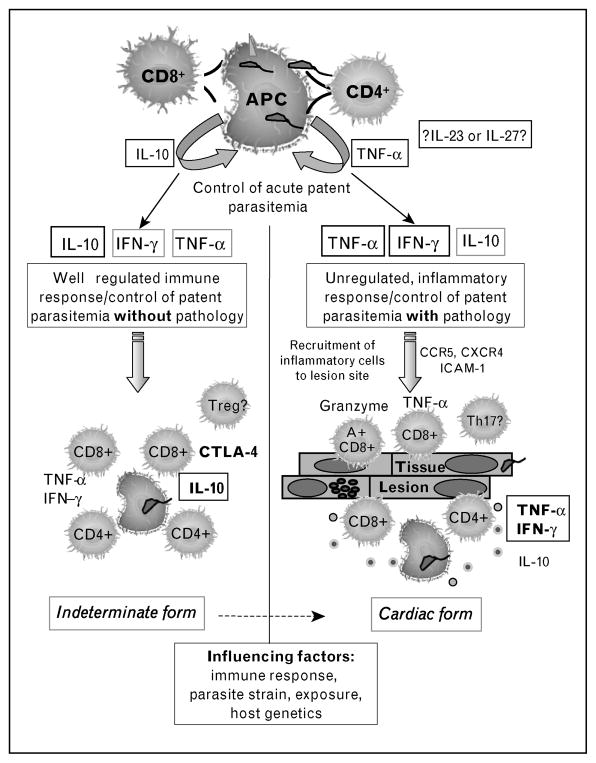
We discuss recent findings concerning the cellular immune response in human Chagas disease focusing on immunoregulation and the development of pathology. We seek to put several findings into the context of a disease that initially controls an extreme and patent infection, and later progresses to a chronic phase marked by the presence (cardiac and digestive forms), or not (indeterminate form), of associated pathology.
Several theories exist to explain differential clinical evolution of Chagas disease. A coherent understanding of these theories will certainly aid in determining what combination of them approximates the true development of chagasic pathology. For achieving the goal of developing a successful therapy or intervention, it is critical that no theory be excluded at this point, but. Rather, rather that a thoughtful analysis and assimilation of the best components of each system into a central theory that best fits the reality of human Chagas disease is desirable.
恰加斯病是一种由克氏锥虫感染引起的复杂疾病。它在拉丁美洲折磨着数百万人。多年来的研究集中在恰加斯病的病理学发展上,最近的研究帮助我们了解了恰加斯病不同临床演变背后的细胞机制。
我们讨论了关于人类恰加斯病细胞免疫反应的最新发现,重点是免疫调节和病理学发展。我们试图将一些发现置于一种疾病的背景下,这种疾病最初能控制严重且明显的感染,随后进展到慢性期,其特征为存在(心脏和消化型)或不存在(不确定型)相关病理学表现。
存在几种理论来解释恰加斯病的不同临床演变。对这些理论的连贯理解肯定有助于确定它们的何种组合最接近恰加斯病病理学的真实发展情况。为了实现开发成功治疗方法或干预措施的目标,此时不排除任何一种理论至关重要,相反,需要对每个系统的最佳组成部分进行深入分析并将其整合到最符合人类恰加斯病实际情况的核心理论中。