SENAI Institute of Innovation in Health Advanced Systems (CIMATEC ISI SAS), University Center SENAI/CIMATEC, Salvador, Brazil.
Gonçalo Moniz Institute, Oswaldo Cruz Foundation (IGM-FIOCRUZ/BA), Salvador, Brazil.
Front Cell Infect Microbiol. 2021 Nov 12;11:765879. doi: 10.3389/fcimb.2021.765879. eCollection 2021.
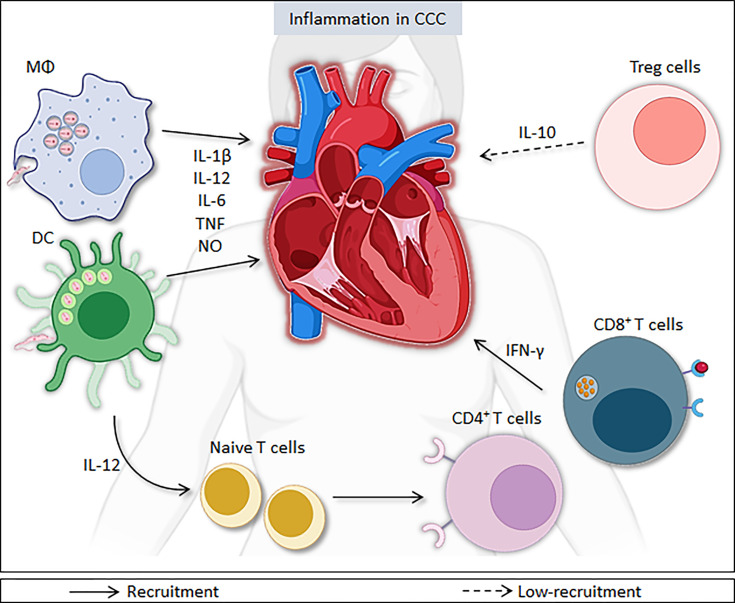
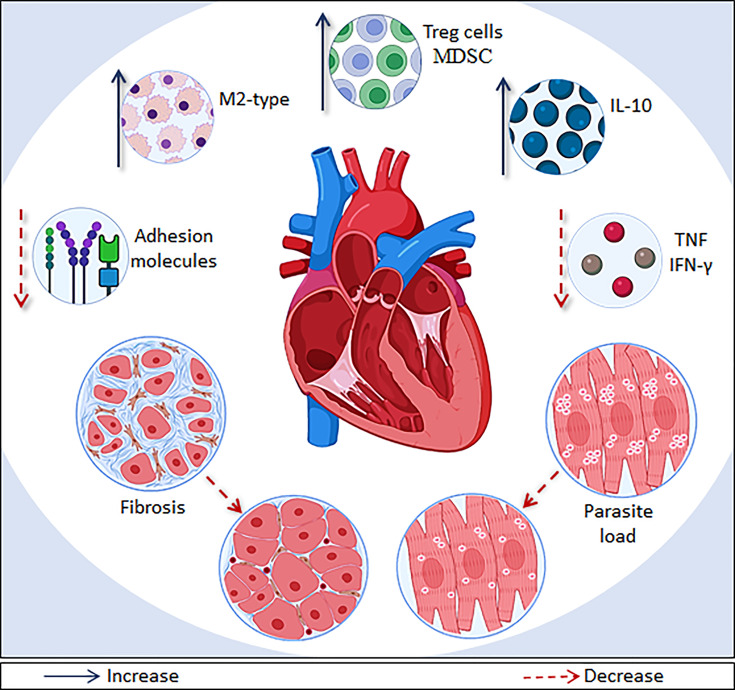
Chagas disease is a parasitic infection caused by the intracellular protozoan . Chronic Chagas cardiomyopathy (CCC) is the most severe manifestation of the disease, developed by approximately 20-40% of patients and characterized by occurrence of arrhythmias, heart failure and death. Despite having more than 100 years of discovery, Chagas disease remains without an effective treatment, especially for patients with CCC. Since the pathogenesis of CCC depends on a parasite-driven systemic inflammatory profile that leads to cardiac tissue damage, the use of immunomodulators has become a rational alternative for the treatment of CCC. In this context, different classes of drugs, cell therapies with dendritic cells or stem cells and gene therapy have shown potential to modulate systemic inflammation and myocarditis in CCC models. Based on that, the present review provides an overview of current reports regarding the use of immunomodulatory agents in treatment of CCC, bringing the challenges and future directions in this field.
恰加斯病是一种由细胞内原生动物引起的寄生虫感染。慢性恰加斯心肌病(CCC)是该病最严重的表现形式,约 20-40%的患者会发生该病,其特征是心律失常、心力衰竭和死亡。尽管恰加斯病已被发现了 100 多年,但仍没有有效的治疗方法,特别是对于 CCC 患者。由于 CCC 的发病机制依赖于寄生虫驱动的全身炎症谱,导致心脏组织损伤,因此免疫调节剂的使用已成为治疗 CCC 的合理选择。在这种情况下,不同类别的药物、树突状细胞或干细胞的细胞疗法以及基因疗法已显示出在 CCC 模型中调节全身炎症和心肌炎的潜力。基于此,本综述提供了关于免疫调节剂在 CCC 治疗中的应用的最新报告概述,介绍了该领域的挑战和未来方向。