Oberg Tara, Brosseau Lisa M
University of Minnesota, Minneapolis, MN 55455, USA.
Am J Infect Control. 2008 May;36(4):276-82. doi: 10.1016/j.ajic.2007.07.008.
Surgical masks have been used since the early 1900s to minimize infection of surgical wounds from wearer-generated bacteria. There is ongoing debate, however, whether surgical masks can meet the expectations of respiratory protection devices. The goal of this study was to evaluate the filter performance and facial fit of a sample of surgical masks.
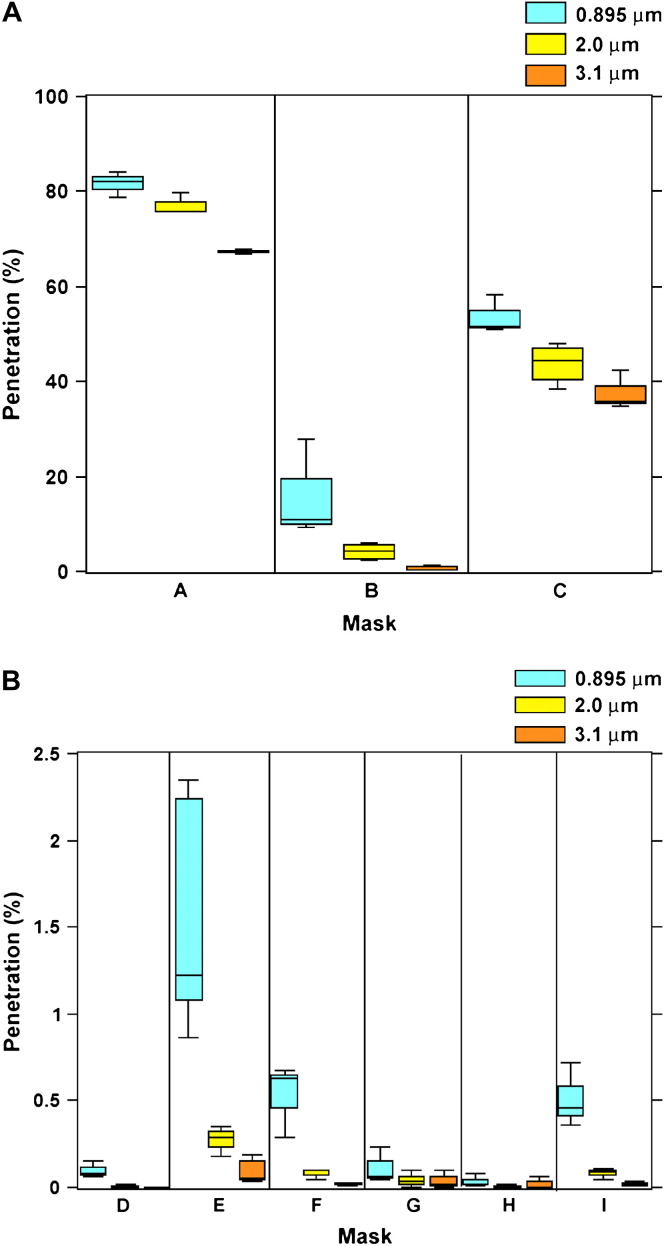
Filter penetration was measured for at least 3 replicates of 9 surgical masks using monodisperse latex sphere aerosols (0.895, 2.0, and 3.1 microm) at 6 L/min and 0.075-microm sodium chloride particles at 84 L/min. Facial fit was measured on 20 subjects for the 5 masks with lowest particle penetration, using both qualitative and quantitative fit tests.
Masks typically used in dental settings collected particles with significantly lower efficiency than those typically used in hospital settings. All subjects failed the unassisted qualitative fit test on the first exercise (normal breathing). Eighteen subjects failed the assisted qualitative fit tests; 60% failed on the first exercise. Quantitative fit factors ranged from 2.5 to 9.6.
None of these surgical masks exhibited adequate filter performance and facial fit characteristics to be considered respiratory protection devices.
自20世纪初以来,外科口罩就被用于尽量减少佩戴者产生的细菌对手术伤口的感染。然而,对于外科口罩是否能达到呼吸防护设备的预期,目前仍存在争议。本研究的目的是评估一组外科口罩的过滤性能和面部贴合度。
使用单分散乳胶球气溶胶(0.895、2.0和3.1微米)在6升/分钟的流量下以及0.075微米的氯化钠颗粒在84升/分钟的流量下,对9个外科口罩的至少3个复制品测量过滤穿透率。对于颗粒穿透率最低的5个口罩,在20名受试者身上使用定性和定量贴合测试来测量面部贴合度。
牙科环境中通常使用的口罩收集颗粒的效率明显低于医院环境中通常使用的口罩。所有受试者在第一次练习(正常呼吸)时无人通过非辅助定性贴合测试。18名受试者未通过辅助定性贴合测试;60%的人在第一次练习时未通过。定量贴合因子范围为2.5至9.6。
这些外科口罩均未表现出足以被视为呼吸防护设备的过滤性能和面部贴合度特征。