Fournier Jean Paul, Demeester Anne, Charlin Bernard
CPASS, direction de la recherche, Faculté de Médecine, Université de Montréal, CP 6128, Succursale centre-ville, Montréal, Québec, H3C 3J7, Canada.
BMC Med Inform Decis Mak. 2008 May 6;8:18. doi: 10.1186/1472-6947-8-18.
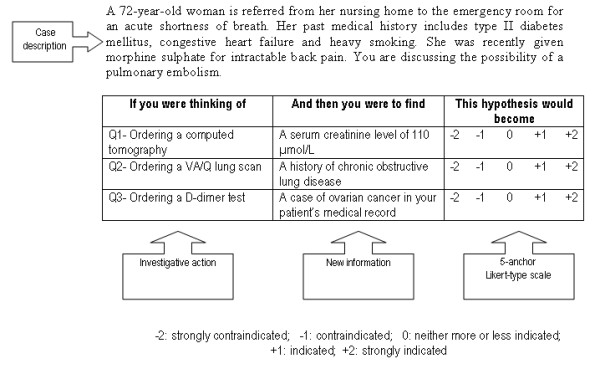
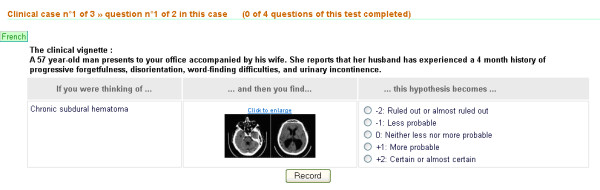
SCT is used to assess clinical reasoning in ambiguous or uncertain situations. It allows testing on real-life situations that are not adequately measured with current tests. It probes the multiple judgments that are made in the clinical reasoning process. Scoring reflects the degree of concordance of these judgments to those of a panel of reference experts.
SCT is an item format that is gaining acceptance in education in the health professions. However, there are no detailed guidelines on item writing, test scoring or test optimization.
The item format is described and the steps for preparing and administering reliable and valid SCTs are presented.
SCTs probe examinees on a specific clinical reasoning task: data interpretation, a crucial step in the clinical reasoning process. It is inferred that a high degree of concordance corresponds to optimal use of information in the context of these specific tasks and therefore provides an indication of clinical reasoning quality.
情境判断测验(SCT)用于评估在模糊或不确定情况下的临床推理能力。它能够对现实生活中的情况进行测试,而这些情况无法通过当前的测试得到充分评估。它探究了临床推理过程中所做出的多重判断。评分反映了这些判断与一组参考专家的判断的一致程度。
情境判断测验是一种在卫生专业教育中逐渐被接受的题型。然而,在题目编写、测试评分或测试优化方面没有详细的指导方针。
描述了该题型,并介绍了准备和实施可靠且有效的情境判断测验的步骤。
情境判断测验针对特定的临床推理任务对考生进行考查:数据解读,这是临床推理过程中的关键一步。据推断,高度的一致性对应于在这些特定任务背景下对信息的最佳利用,因此提供了临床推理质量的一个指标。