Farrell M J, Dobson A T, Feldman L T
Molecular Biology Institute, University of California, Los Angeles 90024.
Proc Natl Acad Sci U S A. 1991 Feb 1;88(3):790-4. doi: 10.1073/pnas.88.3.790.
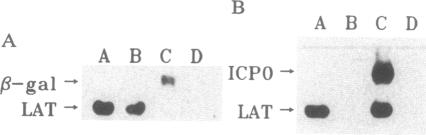
The latency-associated transcript (LAT) is the major viral transcript detected by in situ hybridization of mouse and human sensory ganglia latently infected with herpes simplex virus type 1. The last 750 bases of LAT are complementary to infected-cell polypeptide 0, a herpes simplex virus type 1 immediate-early gene that encodes a transactivating protein that may facilitate re-activation of the virus from the latent state. Several laboratories have shown that LAT accumulates in the nucleus and is not polyadenylylated. Recently, we showed that the promoter for LAT lies 688 bases upstream from its 5' end. We report here that LAT is actually a uniquely stable intron. Furthermore, LAT effectively inhibits transactivation of gene expression by infected-cell polypeptide 0 in transient transfection assays.
潜伏期相关转录本(LAT)是在单纯疱疹病毒1型潜伏感染的小鼠和人类感觉神经节原位杂交检测中发现的主要病毒转录本。LAT的最后750个碱基与感染细胞多肽0互补,感染细胞多肽0是单纯疱疹病毒1型的一个立即早期基因,编码一种反式激活蛋白,该蛋白可能有助于病毒从潜伏状态重新激活。多个实验室已表明LAT在细胞核中积累且不进行多聚腺苷酸化。最近,我们发现LAT的启动子位于其5'端上游688个碱基处。我们在此报告LAT实际上是一个独特稳定的内含子。此外,在瞬时转染实验中,LAT有效抑制感染细胞多肽0对基因表达的反式激活作用。