Tsuji Naotoshi, Miyoshi Takeharu, Battsetseg Badger, Matsuo Tomohide, Xuan Xuenan, Fujisaki Kozo
Laboratory of Parasitic Diseases, National Institute of Animal Health, National Agriculture and Food Research Organization, Tsukuba, Ibaraki, Japan.
PLoS Pathog. 2008 May 16;4(5):e1000062. doi: 10.1371/journal.ppat.1000062.
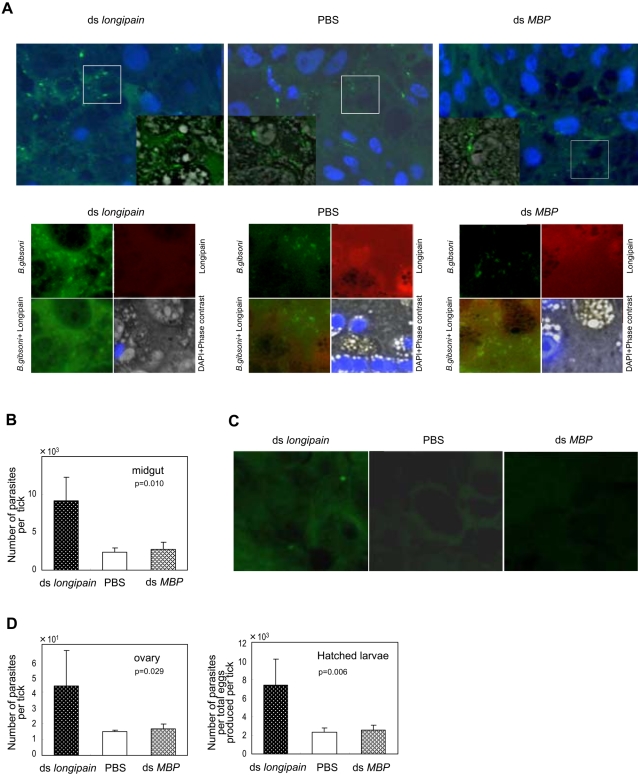
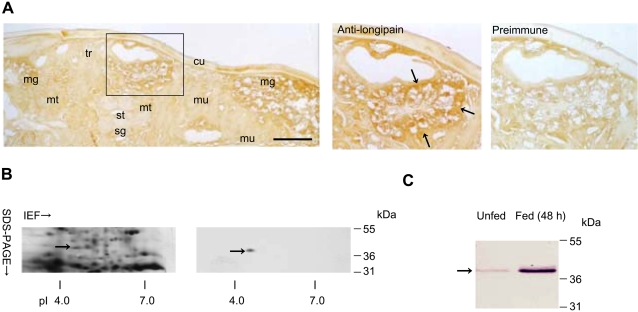
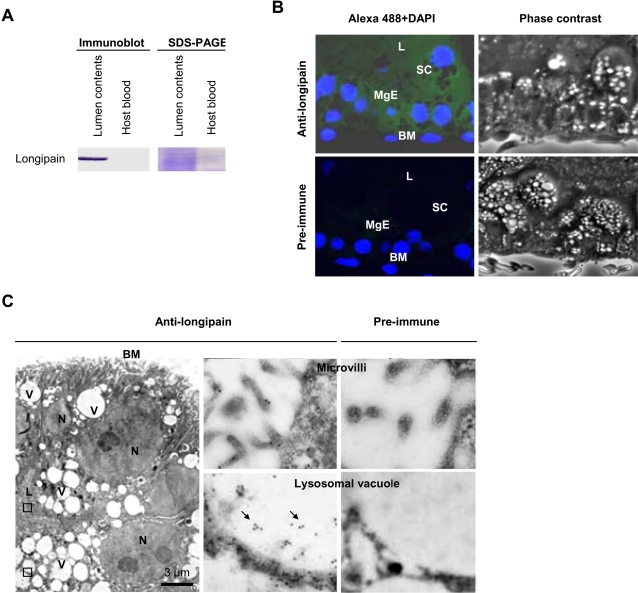
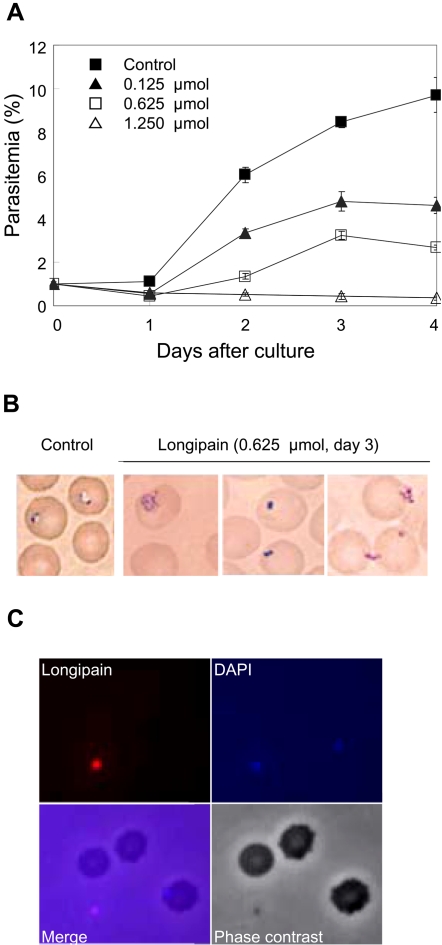
Vector ticks possess a unique system that enables them to digest large amounts of host blood and to transmit various animal and human pathogens, suggesting the existence of evolutionally acquired proteolytic mechanisms. We report here the molecular and reverse genetic characterization of a multifunctional cysteine protease, longipain, from the babesial parasite vector tick Haemaphysalis longicornis. Longipain shares structural similarity with papain-family cysteine proteases obtained from invertebrates and vertebrates. Endogenous longipain was mainly expressed in the midgut epithelium and was specifically localized at lysosomal vacuoles and possibly released into the lumen. Its expression was up-regulated by host blood feeding. Enzymatic functional assays using in vitro and in vivo substrates revealed that longipain hydrolysis occurs over a broad range of pH and temperature. Haemoparasiticidal assays showed that longipain dose-dependently killed tick-borne Babesia parasites, and its babesiacidal effect occurred via specific adherence to the parasite membranes. Disruption of endogenous longipain by RNA interference revealed that longipain is involved in the digestion of the host blood meal. In addition, the knockdown ticks contained an increased number of parasites, suggesting that longipain exerts a killing effect against the midgut-stage Babesia parasites in ticks. Our results suggest that longipain is essential for tick survival, and may have a role in controlling the transmission of tick-transmittable Babesia parasites.
蜱虫拥有一套独特的系统,使其能够消化大量宿主血液并传播各种动物和人类病原体,这表明存在进化获得的蛋白水解机制。我们在此报告了来自巴贝斯虫寄生虫载体蜱长角血蜱的一种多功能半胱氨酸蛋白酶——长蛋白酶的分子和反向遗传学特征。长蛋白酶与从无脊椎动物和脊椎动物获得的木瓜蛋白酶家族半胱氨酸蛋白酶具有结构相似性。内源性长蛋白酶主要在中肠上皮中表达,特异性定位于溶酶体空泡,并可能释放到肠腔中。其表达通过宿主血液进食而上调。使用体外和体内底物的酶功能测定表明,长蛋白酶在广泛的pH和温度范围内发生水解。杀血寄生虫试验表明,长蛋白酶剂量依赖性地杀死蜱传播的巴贝斯虫寄生虫,其杀巴贝斯虫作用通过特异性粘附于寄生虫膜而发生。通过RNA干扰破坏内源性长蛋白酶表明,长蛋白酶参与宿主血餐的消化。此外,敲低的蜱虫体内寄生虫数量增加,这表明长蛋白酶对蜱中肠阶段的巴贝斯虫寄生虫具有杀伤作用。我们的结果表明,长蛋白酶对蜱的生存至关重要,并且可能在控制蜱传播的巴贝斯虫寄生虫的传播中发挥作用。