Münch Anna, Stingl Lavinia, Jung Kirsten, Heermann Ralf
Ludwig-Maximilians-Universität München, Department Biologie I, Bereich Mikrobiologie, Maria-Ward-Str, 1a, D-80638 München, Germany.
BMC Genomics. 2008 May 19;9:229. doi: 10.1186/1471-2164-9-229.
Photorhabdus luminescens is a Gram-negative luminescent enterobacterium and a symbiote to soil nematodes belonging to the species Heterorhabditis bacteriophora. P.luminescens is simultaneously highly pathogenic to insects. This bacterium exhibits a complex life cycle, including one symbiotic stage characterized by colonization of the upper nematode gut, and a pathogenic stage, characterized by release from the nematode into the hemocoel of insect larvae, resulting in rapid insect death caused by bacterial toxins. P. luminescens appears to sense and adapt to the novel host environment upon changing hosts, which facilitates the production of factors involved in survival within the host, host-killing, and -exploitation.
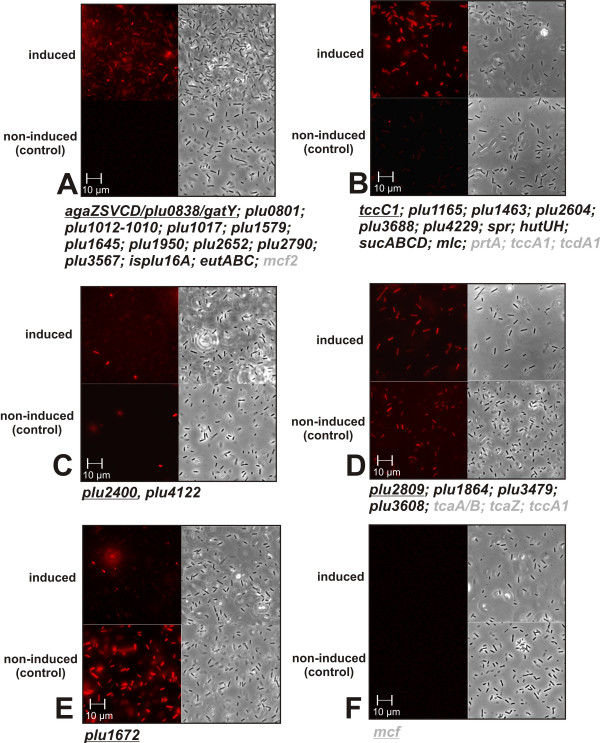
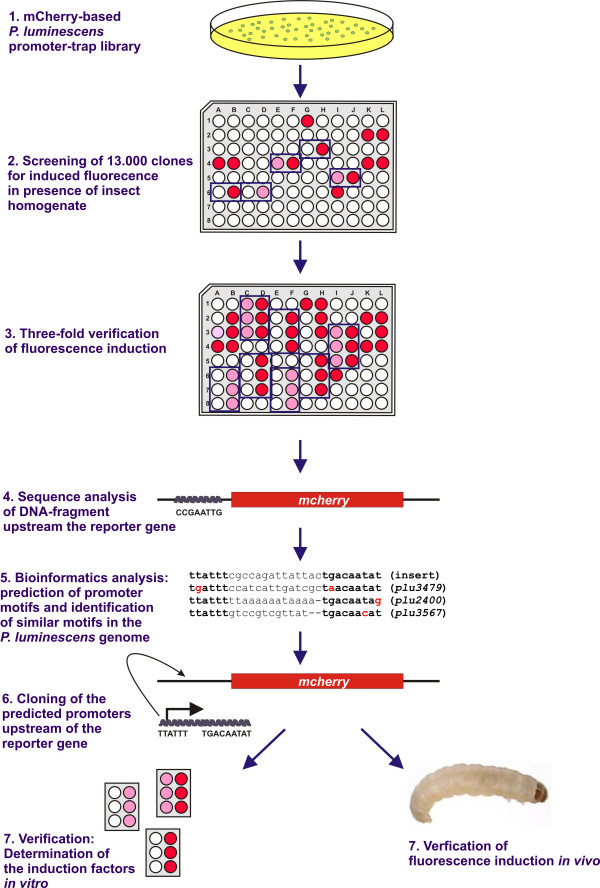
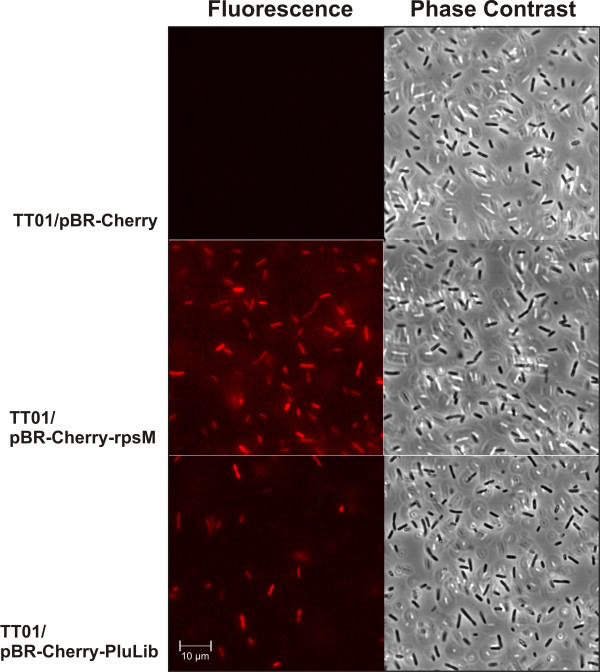
A differential fluorescence induction (DFI) approach was applied to identify genes that are up-regulated in the bacterium after infection of the insect host Galleria mellonella. For this purpose, a P. luminescens promoter-trap library utilizing the mCherry fluorophore as a reporter was constructed, and approximately 13,000 clones were screened for fluorescence induction in the presence of a G. mellonella larvae homogenate. Since P. luminescens has a variety of regulators that potentially sense chemical molecules, like hormones, the screen for up-regulated genes or operons was performed in vitro, excluding physicochemical signals like oxygen, temperature or osmolarity as variables. Clones (18) were obtained exhibiting at least 2.5-fold induced fluorescence and regarded as specific responders to insect homogenate. In combination with a bioinformatics approach, sequence motifs were identified in these DNA-fragments that are similar to 29 different promoters within the P. luminescens genome. By cloning each of the predicted promoters upstream of the reporter gene, induction was verified for 27 promoters in vitro, and for 24 promoters in viable G. mellonella larvae. Among the validated promoters are some known to regulate the expression of toxin genes, including tccC1 (encoding an insecticidal toxin complex), and others encoding putative toxins. A comparably high number of metabolic genes or operons were observed to be induced upon infection; among these were eutABC, hutUH, and agaZSVCD, which encode proteins involved in ethanolamine, histidine and tagatose degradation, respectively. The results reflect rearrangements in metabolism and the use of other metabolites available from the insect. Furthermore, enhanced activity of promoters controlling the expression of genes encoding enzymes linked to antibiotic production and/or resistance was observed. Antibiotic production and resistance may influence competition with other bacteria, and thus might be important for a successful infection. Lastly, several genes of unknown function were identified that may represent novel pathogenicity factors.
We show that a DFI screen is useful for identifying genes or operons induced by chemical stimuli, such as diluted insect homogenate. A bioinformatics comparison of motifs similar to known promoters is a powerful tool for identifying regulated genes or operons. We conclude that signals for the regulation of those genes or operons induced in P. luminescens upon insect infection may represent a wide variety of compounds that make up the insect host. Our results provide insight into the complex response to the host that occurs in a bacterial pathogen, particularly reflecting the potential for metabolic shifts and other specific changes associated with virulence.
发光杆菌是一种革兰氏阴性发光肠杆菌,是嗜线虫致病杆菌属土壤线虫的共生体。发光杆菌同时对昆虫具有高度致病性。这种细菌具有复杂的生命周期,包括一个以定殖于线虫上消化道为特征的共生阶段,以及一个以从线虫释放到昆虫幼虫血腔为特征的致病阶段,细菌毒素导致昆虫迅速死亡。发光杆菌在更换宿主时似乎能够感知并适应新的宿主环境,这有助于产生参与在宿主体内存活、杀死宿主和利用宿主的因子。
应用差异荧光诱导(DFI)方法来鉴定昆虫宿主大蜡螟感染后细菌中上调的基因。为此,构建了一个利用mCherry荧光团作为报告基因的发光杆菌启动子捕获文库,并在存在大蜡螟幼虫匀浆的情况下筛选了约13000个克隆的荧光诱导情况。由于发光杆菌有多种可能感知化学分子(如激素)的调节因子,因此上调基因或操纵子的筛选是在体外进行的,排除了氧气、温度或渗透压等物理化学信号作为变量。获得了18个克隆,其荧光诱导至少为2.5倍,被视为对昆虫匀浆的特异性反应者。结合生物信息学方法,在这些DNA片段中鉴定出与发光杆菌基因组内29个不同启动子相似的序列基序。通过在报告基因上游克隆每个预测的启动子,在体外验证了27个启动子的诱导情况,在活的大蜡螟幼虫中验证了24个启动子的诱导情况。在经过验证的启动子中,有一些已知可调节毒素基因的表达,包括tccC1(编码一种杀虫毒素复合物),以及其他编码假定毒素的基因。观察到感染后有相当数量的代谢基因或操纵子被诱导;其中包括eutABC、hutUH和agaZSVCD,它们分别编码参与乙醇胺、组氨酸和塔格糖降解的蛋白质。结果反映了代谢的重排以及对昆虫中其他可用代谢物的利用。此外,观察到控制与抗生素产生和/或抗性相关的酶编码基因表达的启动子活性增强。抗生素的产生和抗性可能影响与其他细菌的竞争,因此可能对成功感染很重要。最后,鉴定出几个功能未知的基因,它们可能代表新的致病因子。
我们表明DFI筛选可用于鉴定由化学刺激(如稀释的昆虫匀浆)诱导的基因或操纵子。与已知启动子相似基序的生物信息学比较是鉴定受调控基因或操纵子的有力工具。我们得出结论,发光杆菌在昆虫感染后诱导的那些基因或操纵子的调控信号可能代表构成昆虫宿主的多种化合物。我们的结果深入了解了细菌病原体对宿主的复杂反应,特别是反映了与毒力相关的代谢转变和其他特定变化的潜力。