Suzuki Hideo, Morris Jeffrey S, Li Yanan, Doll Mark A, Hein David W, Liu Jun, Jiao Li, Hassan Manal M, Day Rena S, Bondy Melissa L, Abbruzzese James L, Li Donghui
Department of Gastrointestinal Medical Oncology, The University of Texas MD Anderson Cancer Center, 1515 Holcombe Boulevard, Houston, TX 77030, USA.
Carcinogenesis. 2008 Jun;29(6):1184-91. doi: 10.1093/carcin/bgn085. Epub 2008 May 21.
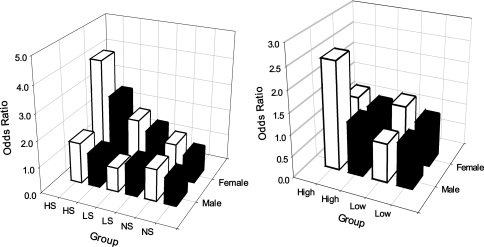
Aromatic amines, N-nitroso compounds and heterocyclic amines are suspected human pancreatic carcinogens. Cytochrome P450 (CYP) 1A2, N-acetyltransferase (NAT) 1, NAT2 and sulfotransferase (SULT) are enzymes involved in the metabolism of these carcinogens. To test the hypothesis that genetic variations in carcinogen metabolism modify the risk of pancreatic cancer (PC), we investigated the effect of single-nucleotide polymorphisms (SNPs) of the CYP1A2, NAT1, NAT2 and SULT1A1 gene on modification of the risk of PC in a hospital-based study of 755 patients with pancreatic adenocarcinoma and 636 healthy frequency-matched controls. Smoking and dietary mutagen exposure information was collected by personal interviews. Genotypes were determined using the polymerase chain reaction-restriction fragment length polymorphism and Taqman methods. Odds ratios (ORs) and 95% confidence intervals (CIs) were estimated using unconditional multivariate logistic regression analysis. We observed no significant main effects of any of these genes on the risk of PC. The CYP1A2 and NAT1 but not SULT1A1 and NAT2 genotypes showed significant interactions with heavy smoking in women not men. In contrast, a significant interaction between NAT1 genotype and dietary mutagen intake on modifying the risk of PC were observed among men but not women. The OR (95% CI) of PC was 2.23 (1.33-3.72) and 2.54 (1.51-4.25) for men having the NAT110 and a higher intake of 2-amino-1-methyl-6-phenylimidazo[4,5-b]pyridine and benzo[a]pyrene, respectively, compared with individuals having no NAT110 or a lower intake of these dietary mutagens. These data suggest the existence of gender-specific susceptibility to tobacco carcinogen and dietary mutagen exposure in PC.
芳香胺、N-亚硝基化合物和杂环胺被怀疑是人类胰腺癌致癌物。细胞色素P450(CYP)1A2、N-乙酰转移酶(NAT)1、NAT2和磺基转移酶(SULT)是参与这些致癌物代谢的酶。为了检验致癌物代谢中的基因变异会改变胰腺癌(PC)风险这一假设,我们在一项基于医院的研究中,调查了CYP1A2、NAT1、NAT2和SULT1A1基因的单核苷酸多态性(SNP)对755例胰腺腺癌患者和636例频率匹配的健康对照者PC风险改变的影响。通过个人访谈收集吸烟和饮食诱变剂暴露信息。使用聚合酶链反应-限制性片段长度多态性和Taqman方法确定基因型。使用无条件多变量逻辑回归分析估计比值比(OR)和95%置信区间(CI)。我们未观察到这些基因中的任何一个对PC风险有显著的主要影响。CYP1A2和NAT1基因型(而非SULT1A1和NAT2基因型)在女性而非男性中与大量吸烟存在显著交互作用。相反,在男性而非女性中观察到NAT1基因型与饮食诱变剂摄入之间在改变PC风险方面存在显著交互作用。与没有NAT110或这些饮食诱变剂摄入量较低的个体相比,携带NAT110且2-氨基-1-甲基-6-苯基咪唑[4,5-b]吡啶和苯并[a]芘摄入量较高的男性患PC的OR(95%CI)分别为2.23(1.33 - 3.72)和2.54(1.51 - 4.25)。这些数据表明在PC中存在对烟草致癌物和饮食诱变剂暴露的性别特异性易感性。