Hanson Beate, van der Werken Chris, Stengel Dirk
AO Foundation, Clinical Investigation and Documentation, Dübendorf, Switzerland.
BMC Musculoskelet Disord. 2008 May 24;9:73. doi: 10.1186/1471-2474-9-73.
The routine removal of orthopaedic fixation devices after fracture healing remains an issue of debate. There are no evidence-based guidelines on this matter, and little is known on surgeons' practice and perceived effectiveness of implant removal in different clinical settings.
A 41-item questionnaire was distributed to 730 attendees of the AO Principles and Masters Courses of Operative Fracture Treatment in Davos, Switzerland, to assess their attitudes towards removal of different types of implants, and perceived benefits and risks with this common procedure.
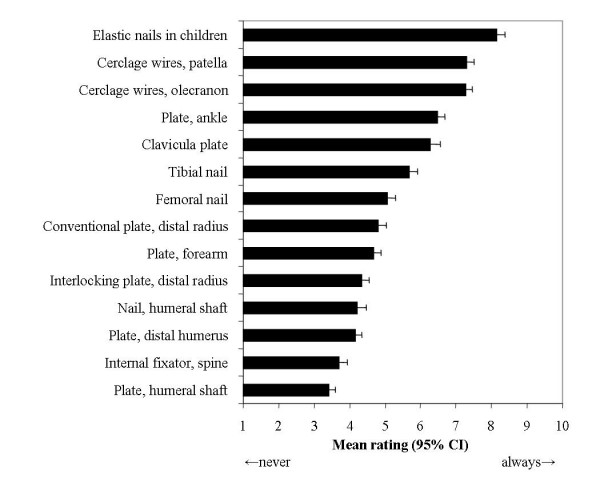
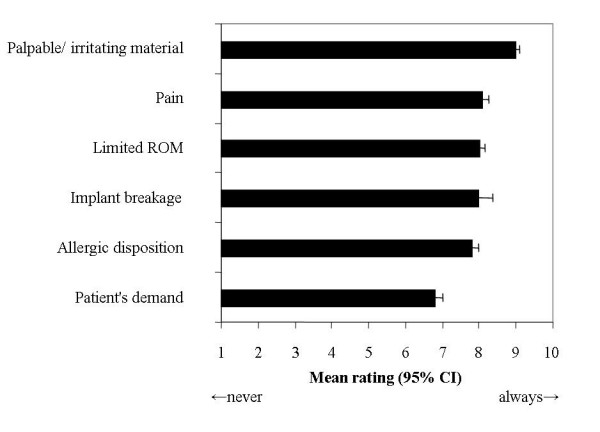
The response rate was 655/730 (89.7%), representing 54.6% of all 1199 course attendees. Surgeons from 65 countries (571 males and 84 females, mean age 39 +/- SD 9 years) took part in the survey. Fifty-eight percent of the participants did not agree that routine implant removal is necessary, and 49% and 58% did not agree that indwelling implants pose an excess risk for fractures or general adverse effects. Forty-eight percent felt that removal is riskier than leaving the implant in situ. Implant removal in symptomatic patients was rated to be moderately effective (mean rating on a 10-point-scale, 5.8, 95% confidence interval 5.7-6.0). Eighty-five percent of all participants agreed that implant removal poses a burden to hospital resources. Surgeons were undetermined whether implant removal is adequately reimbursed by payers of health care services (44% "I-don't-know"-answers).
Many surgeons refuse a routine implant removal policy, and do not believe in clinically significant adverse effects of retained metal implants. Given the frequency of the procedure in orthopaedic departments worldwide, there is an urgent need for a large randomized trial to determine the efficacy and effectiveness of implant removal with regard to patient-centred outcomes.
骨折愈合后常规取出骨科内固定装置仍是一个有争议的问题。在这个问题上没有基于证据的指南,对于外科医生在不同临床情况下取出植入物的做法以及所认为的有效性了解甚少。
向瑞士达沃斯AO骨折手术治疗原则与大师课程的730名参会者发放了一份包含41个条目的问卷,以评估他们对不同类型植入物取出的态度,以及对这一常见操作所认为的益处和风险。
回复率为655/730(89.7%),占所有1199名课程参会者的54.6%。来自65个国家的外科医生(571名男性和84名女性,平均年龄39±标准差9岁)参与了调查。58%的参与者不同意常规取出植入物是必要的,49%和58%的参与者不同意留置植入物会增加骨折风险或产生一般不良反应。48%的人认为取出植入物比留在原位风险更大。对有症状患者取出植入物的效果被评为中等有效(10分制平均评分5.8,95%置信区间5.7 - 6.0)。85%的参与者同意取出植入物会给医院资源带来负担。外科医生不确定医疗服务支付方是否对植入物取出给予了足够的补偿(44%回答“我不知道”)。
许多外科医生拒绝常规取出植入物的政策,并且不相信留存金属植入物会产生具有临床意义的不良反应。鉴于全球骨科科室中该操作的频繁程度,迫切需要进行一项大型随机试验,以确定就以患者为中心的结果而言取出植入物的疗效和有效性。