Schröder Ewald, Brennan Jonathan P, Eaton Philip
Dept. of Cardiology, St. Thomas' Hospital, King's College London, London SE1 7EH, UK.
Am J Physiol Heart Circ Physiol. 2008 Jul;295(1):H425-33. doi: 10.1152/ajpheart.00017.2008. Epub 2008 May 23.
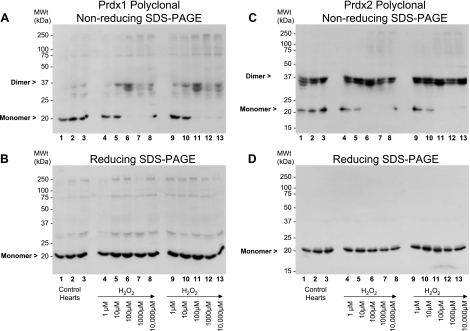
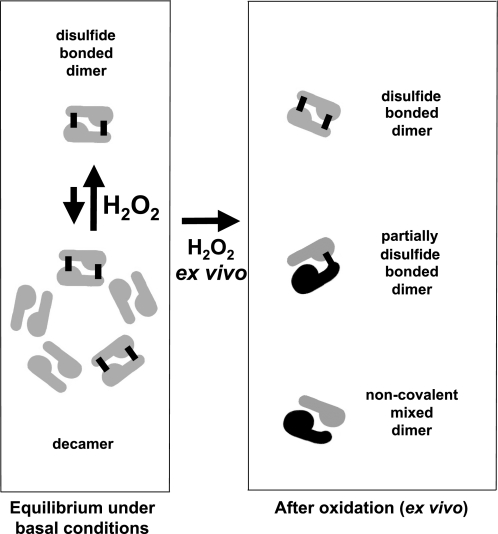
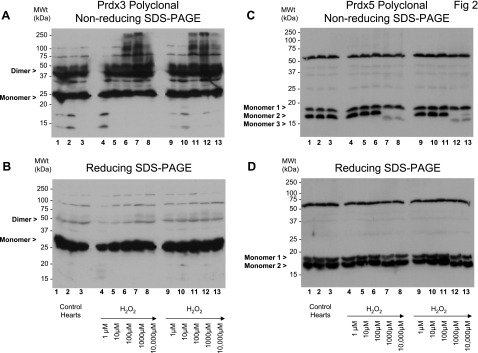
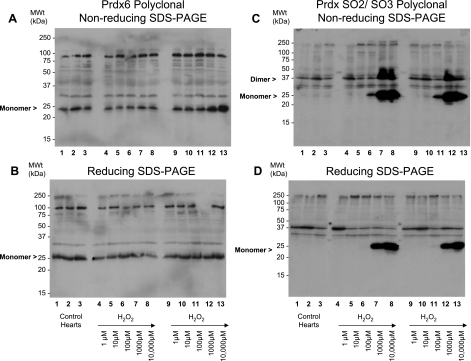
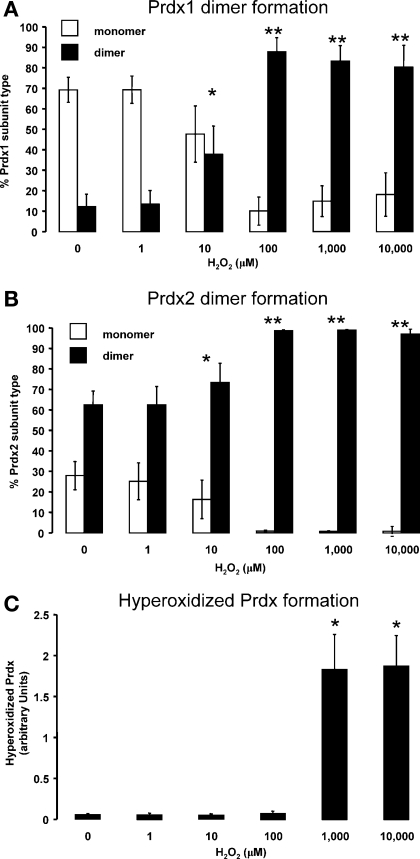
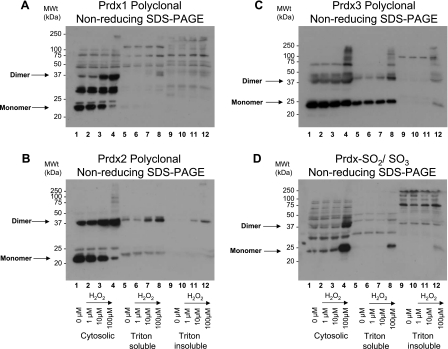
Peroxiredoxins (Prdxs), a family of antioxidant and redox-signaling proteins, are plentiful within the heart; however, their cardiac functions are poorly understood. These studies were designed to characterize the complex changes in Prdxs induced by oxidant stress in rat myocardium. Hydrogen peroxide, a Prdx substrate, was used as the model oxidant pertinent to redox signaling during health and to injury at higher concentrations. Rat hearts were aerobically perfused with a broad concentration range of hydrogen peroxide by the Langendorff method, homogenized, and analyzed by immunoblotting. Heart extracts were also analyzed by size-exclusion chromatography under nondenaturing conditions. Hydrogen peroxide-induced changes in disulfide bond formation, nonreversible oxidation of cysteine (hyperoxidation), and subcellular localization were determined. Hydrogen peroxide induced an array of changes in the myocardium, including formation of disulfide bonds that were intermolecular for Prdx1, Prdx2, and Prdx3 but intramolecular within Prdx5. For Prdx1, Prdx2, and Prdx5, disulfide bond formation can be approximated to an EC(50) of 10-100, 1-10, and 100-1,000 microM peroxide, respectively. Hydrogen peroxide induced hyperoxidation, not just within monomeric Prdx (by SDS-PAGE), but also within Prdx disulfide dimers, and reflects a flexibility within the dimeric unit. Prdx oxidation was also associated with movement from the cytosolic to the membrane and myofilament-enriched fractions. In summary, Prdxs undergo a complex series of redox-dependent structural changes in the heart in response to oxidant challenge with its substrate hydrogen peroxide.
过氧化物酶(Prdxs)是一类抗氧化和氧化还原信号蛋白,在心脏中含量丰富;然而,它们在心脏中的功能却鲜为人知。这些研究旨在描述大鼠心肌中氧化应激诱导的Prdxs的复杂变化。过氧化氢是Prdxs的底物,被用作与健康期间氧化还原信号相关以及高浓度时与损伤相关的模型氧化剂。采用Langendorff法用宽浓度范围的过氧化氢对大鼠心脏进行有氧灌注,匀浆后通过免疫印迹分析。还在非变性条件下通过尺寸排阻色谱法对心脏提取物进行分析。测定了过氧化氢诱导的二硫键形成、半胱氨酸不可逆氧化(超氧化)和亚细胞定位的变化。过氧化氢在心肌中诱导了一系列变化,包括Prdx1、Prdx2和Prdx3分子间二硫键的形成,但Prdx5分子内二硫键的形成。对于Prdx1、Prdx2和Prdx5,二硫键形成的半数有效浓度(EC50)分别约为10 - 100、1 - 10和100 - 1000微摩尔/升的过氧化物。过氧化氢不仅在单体Prdx(通过SDS - PAGE)中诱导超氧化,而且在Prdx二硫键二聚体中也诱导超氧化,这反映了二聚体单元内的灵活性。Prdx氧化还与从细胞质向富含膜和肌丝的组分转移有关。总之,在心脏中,Prdxs响应其底物过氧化氢的氧化应激挑战,经历了一系列复杂的氧化还原依赖性结构变化。