Sarkozy Anna, Digilio Maria Cristina, Dallapiccola Bruno
IRCCS-CSS, San Giovanni Rotondo and CSS-Mendel Institute, Viale Regina Elena 261, 00198, Rome, Italy.
Orphanet J Rare Dis. 2008 May 27;3:13. doi: 10.1186/1750-1172-3-13.
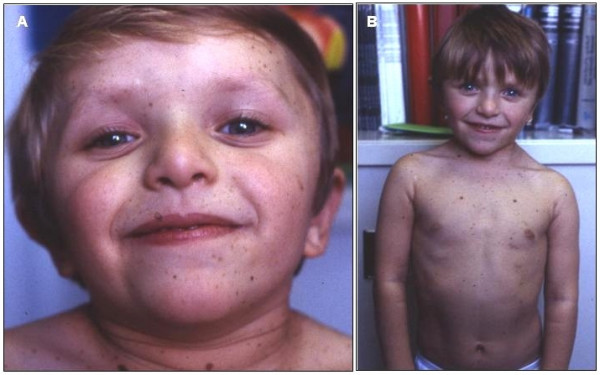
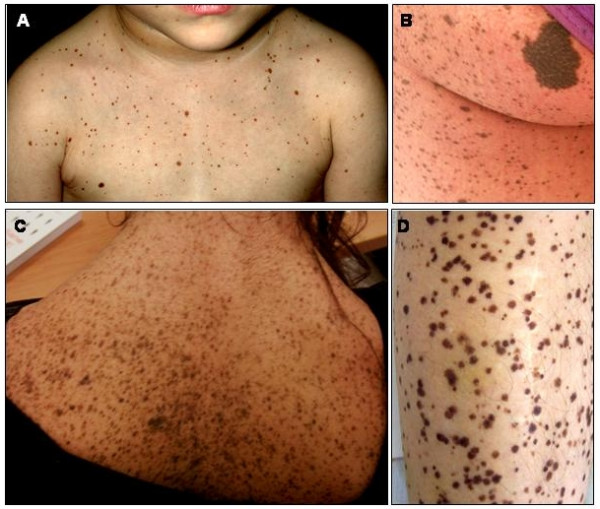
LEOPARD syndrome (LS, OMIM 151100) is a rare multiple congenital anomalies condition, mainly characterized by skin, facial and cardiac anomalies. LEOPARD is an acronym for the major features of this disorder, including multiple Lentigines, ECG conduction abnormalities, Ocular hypertelorism, Pulmonic stenosis, Abnormal genitalia, Retardation of growth, and sensorineural Deafness. About 200 patients have been reported worldwide but the real incidence of LS has not been assessed. Facial dysmorphism includes ocular hypertelorism, palpebral ptosis and low-set ears. Stature is usually below the 25th centile. Cardiac defects, in particular hypertrophic cardiomyopathy mostly involving the left ventricle, and ECG anomalies are common. The lentigines may be congenital, although more frequently manifest by the age of 4-5 years and increase throughout puberty. Additional common features are café-au-lait spots (CLS), chest anomalies, cryptorchidism, delayed puberty, hypotonia, mild developmental delay, sensorineural deafness and learning difficulties. In about 85% of the cases, a heterozygous missense mutation is detected in exons 7, 12 or 13 of the PTPN11 gene. Recently, missense mutations in the RAF1 gene have been found in two out of six PTPN11-negative LS patients. Mutation analysis can be carried out on blood, chorionic villi and amniotic fluid samples. LS is largely overlapping Noonan syndrome and, during childhood, Neurofibromatosis type 1-Noonan syndrome. Diagnostic clues of LS are multiple lentigines and CLS, hypertrophic cardiomyopathy and deafness. Mutation-based differential diagnosis in patients with borderline clinical manifestations is warranted. LS is an autosomal dominant condition, with full penetrance and variable expressivity. If one parent is affected, a 50% recurrence risk is appropriate. LS should be suspected in foetuses with severe cardiac hypertrophy and prenatal DNA test may be performed. Clinical management should address growth and motor development and congenital anomalies, in particular cardiac defects that should be monitored annually. Hypertrophic cardiomyopathy needs careful risk assessment and prophylaxis against sudden death in patients at risk. Hearing should be evaluated annually until adulthood. With the only exception of ventricular hypertrophy, adults with LS do not require special medical care and long-term prognosis is favourable.
豹皮综合征(LS,OMIM 151100)是一种罕见的多发性先天性异常疾病,主要特征为皮肤、面部和心脏异常。LEOPARD是该疾病主要特征的首字母缩写,包括多发性雀斑样痣、心电图传导异常、眼距增宽、肺动脉狭窄、生殖器异常、生长发育迟缓以及感音神经性耳聋。全球已报道约200例患者,但LS的实际发病率尚未评估。面部畸形包括眼距增宽、上睑下垂和低位耳。身高通常低于第25百分位。心脏缺陷,特别是主要累及左心室的肥厚型心肌病以及心电图异常较为常见。雀斑样痣可能是先天性的,不过更常见于4 - 5岁时出现,并在整个青春期增多。其他常见特征包括咖啡牛奶斑(CLS)、胸部异常、隐睾、青春期延迟、肌张力减退、轻度发育迟缓、感音神经性耳聋和学习困难。在约85%的病例中,可在PTPN11基因的外显子7、12或13中检测到杂合错义突变。最近,在6例PTPN11基因阴性的LS患者中有2例发现了RAF1基因的错义突变。可对血液、绒毛膜绒毛和羊水样本进行突变分析。LS与努南综合征在很大程度上重叠,在儿童期还与1型神经纤维瘤病 - 努南综合征重叠。LS的诊断线索为多发性雀斑样痣和CLS、肥厚型心肌病和耳聋。对于临床表现不典型的患者,基于突变的鉴别诊断是必要的。LS是一种常染色体显性疾病,具有完全外显率和可变表达性。如果一方父母患病,复发风险为50%。对于有严重心脏肥大的胎儿应怀疑患有LS,并可进行产前DNA检测。临床管理应关注生长发育和运动发育以及先天性异常,尤其是心脏缺陷,应每年进行监测。肥厚型心肌病需要仔细的风险评估,并对有风险的患者预防猝死。应每年评估听力直至成年。除心室肥大外,成年LS患者不需要特殊医疗护理,长期预后良好。