Dufresne Alexis, Ostrowski Martin, Scanlan David J, Garczarek Laurence, Mazard Sophie, Palenik Brian P, Paulsen Ian T, de Marsac Nicole Tandeau, Wincker Patrick, Dossat Carole, Ferriera Steve, Johnson Justin, Post Anton F, Hess Wolfgang R, Partensky Frédéric
Université Paris 6 and CNRS, UMR 7144, Station Biologique, 29682 Roscoff, France.
Genome Biol. 2008;9(5):R90. doi: 10.1186/gb-2008-9-5-r90. Epub 2008 May 28.
The picocyanobacterial genus Synechococcus occurs over wide oceanic expanses, having colonized most available niches in the photic zone. Large scale distribution patterns of the different Synechococcus clades (based on 16S rRNA gene markers) suggest the occurrence of two major lifestyles ('opportunists'/'specialists'), corresponding to two distinct broad habitats ('coastal'/'open ocean'). Yet, the genetic basis of niche partitioning is still poorly understood in this ecologically important group.
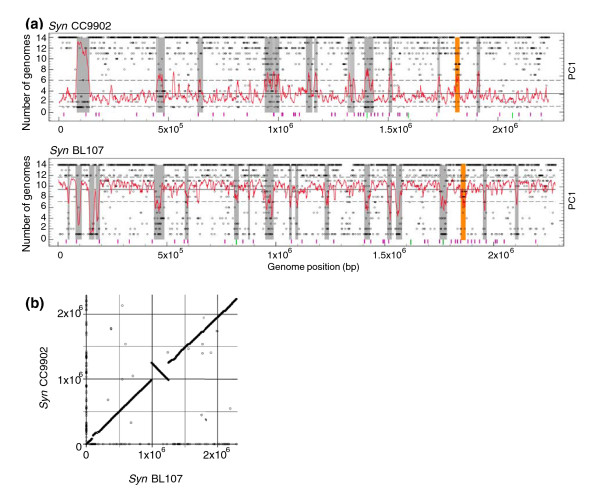
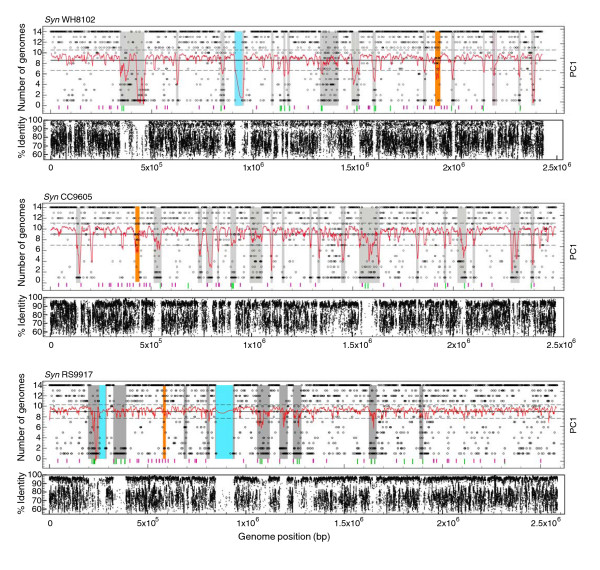
Here, we compare the genomes of 11 marine Synechococcus isolates, representing 10 distinct lineages. Phylogenies inferred from the core genome allowed us to refine the taxonomic relationships between clades by revealing a clear dichotomy within the main subcluster, reminiscent of the two aforementioned lifestyles. Genome size is strongly correlated with the cumulative lengths of hypervariable regions (or 'islands'). One of these, encompassing most genes encoding the light-harvesting phycobilisome rod complexes, is involved in adaptation to changes in light quality and has clearly been transferred between members of different Synechococcus lineages. Furthermore, we observed that two strains (RS9917 and WH5701) that have similar pigmentation and physiology have an unusually high number of genes in common, given their phylogenetic distance.
We propose that while members of a given marine Synechococcus lineage may have the same broad geographical distribution, local niche occupancy is facilitated by lateral gene transfers, a process in which genomic islands play a key role as a repository for transferred genes. Our work also highlights the need for developing picocyanobacterial systematics based on genome-derived parameters combined with ecological and physiological data.
蓝藻聚球藻属广泛分布于广阔的海洋区域,已在光合层占据了大多数可利用的生态位。不同聚球藻进化枝(基于16S rRNA基因标记)的大规模分布模式表明存在两种主要的生活方式(“机会主义者”/“专家型”),对应于两种不同的广泛栖息地(“沿海”/“开阔海洋”)。然而,在这个具有重要生态意义的类群中,生态位划分的遗传基础仍知之甚少。
在这里,我们比较了11株海洋聚球藻分离株的基因组,它们代表了10个不同的谱系。从核心基因组推断的系统发育使我们能够通过揭示主要亚群内的明显二分法来完善进化枝之间的分类关系,这让人想起上述两种生活方式。基因组大小与高变区(或“岛”)的累积长度密切相关。其中一个高变区包含了大多数编码捕光藻胆体杆状复合体的基因,参与对光质变化的适应,并且显然已在不同聚球藻谱系的成员之间转移。此外,我们观察到,鉴于它们的系统发育距离,两株具有相似色素沉着和生理学特征的菌株(RS9917和WH5701)有异常多的共同基因。
我们提出,虽然给定海洋聚球藻谱系的成员可能具有相同的广泛地理分布,但局部生态位占据是由侧向基因转移促成的,在这个过程中,基因组岛作为转移基因的储存库发挥着关键作用。我们的工作还强调了基于基因组衍生参数结合生态和生理数据来发展蓝藻系统学的必要性。