Department of Plant Biology, Carnegie Institution of Washington, Panama Street, Stanford, CA 94305, USA.
Biotechnol Biofuels. 2008 Jun 3;1(1):11. doi: 10.1186/1754-6834-1-11.
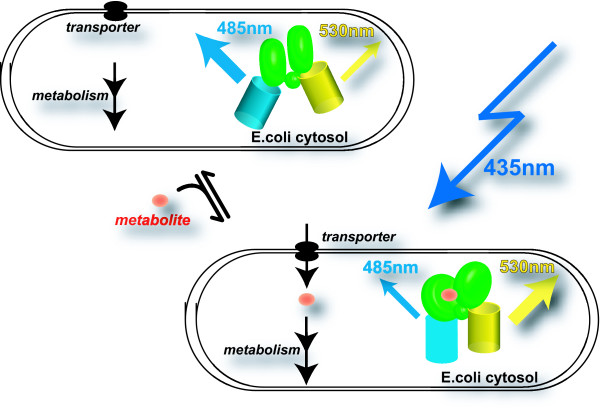
Engineering microorganisms to improve metabolite flux requires detailed knowledge of the concentrations and flux rates of metabolites and metabolic intermediates in vivo. Fluorescence resonance energy transfer sensors represent a promising technology for measuring metabolite levels and corresponding rate changes in live cells. These sensors have been applied successfully in mammalian and plant cells but potentially could also be used to monitor steady-state levels of metabolites in microorganisms using fluorimetric assays. Sensors for hexose and pentose carbohydrates could help in the development of fermentative microorganisms, for example, for biofuels applications. Arabinose is one of the carbohydrates to be monitored during biofuels production from lignocellulose, while maltose is an important degradation product of starch that is relevant for starch-derived biofuels production.
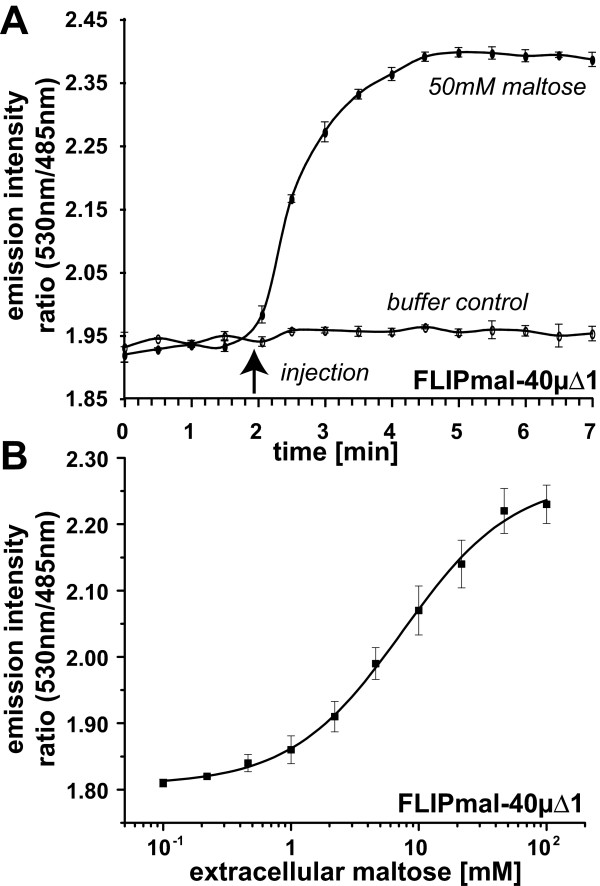
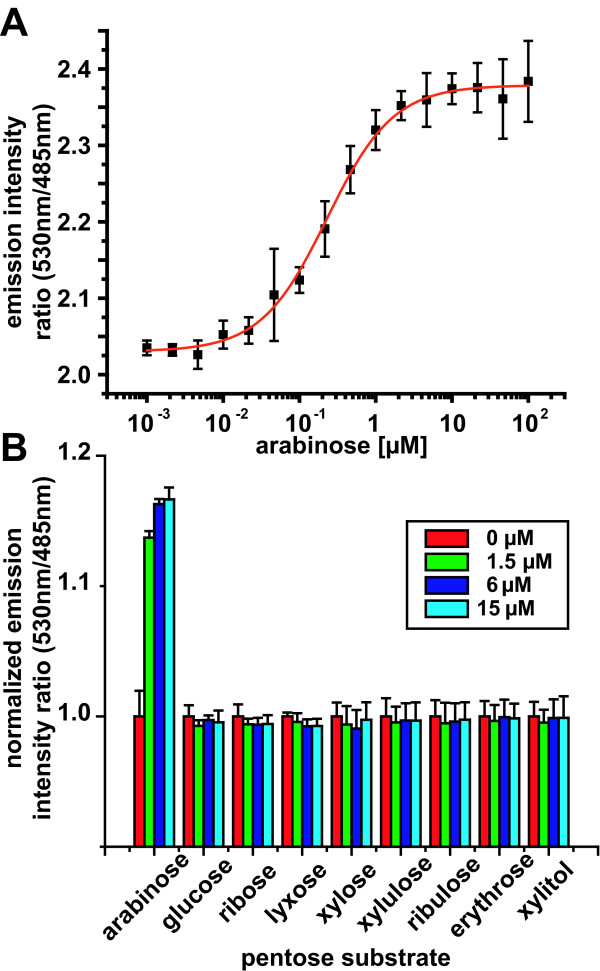
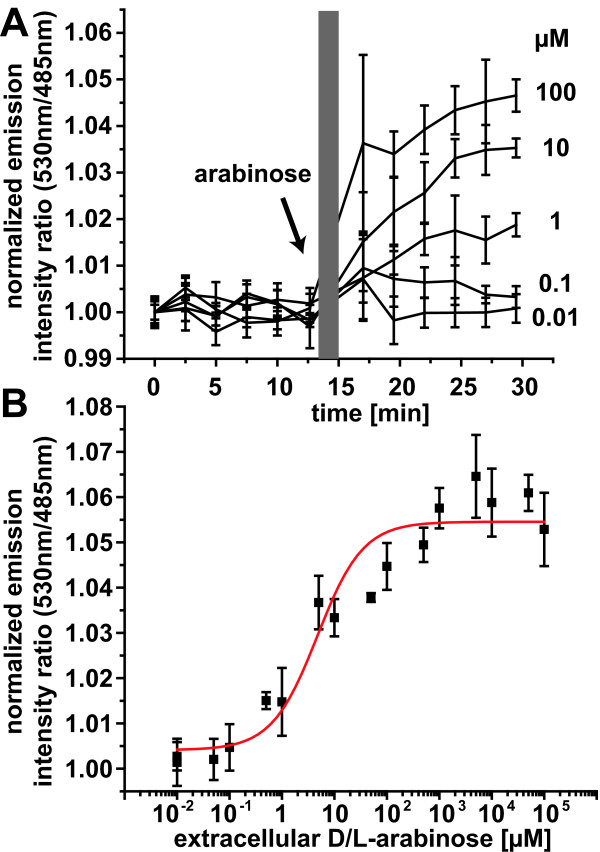
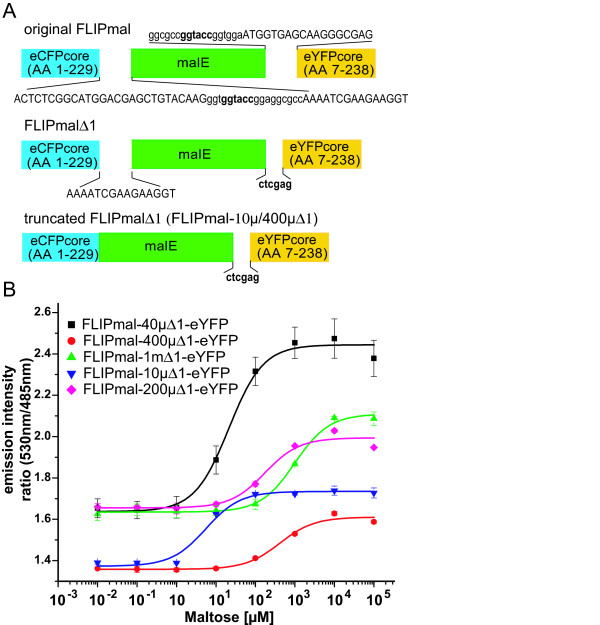
An Escherichia coli expression vector compatible with phage lambda recombination technology was constructed to facilitate sensor construction and was used to generate a novel fluorescence resonance energy transfer sensor for arabinose. In parallel, a strategy for improving the sensor signal was applied to construct an improved maltose sensor. Both sensors were expressed in the cytosol of E. coli and sugar accumulation was monitored using a simple fluorimetric assay of E. coli cultures in microtiter plates. In the case of both nanosensors, the addition of the respective ligand led to concentration-dependent fluorescence resonance energy transfer responses allowing quantitative analysis of the intracellular sugar levels at given extracellular supply levels as well as accumulation rates.
The nanosensor destination vector combined with the optimization strategy for sensor responses should help to accelerate the development of metabolite sensors. The new carbohydrate fluorescence resonance energy transfer sensors can be used for in vivo monitoring of sugar levels in prokaryotes, demonstrating the potential of such sensors as reporter tools in the development of metabolically engineered microbial strains or for real-time monitoring of intracellular metabolite during fermentation.
为了改善代谢物通量,需要对微生物体内代谢物和代谢中间产物的浓度和通量有详细的了解。荧光共振能量转移传感器是一种很有前途的技术,可以测量活细胞中的代谢物水平和相应的速率变化。这些传感器已成功应用于哺乳动物和植物细胞,但也有可能用于通过荧光测定法监测微生物中代谢物的稳态水平。用于己糖和戊糖碳水化合物的传感器可能有助于发酵微生物的开发,例如用于生物燃料应用。阿拉伯糖是生物燃料生产过程中需要监测的碳水化合物之一,而麦芽糖是与淀粉衍生生物燃料生产相关的淀粉降解产物。
构建了一个与噬菌体λ重组技术兼容的大肠杆菌表达载体,以促进传感器的构建,并用于生成一种新的阿拉伯糖荧光共振能量转移传感器。同时,应用了一种提高传感器信号的策略来构建改良的麦芽糖传感器。这两个传感器都在大肠杆菌的细胞质中表达,并使用大肠杆菌培养物的微滴定板荧光测定法监测糖的积累。在这两种纳米传感器的情况下,各自配体的添加导致了浓度依赖性的荧光共振能量转移响应,允许在给定的胞外供应水平下对细胞内糖水平进行定量分析以及积累速率。
纳米传感器目标载体与传感器响应的优化策略相结合,应该有助于加速代谢物传感器的发展。新的碳水化合物荧光共振能量转移传感器可用于原核生物中糖水平的体内监测,证明了这些传感器作为代谢工程微生物菌株开发中的报告工具或在发酵过程中实时监测细胞内代谢物的潜力。