Yap Shue-Fang, Ho Pei-Shan, Kuo Hsiao-Ching, Yang Yi-Hsin
Faculty of Dental Hygiene, College of Dental Medicine, Kaohsiung Medical University, Taiwan.
BMC Public Health. 2008 Jun 5;8:199. doi: 10.1186/1471-2458-8-199.
Betel quid is the fourth most common used substance in the world after tobacco, alcohol and caffeine. Although factors related to betel quid chewing or cessation of behaviors were reported previously, few studies simultaneously compared both behaviors in the same population. In addition, it is essential to consider time-to-event concept, since the chance of developing or stopping habit may vary over time. The purpose of this study was to compare the risk factors for commencement and cessation of betel quid chewing behaviors in a time-to-event setting.
A stratified multi-stage cluster sampling with selection probabilities proportional to size (PPS) was designed for Taiwanese adults with aged 18 years old and above. Kaplan-Meier estimates and Cox proportional hazard regression models were used to compare and calculate the hazard rate ratios for related factors to commencement or cessation of chewing habits.
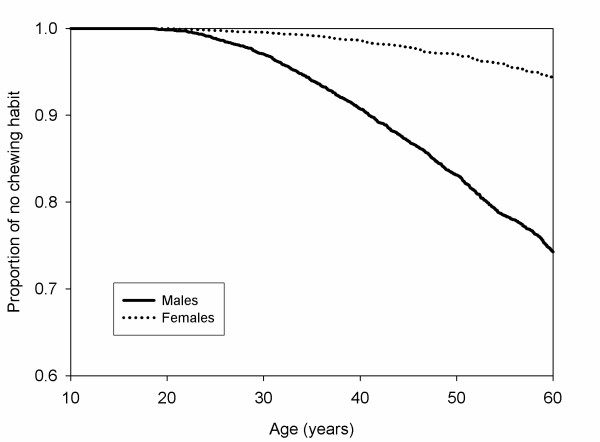
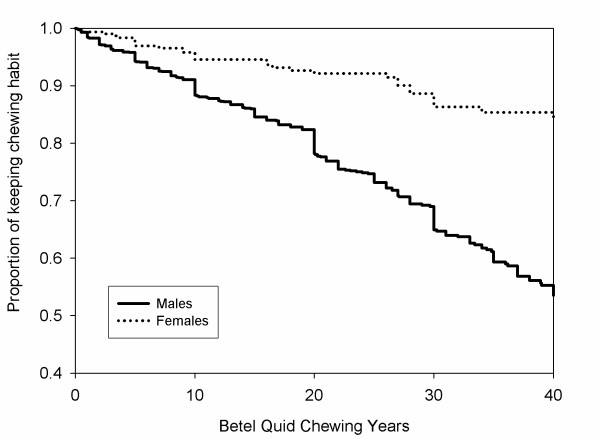
In Taiwan, men had a higher betel quid chewing rate (M: 20.9%, W: 1.2%), but woman chewers had a lower cessation rate (M: 27.5%, W: 12.7%). The hazard rate ratio (HRR) of having chewing habit changed from 4.22 (men vs women) univariately to 1.38 multivariablely, which indicated gender differences were confounded by other factors. In multivariable analysis, the risk factors of gender, education and ethnicity were significantly associated with both starting and cessation of betel quid chewing behavior. The factors of occupation, cigarette smoking and alcohol drinking were only associated with starting habit.
Commencement or cessation of chewing behavior involves a scenario of time, hence it is preferable to use a time-to-event approach for the comparison. The cessation rates of betel quid chewing were decreasingly associated with the daily consumption of betel quid. Hence, reducing of daily amount in betel quid cessation program may be associated with future stopping habit.
槟榔是世界上继烟草、酒精和咖啡因之后第四大最常用的物质。尽管先前已有与嚼槟榔或戒除该行为相关的因素报道,但很少有研究在同一人群中同时比较这两种行为。此外,考虑事件发生时间的概念很重要,因为养成或戒除习惯的可能性可能会随时间而变化。本研究的目的是在事件发生时间的背景下比较开始和停止嚼槟榔行为的危险因素。
针对18岁及以上的台湾成年人设计了一种按规模比例概率抽样(PPS)的分层多阶段整群抽样方法。采用Kaplan-Meier估计法和Cox比例风险回归模型来比较和计算与开始或停止咀嚼习惯相关因素的风险率比。
在台湾,男性嚼槟榔的比例较高(男性:20.9%,女性:1.2%),但女性嚼槟榔者的戒除率较低(男性:27.5%,女性:12.7%)。有咀嚼习惯的风险率比(HRR)从单变量分析时的4.22(男性与女性相比)变为多变量分析时的1.38,这表明性别差异被其他因素所混淆。在多变量分析中,性别、教育程度和种族因素与开始和停止嚼槟榔行为均显著相关。职业、吸烟和饮酒因素仅与开始习惯有关。
咀嚼行为的开始或停止涉及一个时间场景,因此采用事件发生时间的方法进行比较更为可取。嚼槟榔的戒除率与槟榔的每日消费量呈负相关。因此,在槟榔戒除计划中减少每日用量可能与未来戒除习惯有关。