Staud Roland, Bovee Courtney E, Robinson Michael E, Price Donald D
Department of Medicine, University of Florida College of Medicine, Gainesville, FL 32610-0221, USA Department of Clinical & Health Psychology, University of Florida, Gainesville, FL 32610, USA Department of Neuroscience, University of Florida, Gainesville, FL 32610, USA Department of Oral Surgery, University of Florida, Gainesville, FL 32610, USA.
Pain. 2008 Oct 15;139(2):315-323. doi: 10.1016/j.pain.2008.04.024. Epub 2008 Jun 5.
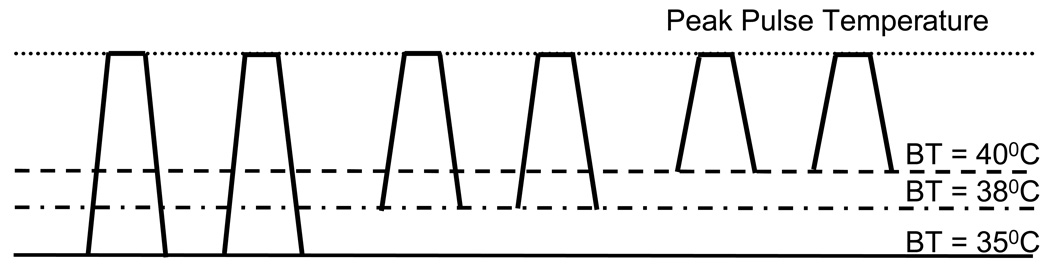
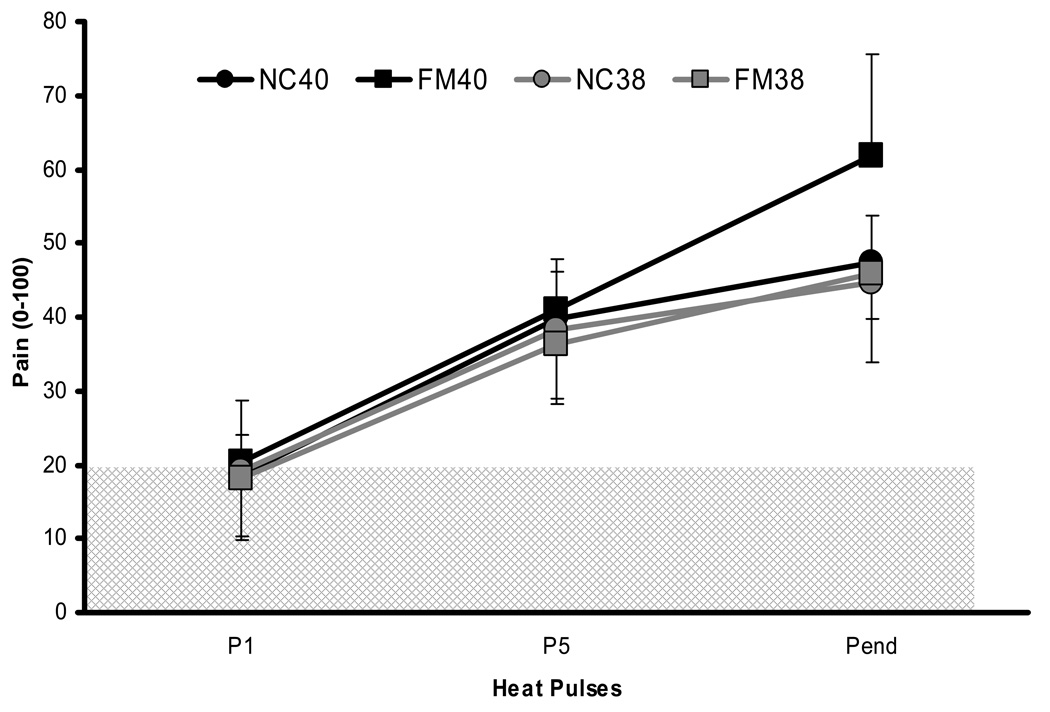
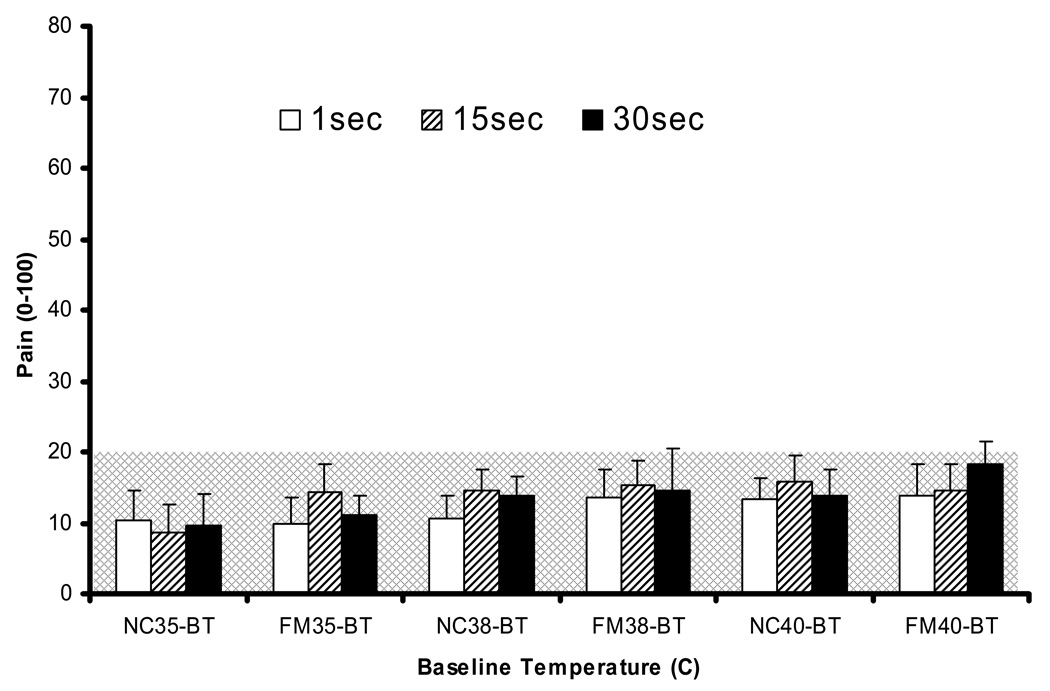
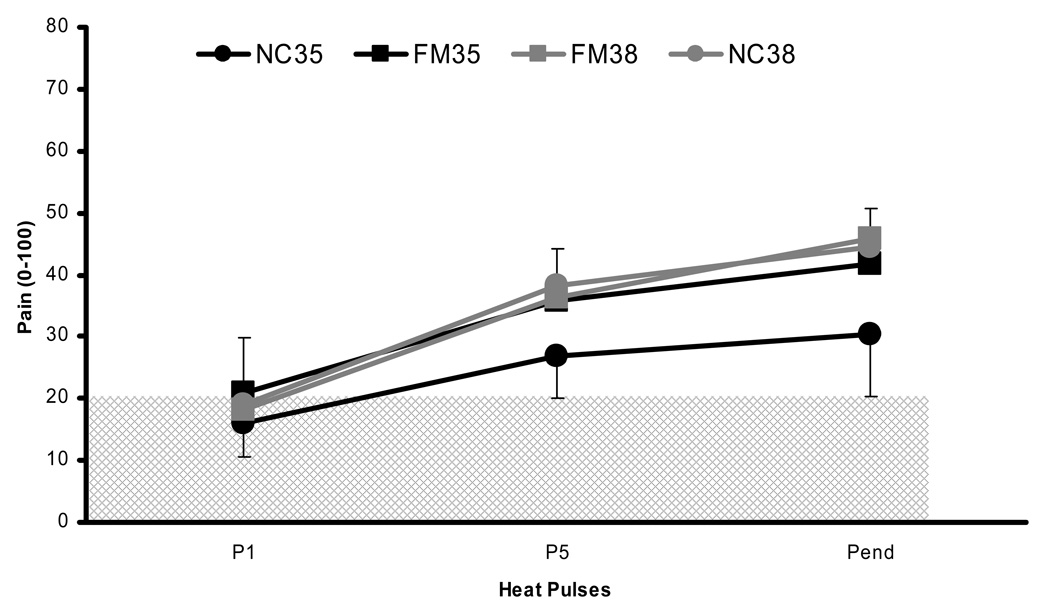
Temporal summation of "second pain" (TSSP) is considered to be the result of C-fiber-evoked responses of dorsal horn neurons, termed 'windup'. TSSP is dependent on stimulus frequency (> or=0.33Hz) and is relevant for central sensitization and chronic pain. We have previously shown that compared to normal controls (NC), fibromyalgia (FM) subjects show abnormal TSSP, requiring lower stimulus intensities/frequencies to achieve similar TSSP. However, it is unknown whether abnormal TSSP in FM is influenced by peripheral sensitization of C-fiber nociceptors and/or bias in pain ratings. Thus, we evaluated 14 FM subjects and 19 NC with pain threshold tests to selective C-fiber stimulation, 30s heat stimuli, and repetitive brief (1.5s) heat pulses at 0.33Hz using a contact heat stimulator (CHEPS). The intensity of heat pulses was varied to achieve maximal TSSP ratings of 45+/-10 (numerical pain scale 0-100) in both FM and NC groups. We found that NC and FM subjects had similar pain thresholds to C-fiber stimulation and yet FM subjects required lower heat pulse temperatures to generate the same magnitudes of TSSP (p<.05). This combination of findings does not support peripheral sensitization and suggests central TSSP abnormalities in FM subjects. In a second experiment, all aspects of individually adjusted TSSP heat pulses were kept the same except that the baseline temperature (BT) between heat pulses was surreptitiously alternated between 35 degrees C and 40 degrees C. These changes of BT resulted in significantly greater TSSP ratings of FM subjects compared to NC subjects, both at 35 degrees C and at 40 degrees C, but did not change their response to the first heat pulse of a stimulus train. These findings provide strong support for alterations of central pain sensitivity and not peripheral sensitization or rating bias as responsible for TSSP differences between NC and FM subjects.
“第二疼痛”的时间总和(TSSP)被认为是背角神经元C纤维诱发反应的结果,称为“windup”。TSSP取决于刺激频率(≥0.33Hz),与中枢敏化和慢性疼痛相关。我们之前已经表明,与正常对照组(NC)相比,纤维肌痛(FM)患者表现出异常的TSSP,达到相似的TSSP需要更低的刺激强度/频率。然而,FM患者中异常的TSSP是否受C纤维伤害感受器的外周敏化和/或疼痛评分偏差的影响尚不清楚。因此,我们使用接触热刺激器(CHEPS)对14名FM患者和19名NC进行了疼痛阈值测试,以评估对选择性C纤维刺激、30秒热刺激以及0.33Hz重复短暂(1.5秒)热脉冲的反应。改变热脉冲强度,以使FM组和NC组的最大TSSP评分均达到45±10(数字疼痛量表0 - 100)。我们发现,NC组和FM组对C纤维刺激的疼痛阈值相似,但FM组产生相同程度的TSSP需要更低的热脉冲温度(p<0.05)。这些结果组合不支持外周敏化,并提示FM患者存在中枢TSSP异常。在第二个实验中,单独调整的TSSP热脉冲的所有方面均保持相同,只是热脉冲之间的基线温度(BT)在35℃和40℃之间悄悄交替。这些BT变化导致FM患者的TSSP评分在35℃和40℃时均显著高于NC患者,但并未改变他们对刺激序列中第一个热脉冲的反应。这些发现有力地支持了中枢疼痛敏感性改变,而非外周敏化或评分偏差导致了NC组和FM组之间的TSSP差异。