Beeri Michal Schnaider, Davidson Michael, Silverman Jeremy M, Schmeidler James, Springer Ramit Ravona, Noy Shlomo, Goldbourt Uri
Department of Psychiatry, Mount Sinai School of Medicine, New York, NY 10029, USA.
J Clin Epidemiol. 2008 Nov;61(11):1161-8. doi: 10.1016/j.jclinepi.2007.09.011. Epub 2008 Jun 6.
The aim of the study was to examine the association of religious education and observance with dementia among participants in the Israeli Ischemic Heart Disease study.
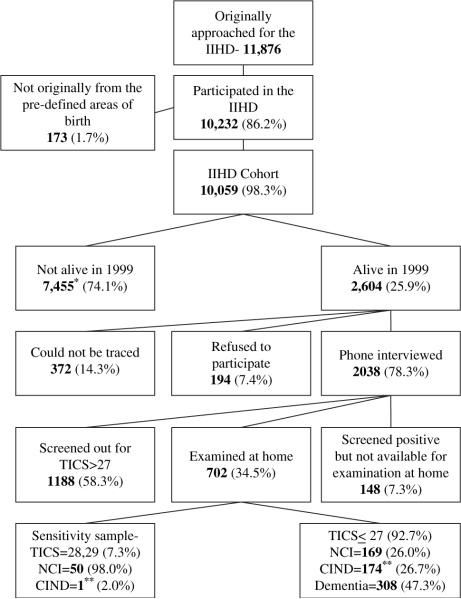
We assessed dementia in 1,890 participants among 2,604 survivors of 10,059 participants in the Israeli Ischemic Heart Disease study, a longitudinal investigation of the incidence and risk factors for cardiovascular disease among Jewish male civil servants in Israel. Face-to-face interviews were conducted with 651 subjects identified as possibly demented by the Modified Telephone Interview for Cognitive Status.
Of 1,628 subjects included in this analysis (mean age 82 at assessment), 308 (18.9%) had dementia. The prevalence rates of dementia (and odds ratios (ORs) relative to those with exclusively religious education, adjusted for age, area of birth, and socioeconomic status) were 27.1% for those with exclusively religious education, 12.6% (OR=0.49) for those with mixed education, and 16.1% (OR=0.76) for those with secular education. For religious self-definition and practice, the prevalence rates were 9.7%, 17.7%, 14.1%, 19.3%, and 28.8% for categories from least to most religious (ORs relative to the most religious: 0.43, 0.67, 0.48, 0.55).
Examining lifestyles associated with religiosity might shed light onto environmental risks for dementia. Mechanisms underlying these associations remain elusive.
本研究旨在探讨以色列缺血性心脏病研究参与者中宗教教育和宗教仪式与痴呆症之间的关联。
我们在以色列缺血性心脏病研究的10059名参与者中的2604名幸存者中的1890名参与者中评估了痴呆症,该研究是对以色列犹太男性公务员心血管疾病发病率和危险因素的纵向调查。对通过改良认知状态电话访谈被确定可能患有痴呆症的651名受试者进行了面对面访谈。
在纳入本次分析的1628名受试者(评估时平均年龄82岁)中,308名(18.9%)患有痴呆症。痴呆症的患病率(以及相对于仅接受宗教教育者的优势比(OR),根据年龄、出生地和社会经济地位进行调整)在仅接受宗教教育者中为27.1%,在接受混合教育者中为12.6%(OR = 0.49),在接受世俗教育者中为16.1%(OR = 0.76)。对于宗教自我定义和宗教实践,从宗教程度最低到最高的类别患病率分别为9.7%、17.7%、14.1%、19.3%和28.8%(相对于宗教程度最高者的OR:0.43、0.67、0.48、0.55)。
研究与宗教信仰相关的生活方式可能有助于揭示痴呆症的环境风险。这些关联背后的机制仍然难以捉摸。