Paffen Chris L E, Naber Marnix, Verstraten Frans A J
Helmholtz Institute and Experimental Psychology, Utrecht University, Utrecht, The Netherlands.
PLoS One. 2008 Jun 11;3(6):e2311. doi: 10.1371/journal.pone.0002311.
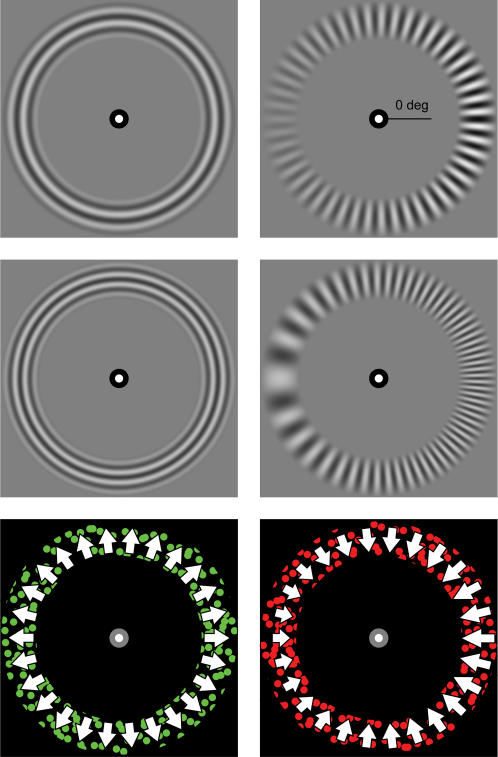
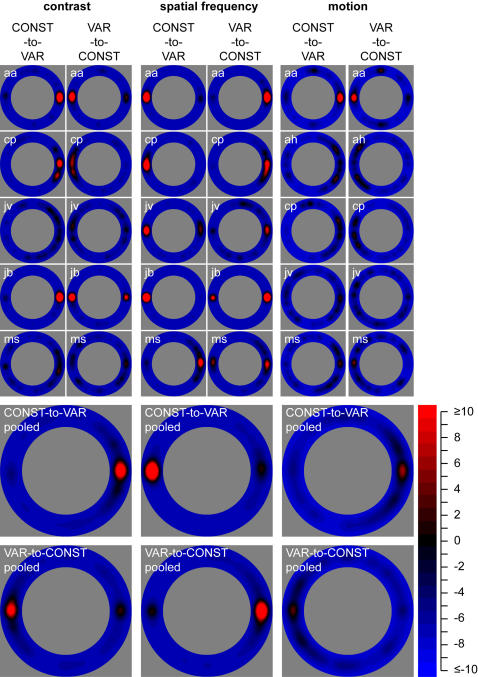
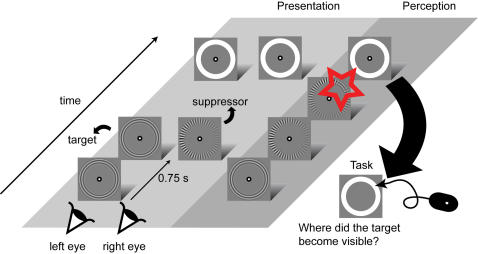
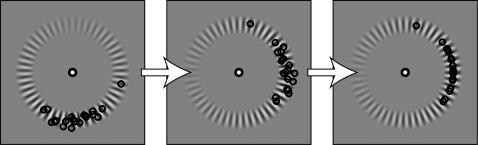
When the left and the right eye are simultaneously presented with incompatible images at overlapping retinal locations, an observer typically reports perceiving only one of the two images at a time. This phenomenon is called binocular rivalry. Perception during binocular rivalry is not stable; one of the images is perceptually dominant for a certain duration (typically in the order of a few seconds) after which perception switches towards the other image. This alternation between perceptual dominance and suppression will continue for as long the images are presented. A characteristic of binocular rivalry is that a perceptual transition from one image to the other generally occurs in a gradual manner: the image that was temporarily suppressed will regain perceptual dominance at isolated locations within the perceived image, after which its visibility spreads throughout the whole image. These gradual transitions from perceptual suppression to perceptual dominance have been labeled as traveling waves of perceptual dominance. In this study we investigate whether stimulus parameters affect the location at which a traveling wave starts. We varied the contrast, spatial frequency or motion speed in one of the rivaling images, while keeping the same parameter constant in the other image. We used a flash-suppression paradigm to force one of the rival images into perceptual suppression. Observers waited until the suppressed image became perceptually dominant again, and indicated the position at which this breakthrough from suppression occurred. Our results show that the starting point of a traveling wave during binocular rivalry is highly dependent on local stimulus parameters. More specifically, a traveling wave most likely started at the location where the contrast of the suppressed image was higher than that of the dominant one, the spatial frequency of the suppressed image was lower than that of the dominant one, and the motion speed of the suppressed image was higher than that of the dominant one. We suggest that a breakthrough from suppression to dominance occurs at the location where salience (the degree to which a stimulus element stands out relative to neighboring elements) of the suppressed image is higher than that of the dominant one. Our results further show that stimulus parameters affecting the temporal dynamics during continuous viewing of rival images described in other studies, also affect the spatial origin of traveling waves during binocular rivalry.
当左眼和右眼在重叠的视网膜位置同时呈现不相容的图像时,观察者通常报告一次只能感知到这两个图像中的一个。这种现象被称为双眼竞争。双眼竞争期间的感知并不稳定;其中一个图像在一段特定的持续时间内(通常为几秒左右)在感知上占主导地位,之后感知会切换到另一个图像。只要图像呈现,这种感知主导和抑制之间的交替就会持续。双眼竞争的一个特点是,从一个图像到另一个图像的感知转换通常以渐进的方式发生:暂时被抑制的图像会在感知图像内的孤立位置重新获得感知主导地位,之后其可见性会扩散到整个图像。这些从感知抑制到感知主导的渐进转换被标记为感知主导的行波。在本研究中,我们调查刺激参数是否会影响行波开始的位置。我们改变竞争图像之一的对比度、空间频率或运动速度,同时保持另一个图像的相同参数不变。我们使用闪光抑制范式将竞争图像之一强制进入感知抑制状态。观察者等待直到被抑制的图像再次在感知上占主导地位,并指出这种从抑制中突破发生的位置。我们的结果表明,双眼竞争期间行波的起始点高度依赖于局部刺激参数。更具体地说,行波最有可能在被抑制图像的对比度高于主导图像、被抑制图像的空间频率低于主导图像、被抑制图像的运动速度高于主导图像的位置开始。我们认为,从抑制到主导的突破发生在被抑制图像的显著性(刺激元素相对于相邻元素突出的程度)高于主导图像的位置。我们的结果进一步表明,影响其他研究中描述的连续观看竞争图像期间时间动态的刺激参数,也会影响双眼竞争期间行波的空间起源。