Onrust Simone, Smit Filip, Willemse Godelief, van den Bout Jan, Cuijpers Pim
Netherlands Institute of Mental Health and Addiction (Trimbos-instituut), P,O, Box 725, 3500 AS, Utrecht, The Netherlands.
BMC Health Serv Res. 2008 Jun 12;8:128. doi: 10.1186/1472-6963-8-128.
Despite a growing understanding of the effectiveness of bereavement interventions and the groups that benefit most from them, we know little about the cost-effectiveness of bereavement interventions.
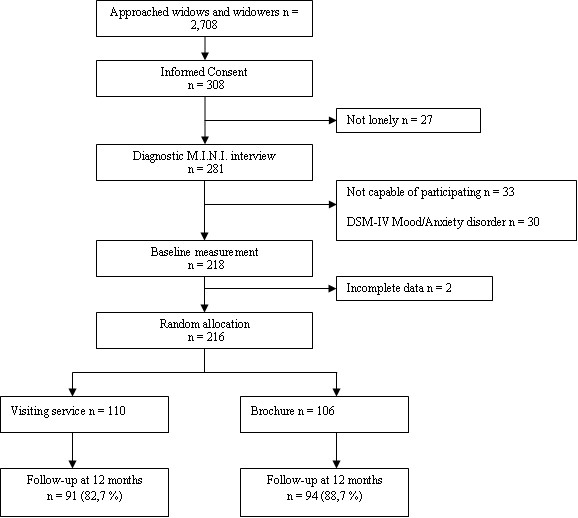
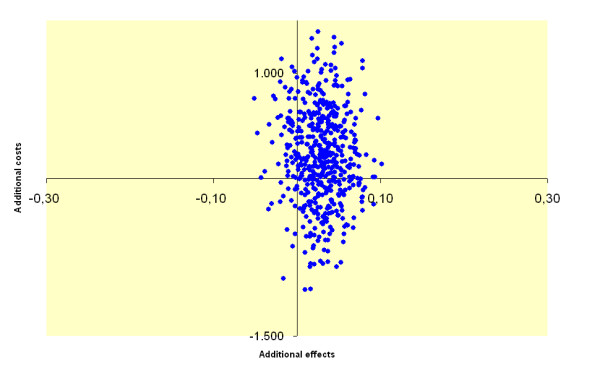
We conducted a cost-utility analysis alongside a randomized clinical trial on a visiting service for older widowed individuals (n=110) versus care as usual (CAU; n=106). The visiting service is a selective bereavement intervention that offers social support to lonely widows and widowers by a trained volunteer. Participants were contacted 6-9 months post-loss. Eleven percent of all contacted persons responded and eight percent participated in the trial. The primary outcome measure was quality adjusted life years (QALYs) gained (assessed with the EQ-5D), which is a generic measure of health status. Costs were calculated from a societal perspective excluding costs arising from productivity losses. Using the bootstrap method, we obtained the incremental cost utility ratio (ICUR), projected these on a cost-utility plane and presented as an acceptability curve.
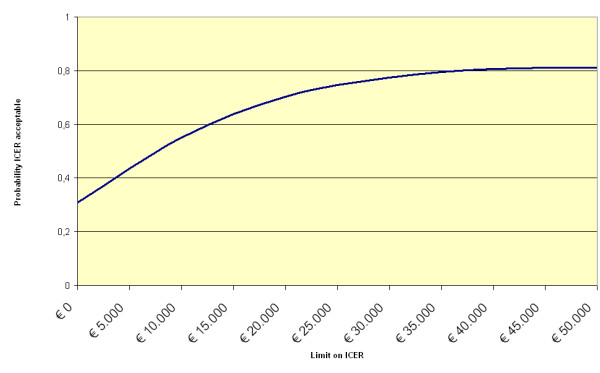
Overall, the experimental group demonstrated slightly better results against slightly higher costs. Whether the visiting service is acceptable depends on the willingness to pay: at a willingness to pay equal to zero per QALY gained, the visiting service has a probability of 31% of being acceptable; beyond euro20,000, the visiting service has a probability of 70% of being more acceptable than CAU.
Selective bereavement interventions like the visiting service will not produce large benefits from the health economic point of view, when targeted towards the entire population of all widowed individuals. We recommend that in depth analyses are conducted to identify who benefits most from this kind of interventions, and in what subgroups the incremental cost-utility is best. In the future bereavement interventions are then best directed to these groups.
Controlled trials ISRCTN17508307.
尽管人们对丧亲之痛干预措施的有效性以及最能从中受益的群体的认识不断加深,但我们对丧亲之痛干预措施的成本效益却知之甚少。
我们在一项针对老年丧偶者的探访服务(n = 110)与常规护理(CAU;n = 106)的随机临床试验中进行了成本效用分析。探访服务是一种选择性丧亲之痛干预措施,由经过培训的志愿者为孤独的寡妇和鳏夫提供社会支持。在丧亲后6 - 9个月联系参与者。所有被联系者中有11%做出回应,8%参与了试验。主要结局指标是获得的质量调整生命年(QALYs)(用EQ - 5D评估),这是一种通用的健康状况衡量指标。成本从社会角度计算,不包括因生产力损失产生的成本。使用自助法,我们获得了增量成本效用比(ICUR),将其投影到成本效用平面上并呈现为可接受性曲线。
总体而言,实验组在成本略高的情况下取得了略好的结果。探访服务是否可接受取决于支付意愿:在每获得一个QALY支付意愿等于零的情况下,探访服务有31%的概率被接受;超过20,000欧元时,探访服务有70%的概率比常规护理更可接受。
从健康经济学角度来看,像探访服务这样的选择性丧亲之痛干预措施针对所有丧偶个体的整个人口群体时,不会产生巨大益处。我们建议进行深入分析,以确定谁最能从这类干预措施中受益,以及在哪些亚组中增量成本效用最佳。未来丧亲之痛干预措施最好针对这些群体。
对照试验ISRCTN17508307