Department of General Medicine, Flinders Medical Centre, Adelaide, South Australia, Australia.
College of Medicine and Public Health, Flinders University, Adelaide, South Australia, Australia.
BMC Geriatr. 2018 Feb 5;18(1):41. doi: 10.1186/s12877-018-0736-0.
Prevalence of malnutrition in older hospitalized patients is 30%. Malnutrition is associated with poor clinical outcomes in terms of high morbidity and mortality and is costly for hospitals. Extended nutrition interventions improve clinical outcomes but limited studies have investigated whether these interventions are cost-effective.
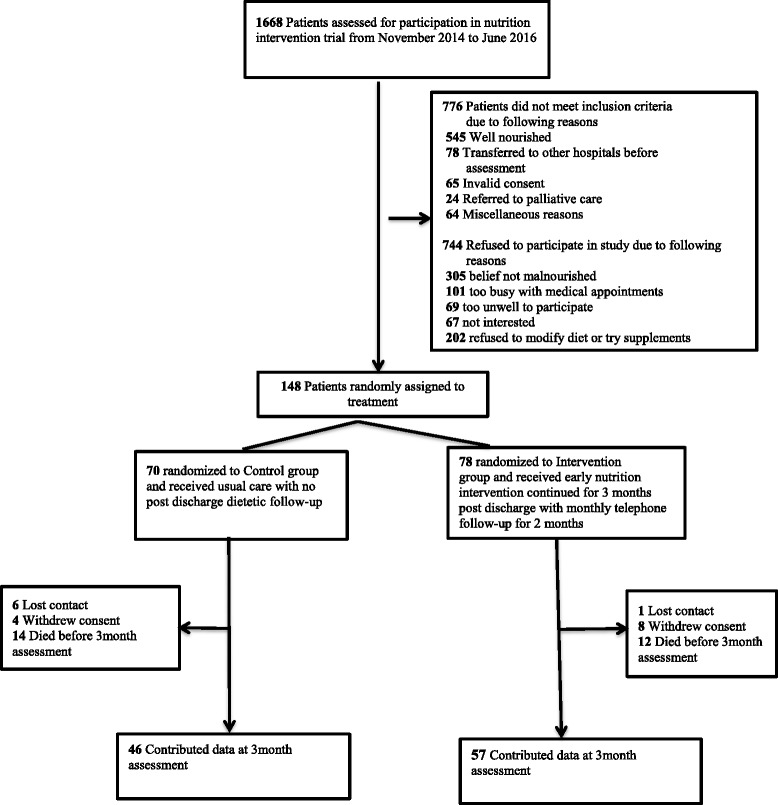
In this randomized controlled trial, 148 malnourished general medical patients ≥60 years were recruited and randomized to receive either an extended nutritional intervention or usual care. Nutrition intervention was individualized and started with 24 h of admission and was continued for 3 months post-discharge with a monthly telephone call whereas control patients received usual care. Nutrition status was confirmed by Patient generated subjective global assessment (PG-SGA) and health-related quality of life (HRQoL) was measured using EuroQoL 5D (EQ-5D-5 L) questionnaire at admission and at 3-months follow-up. A cost-effectiveness analysis was conducted for the primary outcome (incremental costs per unit improvement in PG-SGA) while a cost-utility analysis (CUA) was undertaken for the secondary outcome (incremental costs per quality adjusted life year (QALY) gained).
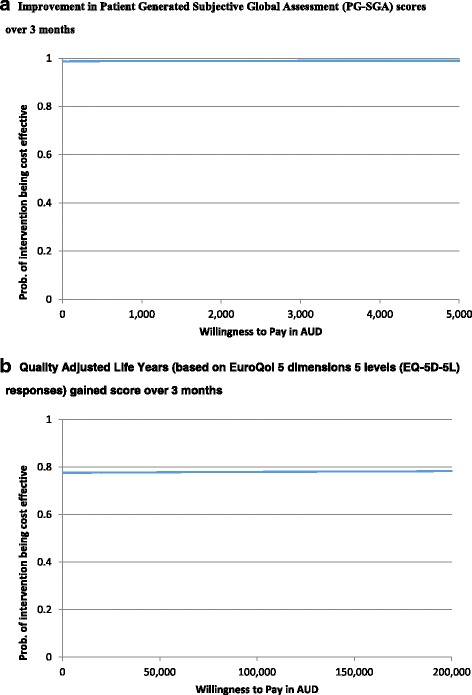
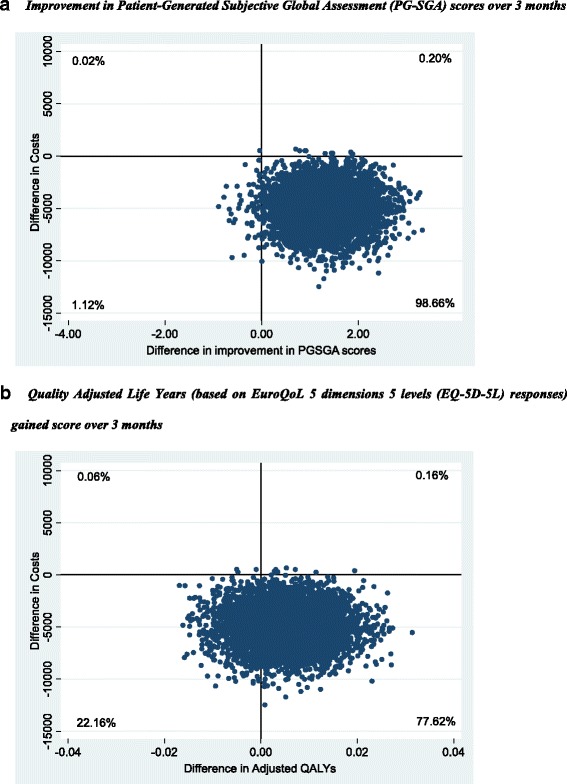
Nutrition status and HRQoL improved in intervention patients. Mean per included patient Australian Medicare costs were lower in intervention group compared to control arm (by $907) but these differences were not statistically significant (95% CI: -$2956 to $4854). The main drivers of higher costs in the control group were higher inpatient ($13,882 versus $13,134) and drug ($838 versus $601) costs. After adjusting outcomes for baseline differences and repeated measures, the intervention was more effective than the control with patients in this arm reporting QALYs gained that were higher by 0.0050 QALYs gained per patient (95% CI: -0.0079 to 0.0199). The probability of the intervention being cost-effective at willingness to pay values as low as $1000 per unit improvement in PG-SGA was > 98% while it was 78% at a willingness to pay $50,000 per QALY gained.
This health economic analysis suggests that the use of extended nutritional intervention in older general medical patients is likely to be cost-effective in the Australian health care setting in terms of both primary and secondary outcomes.
ACTRN No. 12614000833662 . Registered 6 August 2014.
在住院老年患者中,营养不良的患病率为 30%。营养不良与高发病率和死亡率相关的不良临床结局相关,并且对医院来说成本高昂。扩展营养干预可改善临床结局,但有限的研究调查了这些干预措施是否具有成本效益。
在这项随机对照试验中,招募了 148 名年龄在 60 岁以上的营养不良的普通内科患者,并随机分为接受扩展营养干预或常规护理的两组。营养干预是个体化的,从入院后 24 小时开始,并在出院后继续进行 3 个月的随访,每月进行一次电话随访,而对照组患者接受常规护理。通过患者生成的主观整体评估(PG-SGA)确认营养状况,在入院时和 3 个月随访时使用 EuroQoL 5D(EQ-5D-5L)问卷测量健康相关生活质量(HRQoL)。对主要结局(PG-SGA 每单位改善的增量成本)进行成本效果分析,对次要结局(每获得质量调整生命年(QALY)的增量成本)进行成本效用分析(CUA)。
干预组患者的营养状况和 HRQoL 均得到改善。与对照组相比,干预组每位纳入患者的澳大利亚医疗保险平均费用较低(低 907 澳元),但差异无统计学意义(95%CI:-2956 至 4854 澳元)。对照组较高的住院费用(13882 澳元比 13134 澳元)和药物费用(838 澳元比 601 澳元)是导致成本较高的主要因素。在调整了基线差异和重复测量的结果后,干预组比对照组更有效,该组患者报告的 QALY 增加了 0.0050(95%CI:-0.0079 至 0.0199)。在愿意为 PG-SGA 每单位改善支付低至 1000 澳元的情况下,干预措施具有成本效益的概率>98%,而在愿意为每获得一个 QALY 支付 50000 澳元的情况下,该概率为 78%。
这项健康经济学分析表明,在澳大利亚医疗保健环境中,对于普通内科老年患者使用扩展营养干预在主要和次要结局方面可能具有成本效益。
ACTRN 号 12614000833662。于 2014 年 8 月 6 日注册。